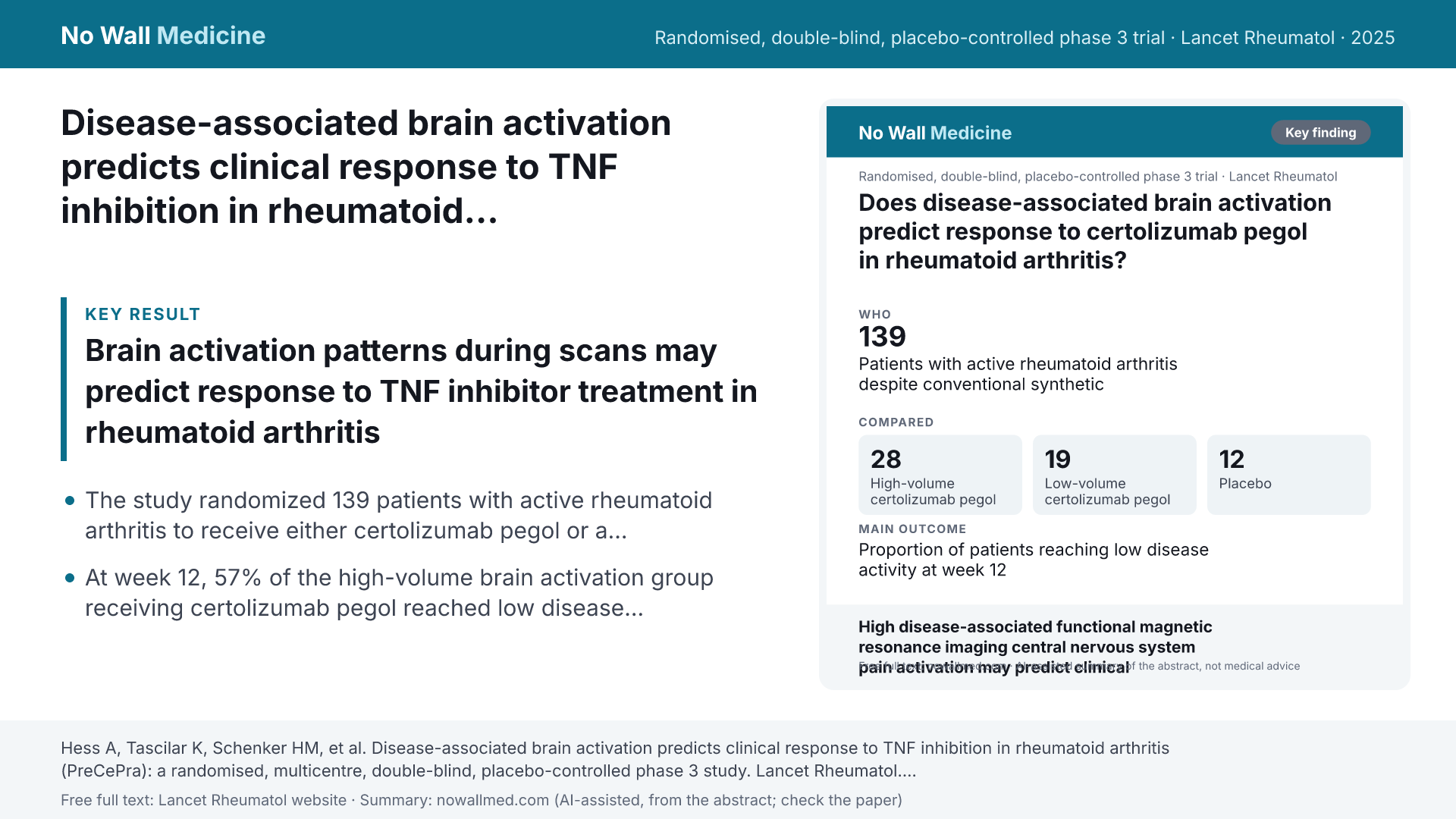
Brain activation patterns during scans may predict response to TNF inhibitor treatment in rheumatoid arthritis
Disease-associated brain activation predicts clinical response to TNF inhibition in rheumatoid arthritis (PreCePra): a randomised, multicentre, double-blind, placebo-controlled phase 3 study
Randomised, double-blind, placebo-controlled phase 3 trialBenefit found
Does disease-associated brain activation predict response to certolizumab pegol in rheumatoid arthritis?
Who
139
Patients with active rheumatoid arthritis despite conventional synthetic disease-modifying antirheumatic drug use · Six rheumatology centres in Germany, Portugal, and Serbia
Compared
28High-volume certolizumab pegol (57%)
19Low-volume certolizumab pegol (44%)
12Placebo (26%)
Main outcome
Proportion of patients reaching low disease activity at week 12
Bottom line: High disease-associated functional magnetic resonance imaging central nervous system pain activation may predict clinical response to certolizumab pegol.
Funded by: UCB Biopharma
Lancet Rheumatol · 2025-06-23Download image
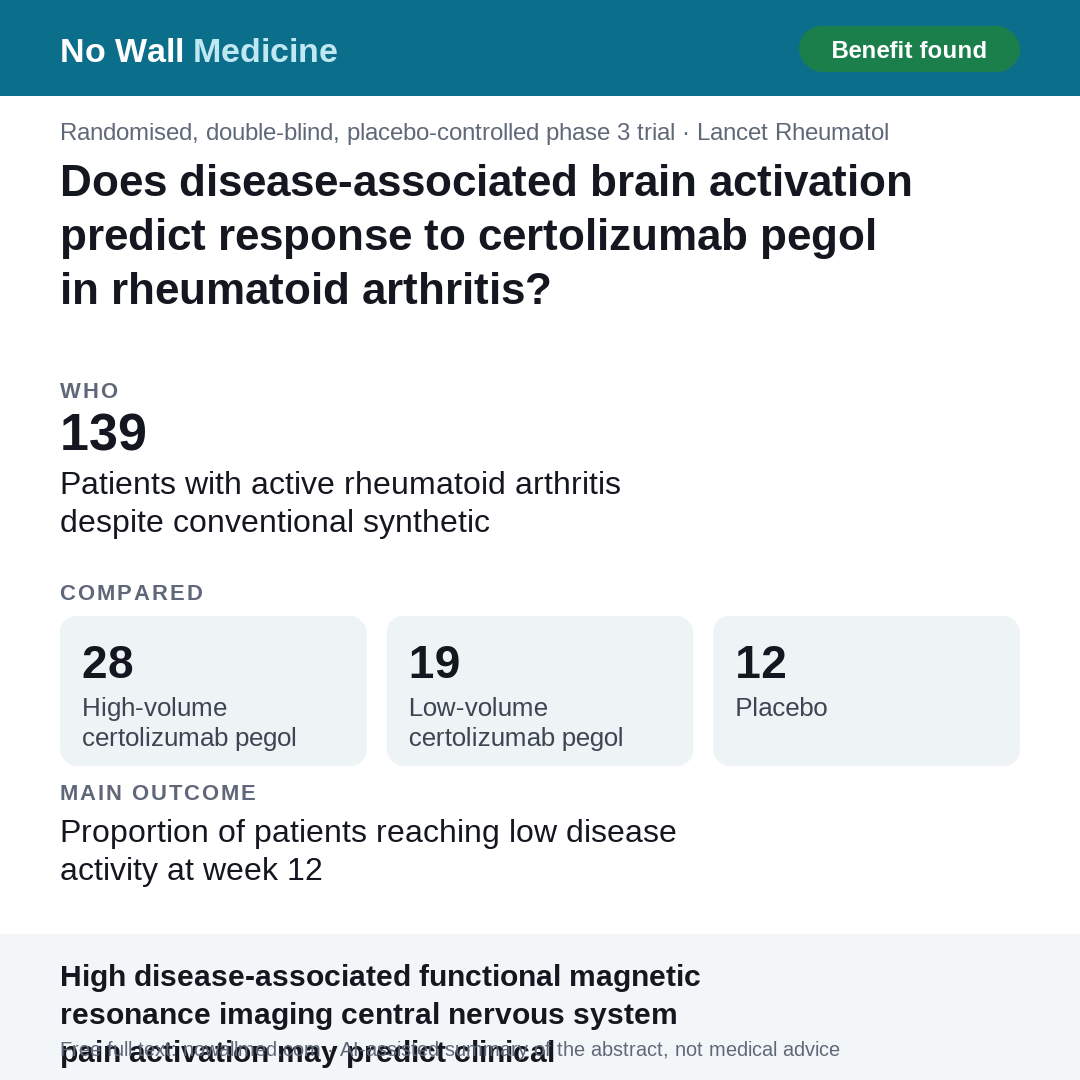
Clinical question: Does disease-associated brain activation predict response to certolizumab pegol in rheumatoid arthritis?
Why it matters: It is unknown if the amount of disease representation in the central nervous system can predict how patients will respond to TNF inhibitor therapy.
Key points
- The study randomized 139 patients with active rheumatoid arthritis to receive either certolizumab pegol or a placebo, stratified by brain pain activation levels measured by functional magnetic resonance imaging.
- At week 12, 57% of the high-volume brain activation group receiving certolizumab pegol reached low disease activity compared to 26% in the placebo group.
- The response in the high-volume certolizumab pegol group was significantly different from placebo, but the low-volume group was not significantly different from placebo.
Headline and key points written with AI from the paper’s abstract, with every number checked against it. Read the paper before relying on them.
Was this summary helpful?
Abstract
Background
Rheumatoid arthritis is an inflammatory disease frequently treated with TNF inhibitors. Little is known about predictors of response to TNF inhibitors. Because clinical response in rheumatoid arthritis is measured by composite scores containing subjective patient-orientated domains (eg, pain and global disease perception), we hypothesised that patients with high disease representation in the CNS might respond better to TNF inhibitors than patients with less CNS disease representation. Methods
We did a phase 3, multicentre, double-blind, placebo-controlled, parallel-group randomised trial in patients with active rheumatoid arthritis at six rheumatology centres across Germany, Portugal, and Serbia. All patients had a functional MRI (fMRI) brain scan at baseline to measure CNS pain activation. Patients (aged ≥18 years) with active rheumatoid arthritis who have active disease despite the use of at least one conventional synthetic disease-modifying antirheumatic drug were stratified according to fMRI (high volume or low volume) and were randomly assigned 2:1 using a randomisation list generated by a study statistician to treatment with the TNF inhibitor certolizumab pegol (400 mg subcutaneously on weeks 0, 2, and 4, and 200 mg once every 2 weeks for maximum 24 weeks) or placebo. Patients and clinicians were masked to allocation. The primary outcome was the proportion of patients reaching low disease activity (Disease Activity Score in 28 joints ≤3·2) at week 12, analysed in the intention-to-treat population. There was no lived experience involvement in study design. The study was registered with EudraCT (2013-000337-13) and ClinicalTrials.gov (NCT01864265). Findings
Between Sept 3, 2013, and Jan 10, 2020, 148 patients with rheumatoid arthritis were screened and 139 (99 [71%] women and 40 [29%] men) were randomly assigned to the high-volume certolizumab pegol group (n=49), the low-volume certolizumab pegol group (n=43), or the placebo group (n=47). Low disease activity was reached by 28 (57%) in the high-volume certolizumab pegol group, 19 (44%) in the low-volume certolizumab pegol group, and 12 (26%) in the placebo group at week 12. Response in the high-volume certolizumab pegol group was significantly different (p=0·0017) to the placebo group, but not the low-volume certolizumab pegol group (p=0·063). There were 25 treatment-related adverse events: 22 in the certolizumab pegol groups and three in the placebo group. Interpretation
High disease-associated fMRI CNS pain activation might predict clinical response of patients with rheumatoid arthritis to TNF inhibitor treatment. Funding
UCB Biopharma.
Abstract reproduced under the article’s CC BY licence.
Subject terms
Cite this article
Hess A, Tascilar K, Schenker HM, Konerth L, Schönau V, Sergeeva M. Disease-associated brain activation predicts clinical response to TNF inhibition in rheumatoid arthritis (PreCePra): a randomised, multicentre, double-blind, placebo-controlled phase 3 study. Lancet Rheumatol. 2025. doi:10.1016/S2665-9913(25)00032-3
Spotted a mistake? Suggest a correction
Top studies every Monday
The week’s key trials and guidelines in your specialties, plus any topics you follow. By email, free.
Get the weekly digest