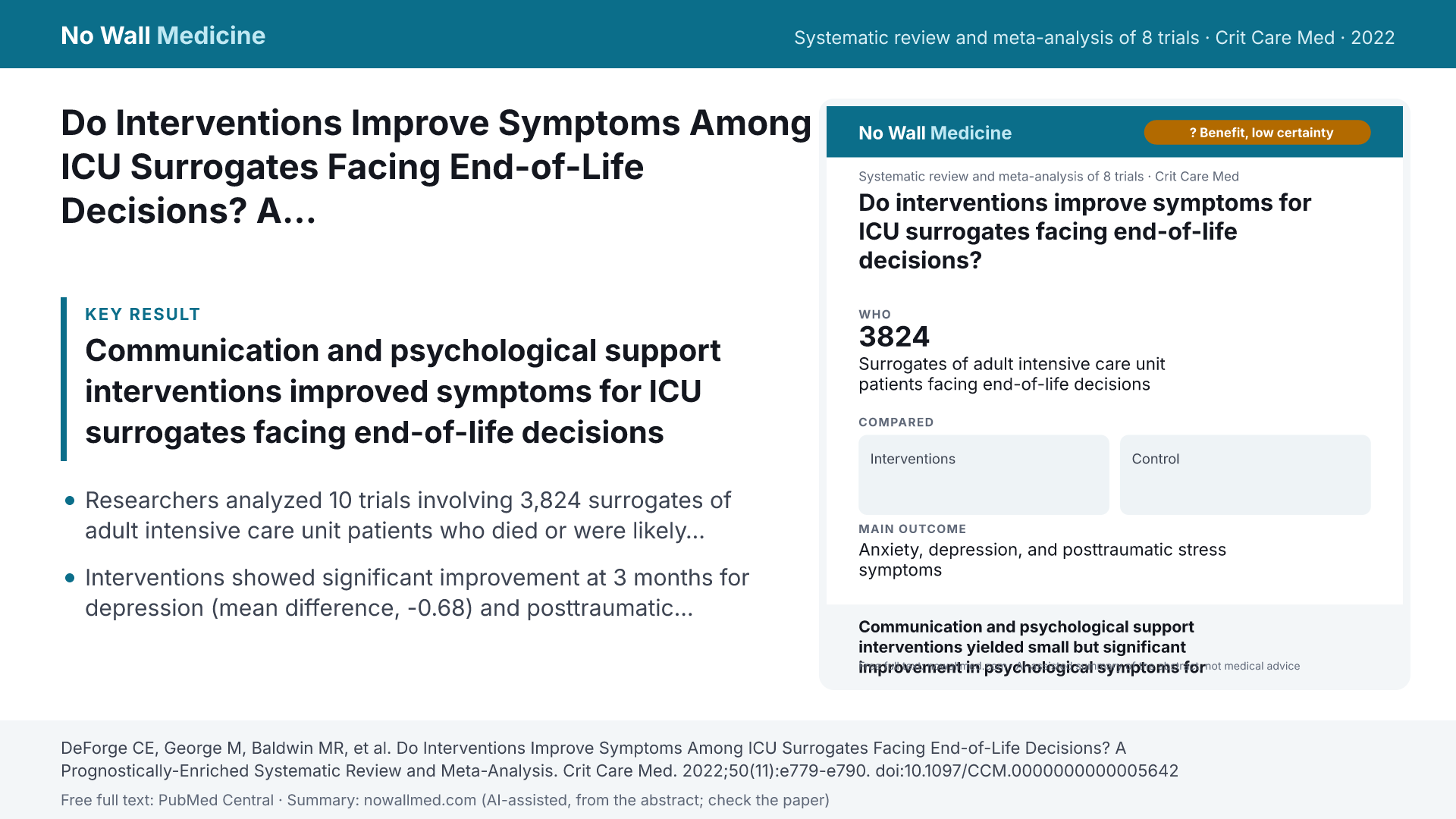
Communication and psychological support interventions improved symptoms for ICU surrogates facing end-of-life decisions
Do Interventions Improve Symptoms Among ICU Surrogates Facing End-of-Life Decisions? A Prognostically-Enriched Systematic Review and Meta-Analysis
Systematic review and meta-analysis of 8 trialsBenefit found
Do interventions improve symptoms for ICU surrogates facing end-of-life decisions?
Who
3824
Surrogates of adult intensive care unit patients facing end-of-life decisions
Compared
Interventions
Control
Main outcome
Anxiety, depression, and posttraumatic stress symptoms
Result: depression MD -0.68 (95% CI -1.14 to -0.22); posttraumatic stress standardized MD -0.25 (95% CI -0.49 to -0.01); anxiety MD -0.70 (95% CI -1.18 to -0.22)
Bottom line: Communication and psychological support interventions yielded small but significant improvement in psychological symptoms for ICU surrogates.
Limitation: Sensitivity analyses suggest significant findings may be unstable and certainty of evidence was moderate to very low.
Crit Care Med · 2022-08-23Download image
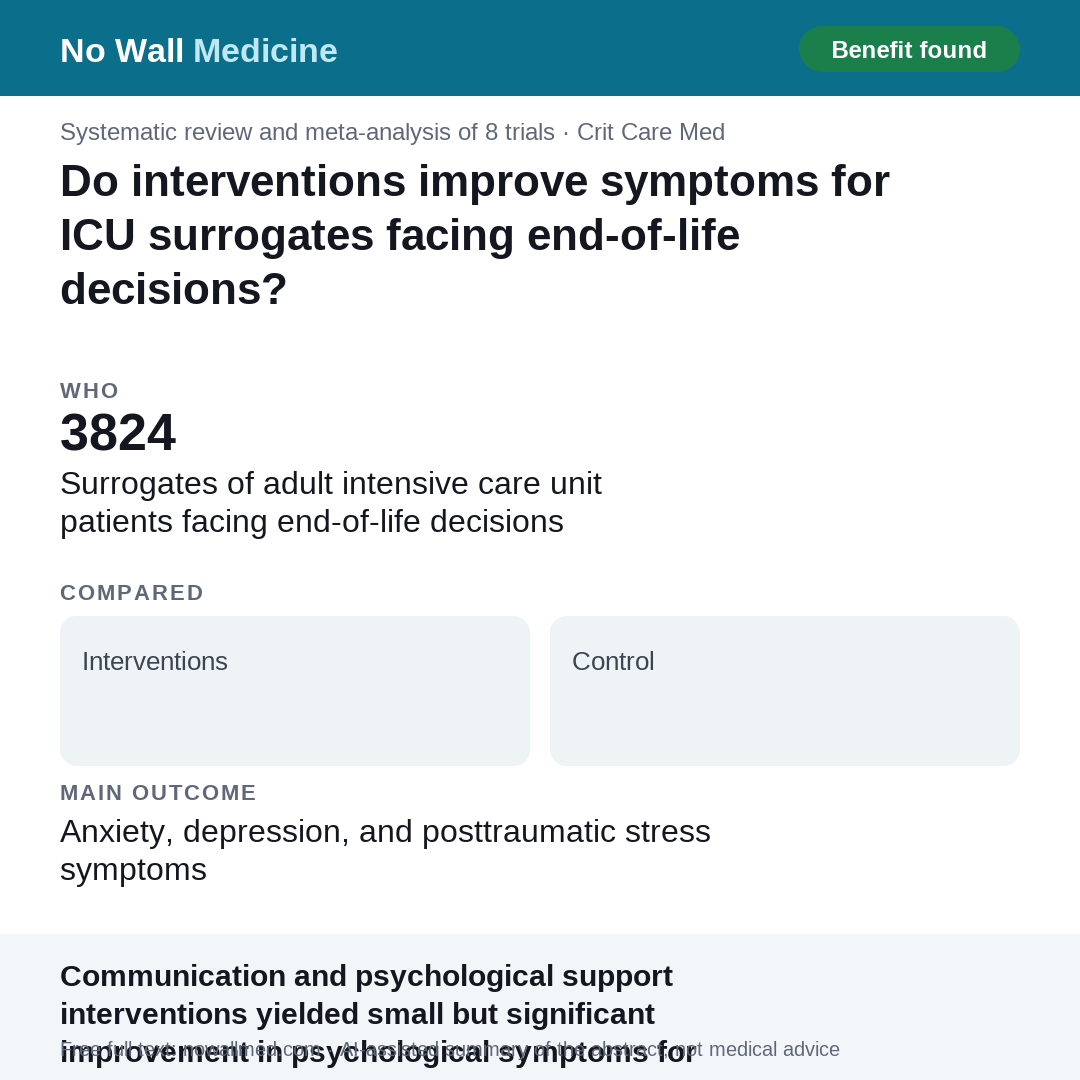
Clinical question: Do interventions improve symptoms for ICU surrogates facing end-of-life decisions?
Why it matters: It was unknown if interventions could improve psychological symptoms for surrogates, the people making medical decisions for patients, when they face end-of-life care.
Key points
- Researchers analyzed 10 trials involving 3,824 surrogates of adult intensive care unit patients who died or were likely to die.
- Interventions showed significant improvement at 3 months for depression (mean difference, -0.68) and posttraumatic stress (standardized mean difference, -0.25).
- At 6 months, interventions were associated with improved anxiety (mean difference, -0.70).
Limitation the authors note: The authors noted that sensitivity analyses suggest the significant findings may be unstable and the overall risk of bias was rated as Some Concerns.
Headline and key points written with AI from the paper’s abstract, with every number checked against it. Read the paper before relying on them.
Was this summary helpful?
Subject terms
Cite this article
DeForge CE, George M, Baldwin MR, South K, Beauchemin M, McHugh ME. Do Interventions Improve Symptoms Among ICU Surrogates Facing End-of-Life Decisions? A Prognostically-Enriched Systematic Review and Meta-Analysis. Crit Care Med. 2022. doi:10.1097/CCM.0000000000005642
Spotted a mistake? Suggest a correction