Early initiation of hypothermic temperature control showed no benefit for neurologic outcomes or survival
Does Time to Achieve a Targeted Body Temperature Matter for Survivors of Cardiac Arrest? A Systematic Review and Meta-Analysis
Systematic review and meta-analysisNo clear difference
Does early hypothermic temperature control initiation and achievement improve neurologic outcomes after cardiac arrest?
Who
Comatose adult cardiac arrest patients
Compared
Early cooling
Late cooling
Main outcome
Neurologic outcomes and overall survival
Result: risk ratio 1.01 (95% CI 0.94-1.14) for neurologic outcomes
Bottom line: Early hypothermic temperature control showed no neurologic or survival benefit in cardiac arrest survivors.
Crit Care Med · 2025-11-11Download image
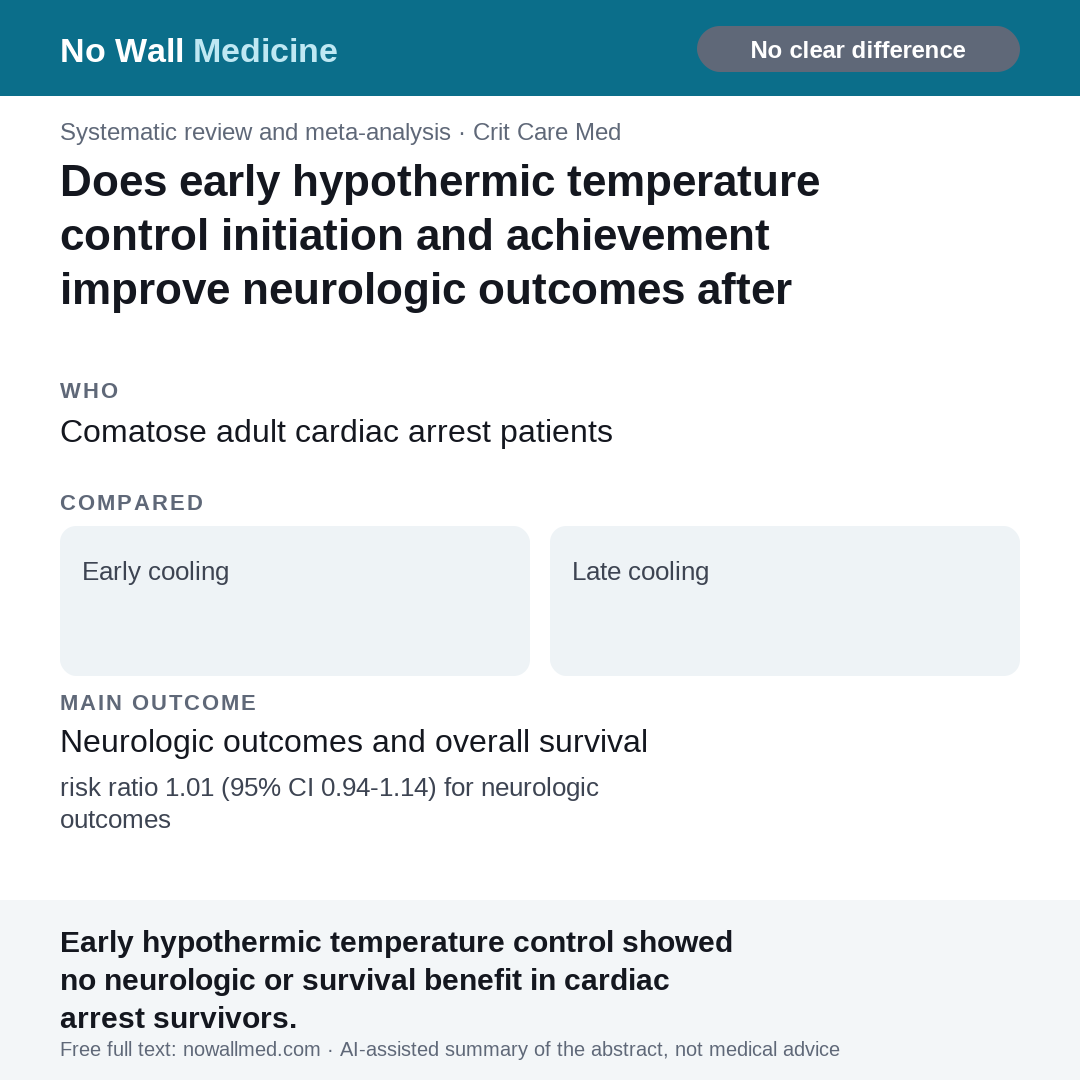
Clinical question: Does early hypothermic temperature control initiation and achievement improve neurologic outcomes after cardiac arrest?
Why it matters: It is unclear if the timing of starting or achieving a target body temperature through hypothermic temperature control affects outcomes for cardiac arrest survivors.
Key points
- Researchers analyzed 11 randomized controlled trials involving comatose adult cardiac arrest patients to compare early cooling with late cooling.
- Early cooling did not improve neurologic outcomes (risk ratio 1.01; 95% CI, 0.94-1.14) or survival (risk ratio 1.01; 95% CI, 0.92-1.11).
- Nasal evaporative cooling during resuscitation was associated with benefits for patients with shockable rhythms (risk ratio 1.40; 95% CI, 1.00-1.96).
Headline and key points written with AI from the paper’s abstract, with every number checked against it. Read the paper before relying on them.
Was this summary helpful?
Subject terms
Cite this article
Alotaibi KS, Saleem N, Chandos Snow TA, Arina P, Dyson A, Singer M. Does Time to Achieve a Targeted Body Temperature Matter for Survivors of Cardiac Arrest? A Systematic Review and Meta-Analysis. Crit Care Med. 2025. doi:10.1097/CCM.0000000000006964
Spotted a mistake? Suggest a correction
Top studies every Monday
The week’s key trials and guidelines in your specialties, plus any topics you follow. By email, free.
Get the weekly digest