Drawing and visual art interventions reduced short-term anxiety in children during medical procedures
Drawing and visual art interventions for anxiety in children aged 5-12: a systematic review and meta-analysis of randomised controlled trials
Systematic review and meta-analysis of randomised controlled trialsBenefit found
Do drawing and visual art interventions reduce anxiety in children aged 5-12 years?
Who
816
Children aged 5-12 years · Medical or procedure-related contexts
Compared
Drawing and visual art interventions
Non-art or usual-care comparators
Main outcome
Postintervention anxiety
Result: standardised mean difference -2.70 (95% CI -3.73 to -1.68)
Bottom line: Drawing and visual art interventions may reduce short-term anxiety in acute medical or procedure-related contexts.
Limitation: Substantial heterogeneity and lack of generalisable effect across paediatric settings.
BMJ Paediatr Open · 2026-09-16Download image
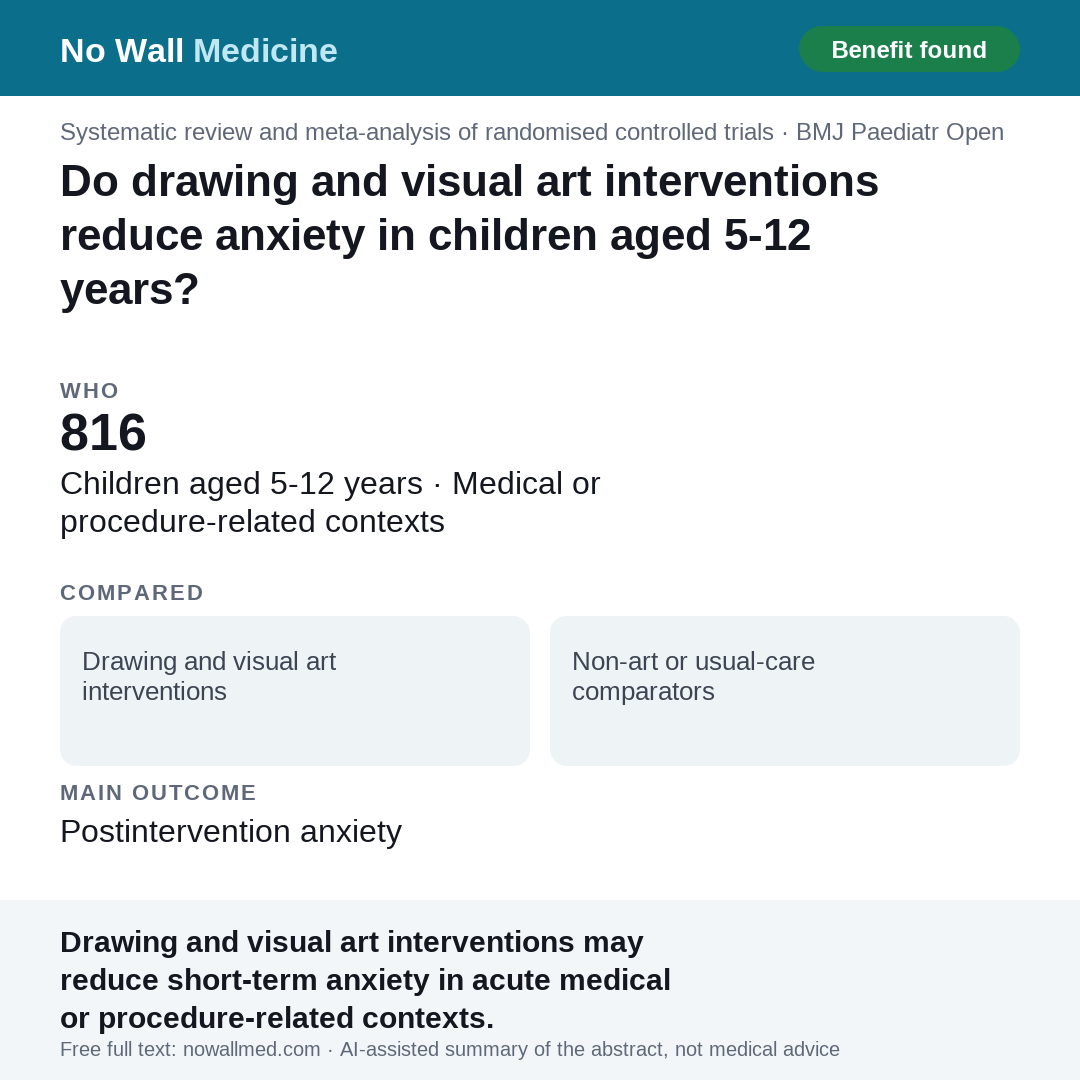
Clinical question: Do drawing and visual art interventions reduce anxiety in children aged 5-12 years?
Why it matters: Researchers sought to evaluate how drawing and visual art interventions affect anxiety levels in children aged 5 to 12 years.
Key points
- Researchers analyzed 10 randomized controlled trials involving 816 children aged 5 to 12 years to evaluate art-based interventions for anxiety.
- In medical or procedure-related settings, art interventions were associated with lower short-term anxiety compared to usual care (SMD=-2.70, 95% CI -3.73 to -1.68).
- The study found that evidence from school-based trials using active art comparators did not support a single generalizable effect across all settings.
Limitation the authors note: The authors stated that heterogeneity was substantial and the current evidence does not support a single generalizable effect across pediatric settings.
Headline and key points written with AI from the paper’s abstract, with every number checked against it. Read the paper before relying on them.
Abstract
Objective
To evaluate the effects of drawing- and visual art-based interventions on anxiety in children aged 5-12 years and to examine variation across comparator structures and settings. Methods
PubMed, Web of Science, Cochrane Library, ERIC, DOAJ and China National Knowledge Infrastructure were searched for randomised controlled trials (RCTs). Postintervention anxiety was the primary outcome and was pooled as standardised mean differences. Trials using non-art or usual-care comparators and those using active art comparators were synthesised separately. Risk of bias was assessed using RoB 2. Results
10 RCTs involving 816 children were included. The primary meta-analysis included eight trials with non-art or usual-care comparators conducted in medical or procedure-related contexts. Drawing- and visual art-based interventions were associated with lower short-term anxiety compared with these controls (SMD=-2.70, 95% CI -3.73 to -1.68; I²=96%). Leave-one-out sensitivity analyses and exclusion of studies at high risk of bias did not materially change the direction of the effect although heterogeneity remained substantial. Two school-based trials used active art-based comparators and were synthesised separately. Conclusion
Drawing- and visual art-based interventions may reduce short-term anxiety mainly in acute medical or procedure-related contexts. Because heterogeneity was substantial and school-based evidence used different comparator structures, the current evidence does not support a single generalisable effect across paediatric settings. Prospero registration number
CRD420261288781.
Abstract reproduced under the article’s CC BY NC licence.
Topics
Cite this article
Jia Y, Zhang S, Liao D. Drawing and visual art interventions for anxiety in children aged 5-12: a systematic review and meta-analysis of randomised controlled trials. BMJ Paediatr Open. 2026. doi:10.1136/bmjpo-2026-004752
Spotted a mistake? Suggest a correction