Driveline exit-site care protocols in patients with left ventricular assist devices: a systematic review
Systematic literature reviewUnclear result
What are the current driveline exit-site care protocols for patients with left ventricular assist devices?
Who
1602
Patients with left ventricular assist devices
Compared
Dressing kit with chlorhexidine, silver, and anchoring device: 6-7.5%
All included studies: median 13.8%
Main outcome
Frequency of driveline infections
Bottom line: Protocols using chlorhexidine, silver-based dressings, and anchoring devices might best reduce driveline infection rates.
Limitation: Prospective studies with larger cohorts are needed to establish the optimal protocol.
Eur J Cardiothorac Surg · 2021-05-09Download image
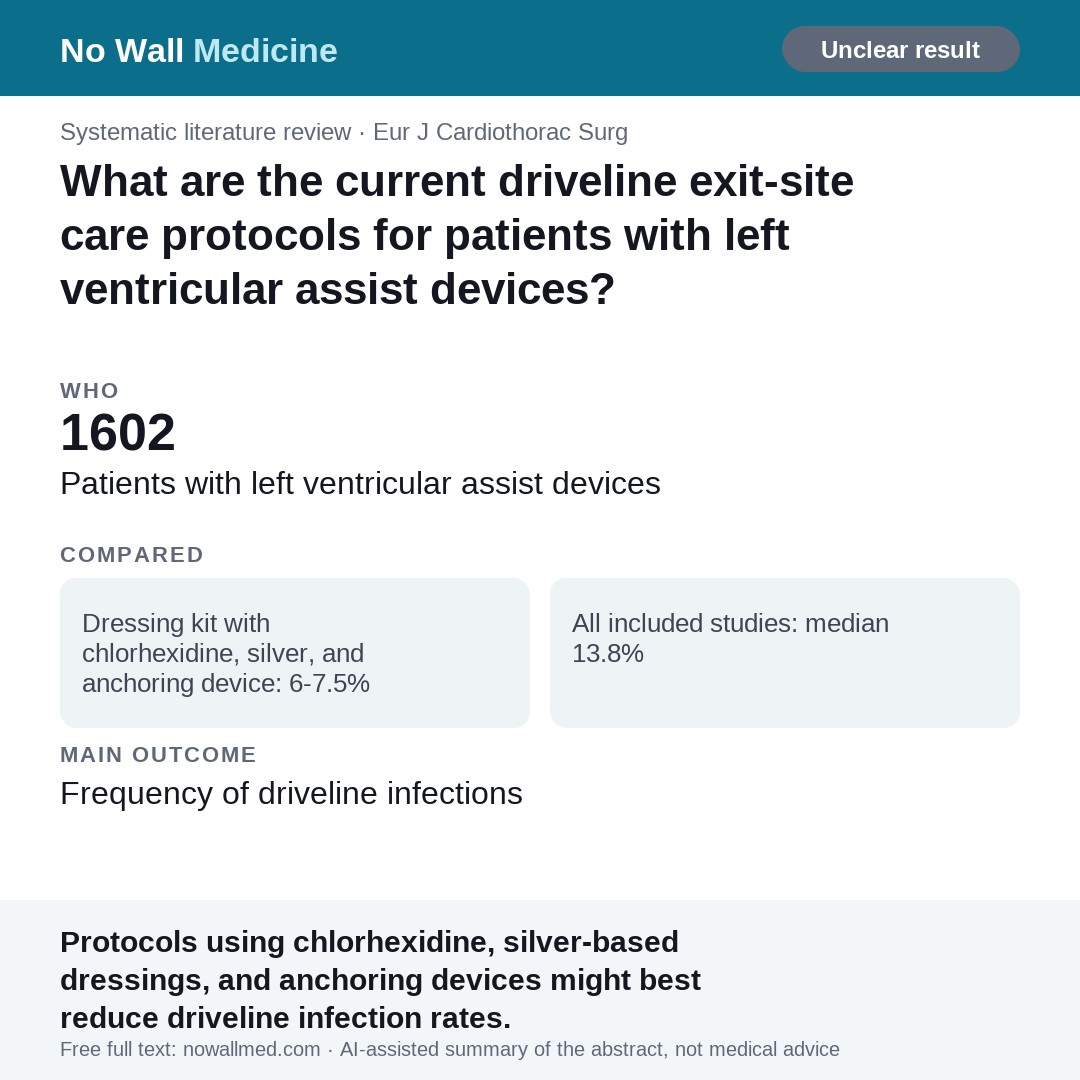
Clinical question: What are the current driveline exit-site care protocols for patients with left ventricular assist devices?
Abstract
Objectives
Driveline infections continue to be a significant complication following left ventricular assist device (LVAD) implantation. Driveline exit-site care is crucial for the prevention of infections; however, there are no uniform guidelines. The goal of this study was to provide an overview of the currently published driveline exit-site care protocols in patients with LVAD. Methods
A systematic literature review was performed. Studies before 15 December 2020 were included if the number of driveline infections was a primary outcome and the driveline exit-site care protocol was explained. Results
Eleven articles were included in the systematic review, including 1602 patients with LVADs. The median of the frequency of driveline infections in the articles was 13.8% with a range of 0-52.6%. There was a marked variability in the methods of care of driveline exit sites, without a standardized driveline dressing technique in patients with LVADs. The frequency of driveline infections was 6-7.5% in studies using a dressing kit that included chlorhexidine, a silver-based dressing and an anchoring device. Furthermore, there was variability in the anchoring devices and the frequency of dressing changes, which varied from daily to weekly. No specific anchoring device or change frequency was found to be superior. Conclusions
Based on this systematic review, driveline exit care protocols that included chlorhexidine, a silver-based dressing, the use of an anchoring device and dressing kits might be best in reducing driveline infection rates. However, prospective studies with larger cohorts are needed to establish the optimal protocol for driveline exit-site care.
Subject terms
Cite this article
Koken ZO, Yalcin YC, van Netten D, de Bakker CC, van der Graaf M, Kervan U. Driveline exit-site care protocols in patients with left ventricular assist devices: a systematic review. Eur J Cardiothorac Surg. 2021. doi:10.1093/ejcts/ezab195
Spotted a mistake? Suggest a correction
Top studies every Monday
The week’s key trials and guidelines in your specialties, plus any topics you follow. By email, free.
Get the weekly digest