Severe shortness of breath was associated with higher intubation rates in acute respiratory failure
Dyspnea is severe and associated with a higher intubation rate in de novo acute hypoxemic respiratory failure
Secondary analysis of a multicenter, randomized, controlled trialHarm found
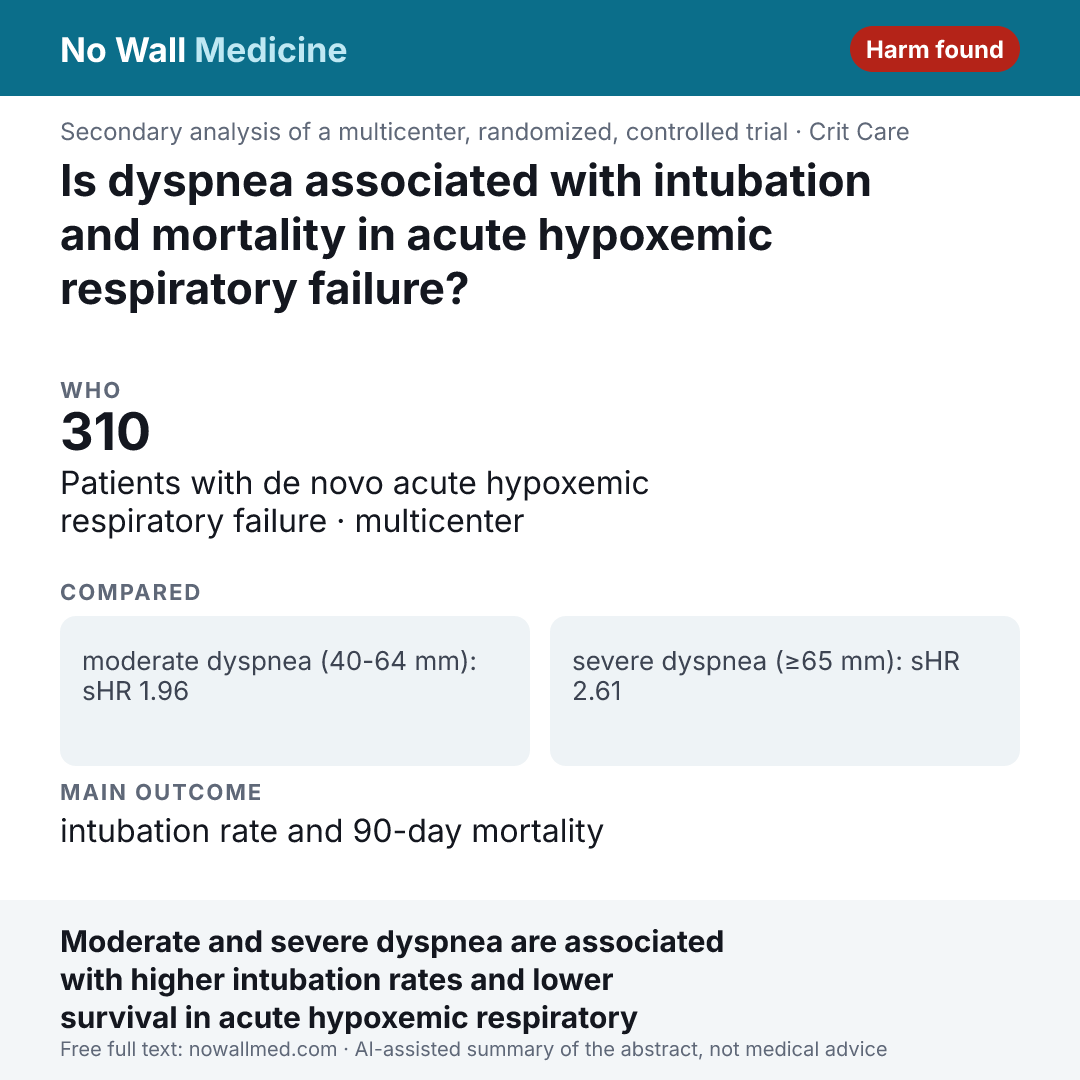
Is dyspnea associated with intubation and mortality in acute hypoxemic respiratory failure?
Who
310
Patients with de novo acute hypoxemic respiratory failure · multicenter
Compared
moderate dyspnea (40-64 mm): sHR 1.96
severe dyspnea (≥65 mm): sHR 2.61
Main outcome
intubation rate and 90-day mortality
Bottom line: Moderate and severe dyspnea are associated with higher intubation rates and lower survival in acute hypoxemic respiratory failure.
Crit Care · 2024-05-23 · Save PNG
Clinical question: Is dyspnea associated with intubation and mortality in acute hypoxemic respiratory failure?
Key points
- Researchers analyzed 259 patients with new-onset acute hypoxemic respiratory failure, a condition where blood oxygen levels are dangerously low.
- Moderate and severe shortness of breath was associated with higher rates of intubation, with sub-group risks of 1.96 and 2.61.
- A 90-day mortality rate of 20% was observed, and lower survival was linked to baseline shortness of breath scores of 40 mm or higher.
Headline and key points written with AI from the paper’s abstract, with every number checked against it. Read the paper before relying on them.
Was this summary helpful?
Subject terms
Headline, design, result, key points, caveat and citation as plain text.
Cite this article
Demoule A, Baptiste A, Thille AW, et al. Dyspnea is severe and associated with a higher intubation rate in de novo acute hypoxemic respiratory failure. Crit Care. 2024;28(1):174. doi:10.1186/s13054-024-04903-5
Spotted a mistake? Suggest a correction