Oxygen targets of 60 versus 90 mm Hg showed similar cognitive outcomes but different pulmonary function
Oxygenation Targets and Long-Term Cognitive and Pulmonary Functions in Hypoxemic Respiratory Failure: A Clinical Trial
Randomized trialMixed results
Does a PaO2 target of 60 versus 90 mm Hg affect 1-year cognitive and pulmonary functions?
Who
1244
ICU survivors of acute hypoxemic respiratory failure
Compared
lower oxygenation group: cognitive mean = 78; SD = 19
higher oxygenation group: cognitive mean = 76; SD = 21
Main outcome
1-year cognitive and pulmonary functions
Result: adjusted mean difference = -5 percentage points (95% CI = -9 to -1)
Bottom line: Lower oxygenation targets resulted in similar cognitive impairment but might reduce pulmonary diffusion capacity in ICU survivors.
AJRCCM · 2025-09-08Download image
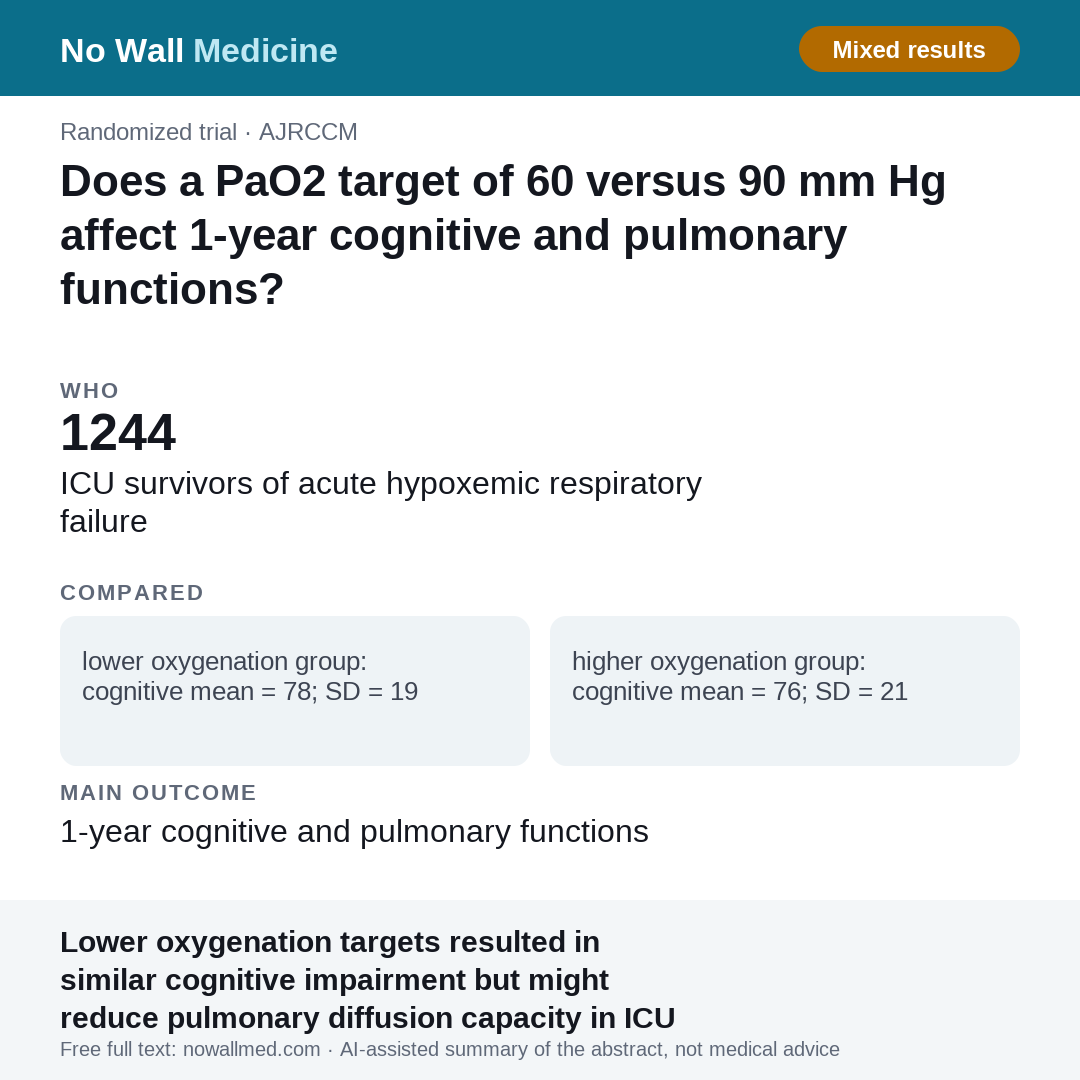
Clinical question: Does a PaO2 target of 60 versus 90 mm Hg affect 1-year cognitive and pulmonary functions?
Why it matters: It is unclear whether lower oxygenation targets impair long-term cognitive function or if higher targets impair long-term pulmonary function in intensive care unit survivors.
Key points
- Researchers analyzed 417 survivors of acute hypoxemic respiratory failure who were randomized to receive either a partial pressure of arterial oxygen target of 60 or 90 mm Hg.
- The oxygen target was associated with similar cognitive scores, with an adjusted mean difference of 2 (95% confidence interval = -2 to 6).
- A target of 60 mm Hg was associated with a lower pulmonary diffusion capacity, measured as the percentage of predicted DlCO, with an adjusted mean difference of -5 percentage points (95% CI = -9 to -1).
Headline and key points written with AI from the paper’s abstract, with every number checked against it. Read the paper before relying on them.
Topics
Cite this article
Crescioli E, Klitgaard TL, Riis JØ, Weinreich UM, Jensen JS, Vestergaard SR. Oxygenation Targets and Long-Term Cognitive and Pulmonary Functions in Hypoxemic Respiratory Failure: A Clinical Trial. AJRCCM. 2025. doi:10.1164/rccm.202412-2499OC
Spotted a mistake? Suggest a correction
Top studies every Monday
The week’s key trials and guidelines in your specialties, by email. Free.
Get the weekly digest