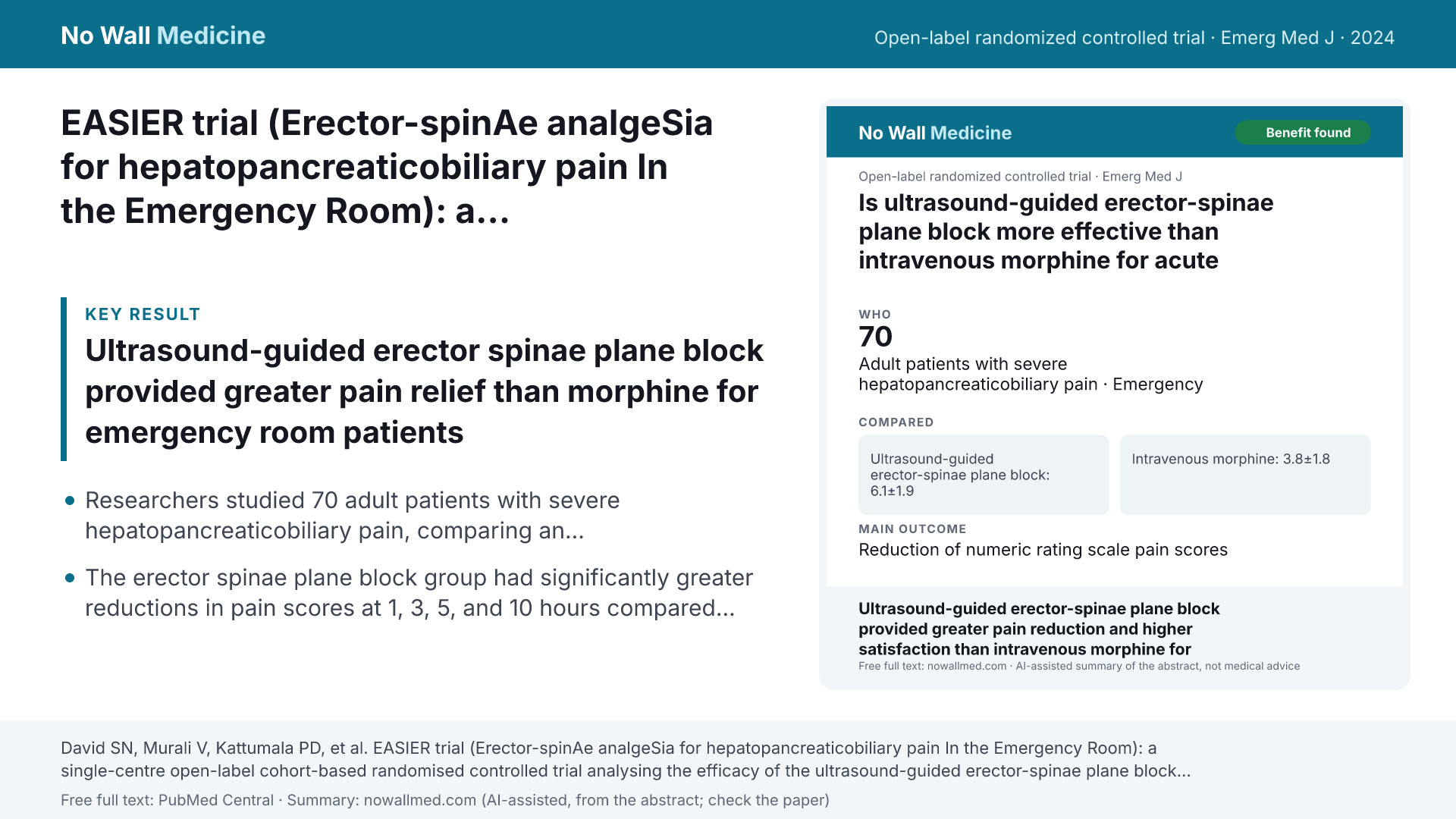
Ultrasound-guided erector spinae plane block provided greater pain relief than morphine for emergency room patients
EASIER trial (Erector-spinAe analgeSia for hepatopancreaticobiliary pain In the Emergency Room): a single-centre open-label cohort-based randomised controlled trial analysing the efficacy of the ultrasound-guided erector-spinae plane block compared with intravenous morphine in the treatment of acute hepatopancreaticobiliary pain in the emergency department
Open-label randomized controlled trialBenefit found
Is ultrasound-guided erector-spinae plane block more effective than intravenous morphine for acute hepatopancreaticobiliary pain?
Who
70
Adult patients with severe hepatopancreaticobiliary pain · Emergency department of a tertiary-care hospital
Compared
Ultrasound-guided erector-spinae plane block: 6.1±1.9
Intravenous morphine: 3.8±1.8
Main outcome
Reduction of numeric rating scale pain scores
Bottom line: Ultrasound-guided erector-spinae plane block provided greater pain reduction and higher satisfaction than intravenous morphine for hepatopancreaticobiliary pain.
Emerg Med J · 2024-09-25 · Save PNG
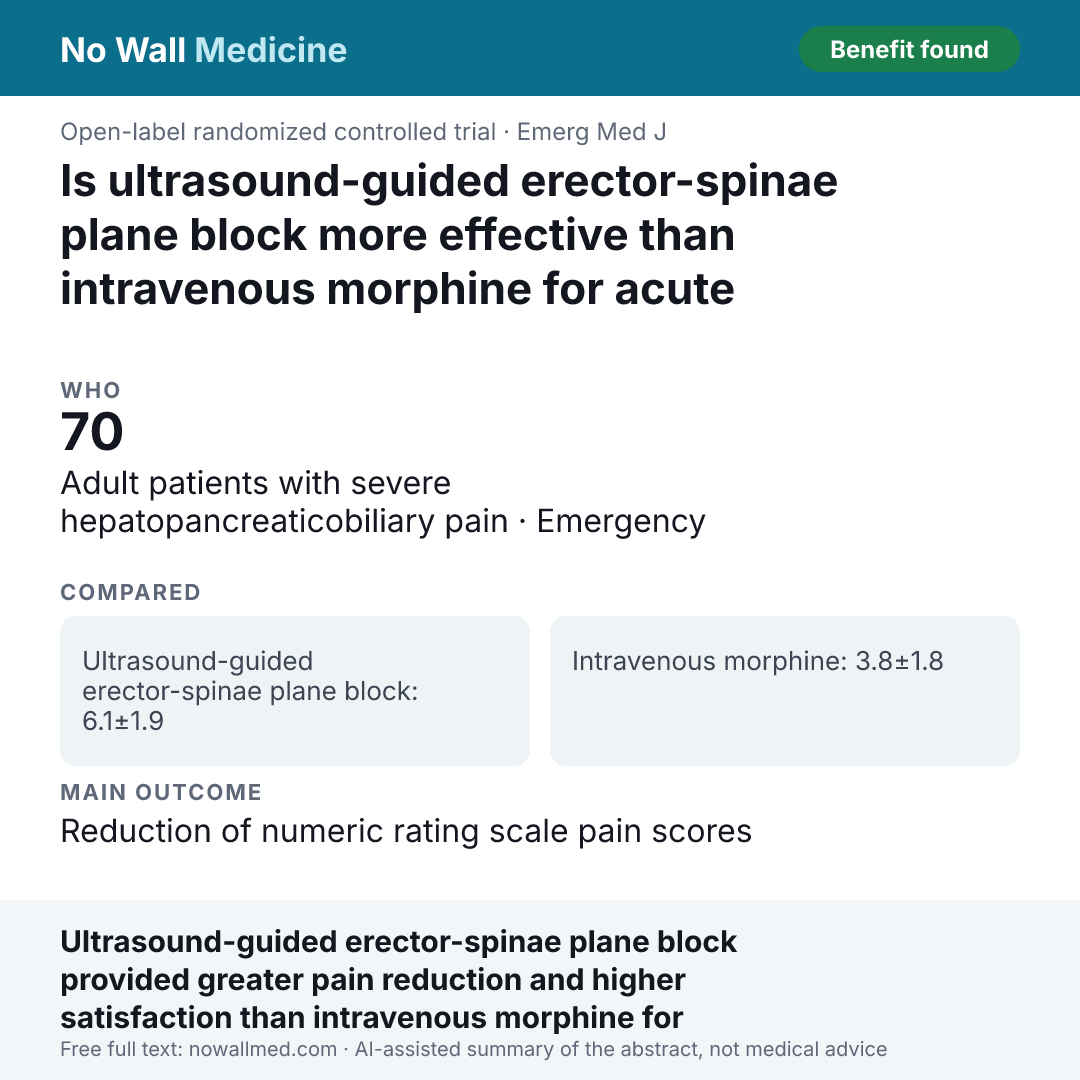
Clinical question: Is ultrasound-guided erector-spinae plane block more effective than intravenous morphine for acute hepatopancreaticobiliary pain?
Key points
- Researchers studied 70 adult patients with severe hepatopancreaticobiliary pain, comparing an ultrasound-guided erector spinae plane block to intravenous morphine.
- The erector spinae plane block group had significantly greater reductions in pain scores at 1, 3, 5, and 10 hours compared to the morphine group.
- Patients receiving the erector spinae plane block required less rescue pain medication at 5 and 10 hours and reported higher satisfaction levels.
Headline and key points written with AI from the paper’s abstract, with every number checked against it. Read the paper before relying on them.
Was this summary helpful?
Abstract
Background
Ultrasound-guided (USG) erector-spinae plane block (ESPB) may be better than intravenous opioids in treating acute hepatopancreaticobiliary (HPB) pain in the ED. Methods
This open-label randomised controlled trial was conducted in the ED of a tertiary-care hospital between March and August 2023. All adult patients with severe HPB pain were recruited during times that a primary investigator was present. Unconsenting patients, numeric rating scale (NRS) ≤6, age ≤18 and ≥80 years, pregnant, unstable or with allergies to local anaesthetics or opioids were excluded. Patients in the intervention arm received bilateral USG ESPB with 0.2% ropivacaine at T7 level, by a trained ED consultant, and those in the control arm received 0.1 mg/kg intravenous morphine. Pain on a 10-point NRS was assessed by the investigators at presentation and at 1, 3, 5 and 10 hours after intervention by the treatment team, along with rescue analgesia requirements and patient satisfaction. Difference in NRS was analysed using analysis of co-variance (ANCOVA) and t-tests. Results
70 participants were enrolled, 35 in each arm. Mean age was 40.4±13.2 years, mean NRS at presentation in the intervention arm was 8.0±0.9 and 7.6±0.6 in the control arm. NRS at 1 hour was significantly lower in the ESPB group (ANCOVA p<0.001). At 1, 3, 5 and 10 hours, reduction of NRS in the intervention arm (7±1.6, 6.7±1.9, 6.6±1.8, 6.1±1.9) was significantly greater than the control arm (4.4±2, 4.6±1.8, 3.7±2.2, 3.8±1.8) (t-test, p<0.001). Fewer patients receiving ESPB required rescue analgesia at 5 (t-test, p=0.031) and 10 hours (t-test, p=0.04). More patients were 'very satisfied' with ESPB compared with receiving only morphine at each time period (p<0.001). Conclusion
ESPB is a promising alternative to morphine in those with HPB pain. Trial registration number
CTRI/2023/03/050595.
Abstract reproduced under the article’s CC BY NC licence.
Subject terms
Headline, design, result, key points, caveat and citation as plain text.
Cite this article
David SN, Murali V, Kattumala PD, et al. EASIER trial (Erector-spinAe analgeSia for hepatopancreaticobiliary pain In the Emergency Room): a single-centre open-label cohort-based randomised controlled trial analysing the efficacy of the ultrasound-guided erector-spinae plane block compared with intravenous morphine in the treatment of acute hepatopancreaticobiliary pain in the emergency department. Emerg Med J. 2024;41(10):588-594. doi:10.1136/emermed-2023-213799
Spotted a mistake? Suggest a correction