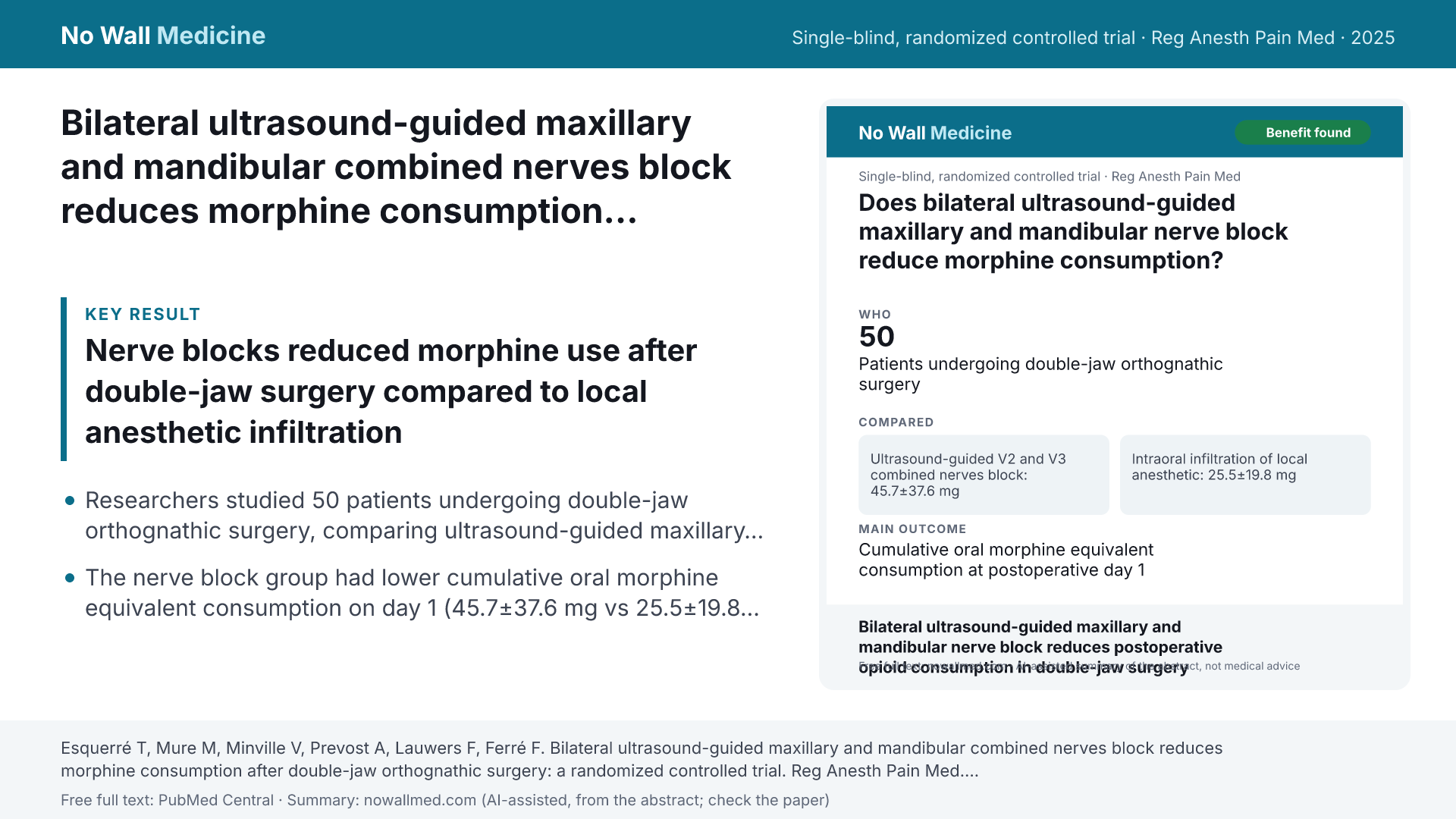
Nerve blocks reduced morphine use after double-jaw surgery compared to local anesthetic infiltration
Bilateral ultrasound-guided maxillary and mandibular combined nerves block reduces morphine consumption after double-jaw orthognathic surgery: a randomized controlled trial
Single-blind, randomized controlled trialBenefit found
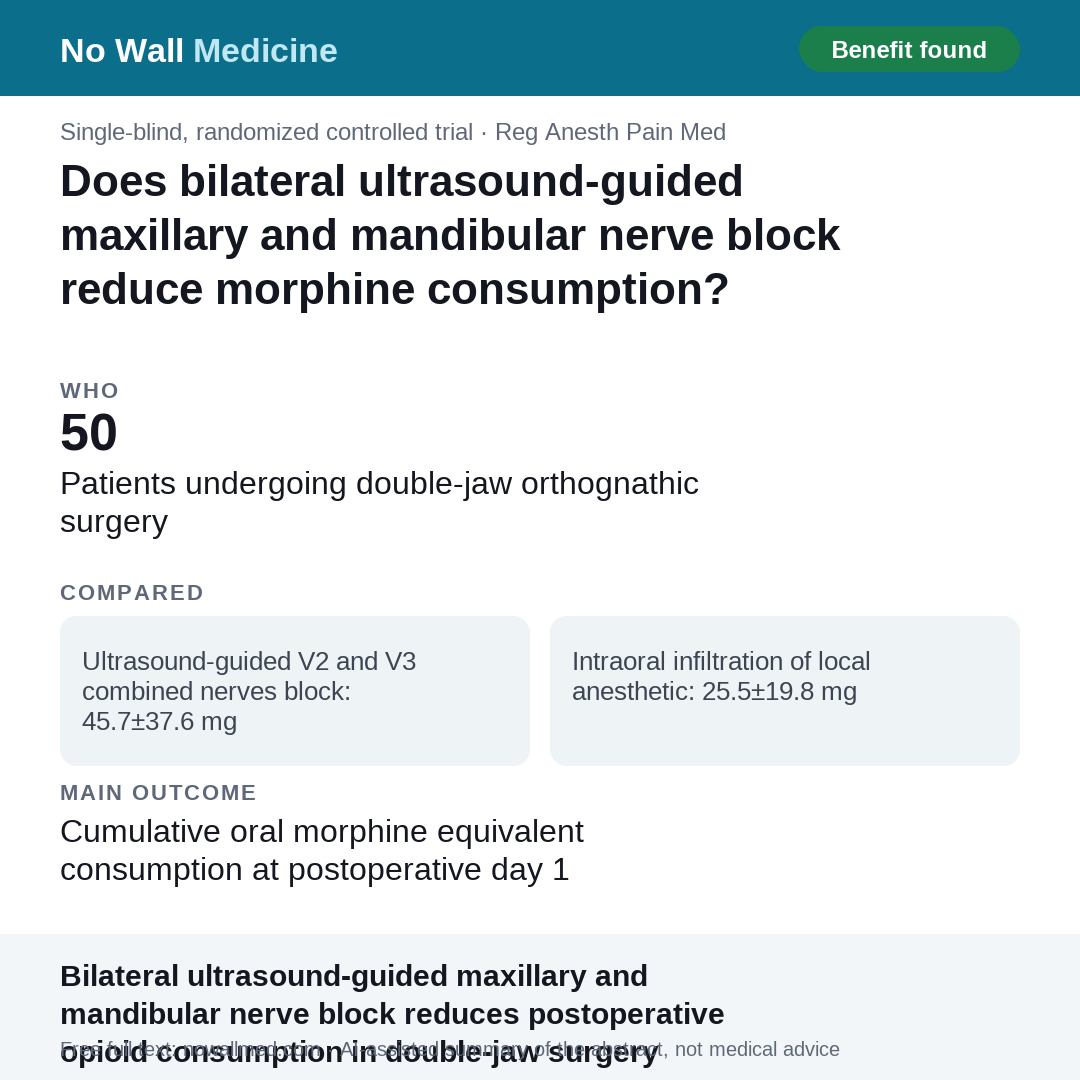
Does bilateral ultrasound-guided maxillary and mandibular nerve block reduce morphine consumption?
Who
50
Patients undergoing double-jaw orthognathic surgery
Compared
Ultrasound-guided V2 and V3 combined nerves block: 45.7±37.6 mg
Intraoral infiltration of local anesthetic: 25.5±19.8 mg
Main outcome
Cumulative oral morphine equivalent consumption at postoperative day 1
Result: mean difference of -20.1 (95% CI -37.4 to -2.9) mg
Bottom line: Bilateral ultrasound-guided maxillary and mandibular nerve block reduces postoperative opioid consumption in double-jaw surgery patients.
Reg Anesth Pain Med · 2025-07-04Download image
Clinical question: Does bilateral ultrasound-guided maxillary and mandibular nerve block reduce morphine consumption?
Why it matters: Double-jaw surgeries are painful and require opioids, but it is unclear if combined maxillary and mandibular nerve blocks provide adequate pain management.
Key points
- Researchers studied 50 patients undergoing double-jaw orthognathic surgery, comparing ultrasound-guided maxillary and mandibular nerve blocks to intraoral infiltration of local anesthetic.
- The nerve block group had lower cumulative oral morphine equivalent consumption on day 1 (45.7±37.6 mg vs 25.5±19.8 mg) and day 2 (64.5±60 mg vs 35.8±30.2 mg).
- Higher preoperative anxiety scores were positively correlated with worse pain scores and higher morphine consumption on postoperative day 2.
Headline and key points written with AI from the paper’s abstract, with every number checked against it. Read the paper before relying on them.
Was this summary helpful?
Abstract
Background
Double-jaw surgeries are known to be painful and to require opioids. Maxillary (V2) and mandibular (V3) nerves block could provide adequate pain management with minimal opioid-related side effects. Our main objective was to evaluate the analgesic effect of bilateral ultrasound-guided V2 and V3 combined nerves block in patients undergoing double-jaw orthognathic surgery. Methods
In this single-blind, randomized control study, 50 patients were prospectively allocated to either bilateral ultrasound-guided V2 and V3 combined nerves block or intraoral infiltration of local anesthetic. Primary outcome was the cumulative oral morphine equivalent (OME) consumption assessed at postoperative day 1. Secondary outcomes were cumulative OME consumption and pain scores in recovery room and at postoperative day 2, intraoperative anesthetic consumption, and opioid-related side effects. Preoperative anxiety was investigated by the Amsterdam Preoperative Anxiety and Information Scale (APAIS). Results
Compared with infiltration, ultrasound-guided regional anesthesia reduced cumulative OME consumption on day 1 (45.7±37.6 mg vs 25.5±19.8 mg, respectively, mean difference of -20.1 (95% CI -37.4 to -2.9) mg, p=0.023) and day 2 (64.5±60 mg vs 35.8±30.2 mg, respectively, mean difference of -28.7 (95% CI -55.9 to -1.43) mg, p=0.040). Interestingly, worst pain score and cumulative OME consumptions on day 2 were positively correlated with the APAIS (Pearson's correlation coefficient of 0.42 (p=0.003) and 0.39 (p=0.006), respectively). Conclusion
Bilateral ultrasound-guided V2 and V3 combined nerves block reduces postoperative opioid consumption by about 50% in patients undergoing double-jaw surgery. Trial registration number
NCT05351151.
Abstract reproduced under the article’s CC BY licence.
Subject terms
Cite this article
Esquerré T, Mure M, Minville V, Prevost A, Lauwers F, Ferré F. Bilateral ultrasound-guided maxillary and mandibular combined nerves block reduces morphine consumption after double-jaw orthognathic surgery: a randomized controlled trial. Reg Anesth Pain Med. 2025. doi:10.1136/rapm-2024-105497
Spotted a mistake? Suggest a correction