Bypass surgery was associated with fewer major amputations than endovascular treatment in patients with adequate veins
Editor's Choice - Reduction of Major Amputations after Surgery versus Endovascular Intervention: The BEST-CLI Randomised Trial
International randomized trialBenefit found
Does bypass surgery or endovascular treatment reduce major amputations in chronic limb threatening ischaemia?
Who
1830
Patients with chronic limb threatening ischaemia · International
Compared
10.3%Surgical bypass with adequate vein (74/718)
14.9%Endovascular treatment with adequate vein (107/716)
Main outcome
Major amputation
Bottom line: In patients with adequate vein, surgical bypass was more effective than endovascular treatment in preventing major amputations.
Eur J Vasc Endovasc Surg · 2024-06-24Download image
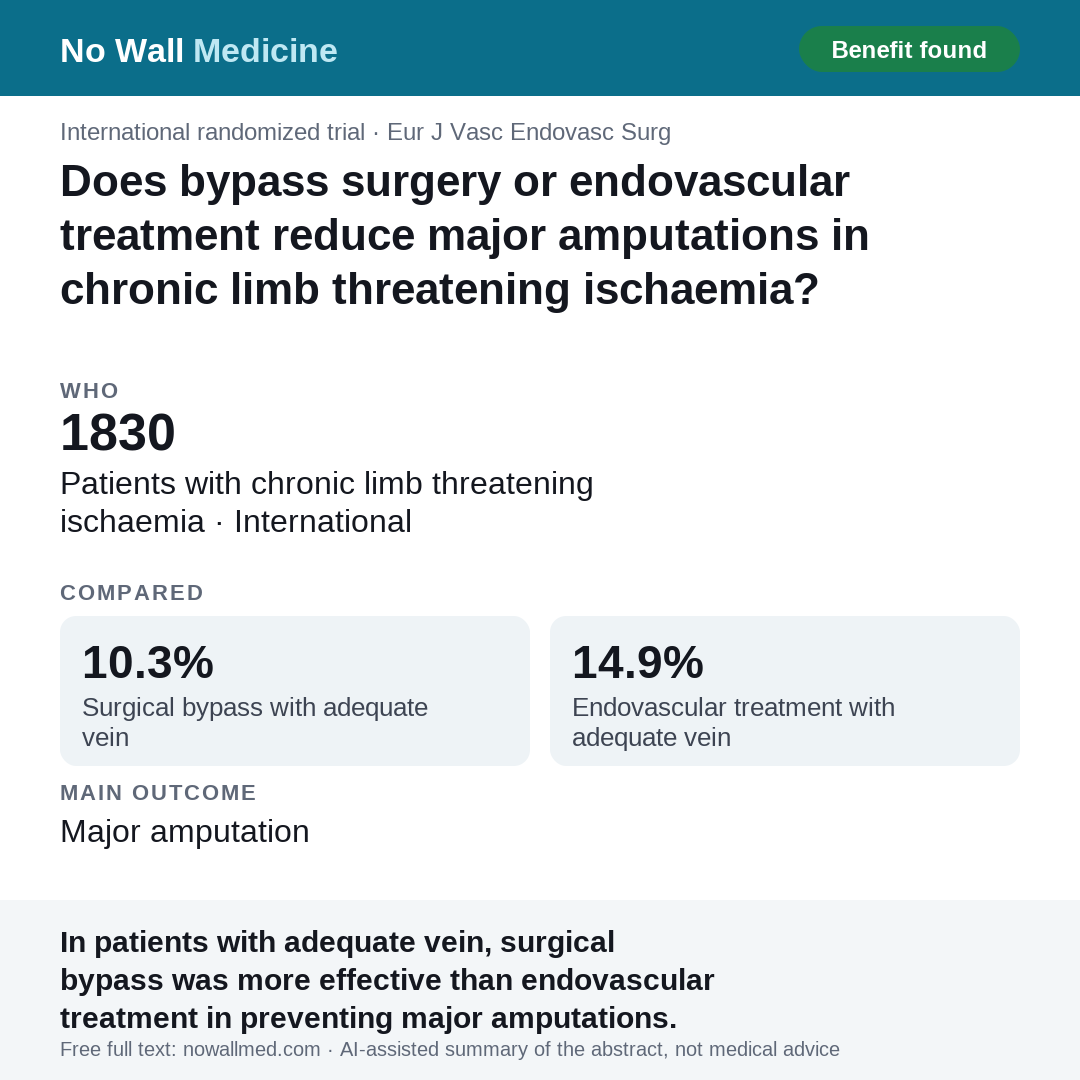
Clinical question: Does bypass surgery or endovascular treatment reduce major amputations in chronic limb threatening ischaemia?
Why it matters: It is unknown whether surgical bypass or endovascular treatment is more effective at preventing major amputations in patients with chronic limb threatening ischaemia.
Key points
- The trial included 1,830 patients with chronic limb threatening ischaemia, comparing surgical bypass to endovascular treatment (using catheters to open vessels) in two groups based on vein availability.
- In patients with adequate single segment great saphenous vein, major amputation occurred in 10.3% of the surgical group versus 14.9% of the endovascular group.
- In patients without adequate single segment great saphenous vein, major amputation rates were 15.2% for surgery and 14.1% for endovascular treatment, which was not a significant difference.
Headline and key points written with AI from the paper’s abstract, with every number checked against it. Read the paper before relying on them.
Was this summary helpful?
Subject terms
Cite this article
Venermo MA, Farber A, Schanzer A, Menard MT, Rosenfield K, Dosluoglu H. Editor's Choice - Reduction of Major Amputations after Surgery versus Endovascular Intervention: The BEST-CLI Randomised Trial. Eur J Vasc Endovasc Surg. 2024. doi:10.1016/j.ejvs.2024.06.018
Spotted a mistake? Suggest a correction
Top studies every Monday
The week’s key trials and guidelines in your specialties, plus any topics you follow. By email, free.
Get the weekly digest