Person-centered care intervention improved HIV care return and retention after treatment interruptions in Zambia
Effect of a person-centered care intervention on return and sustained reengagement after treatment interruptions from HIV care in Zambia: A post-hoc analysis of a stepped-wedged cluster randomized trial
Stepped-wedge cluster randomized trialBenefit found
Does person-centered care improve HIV care reengagement?
Who
128910
Individuals living with HIV in Zambia · 24 clinics in Zambia
Compared
67.7%Control
72.3%Intervention
Main outcome
Return to HIV care after treatment interruption
Result: Adjusted hazard ratio 1.16 (CI 1.12,1.20)
Bottom line: Person-centered care increases return to HIV care
Limitation: Post-hoc analysis and stepped-wedge design limitations
PLOS Med · 2026-09-01Download image
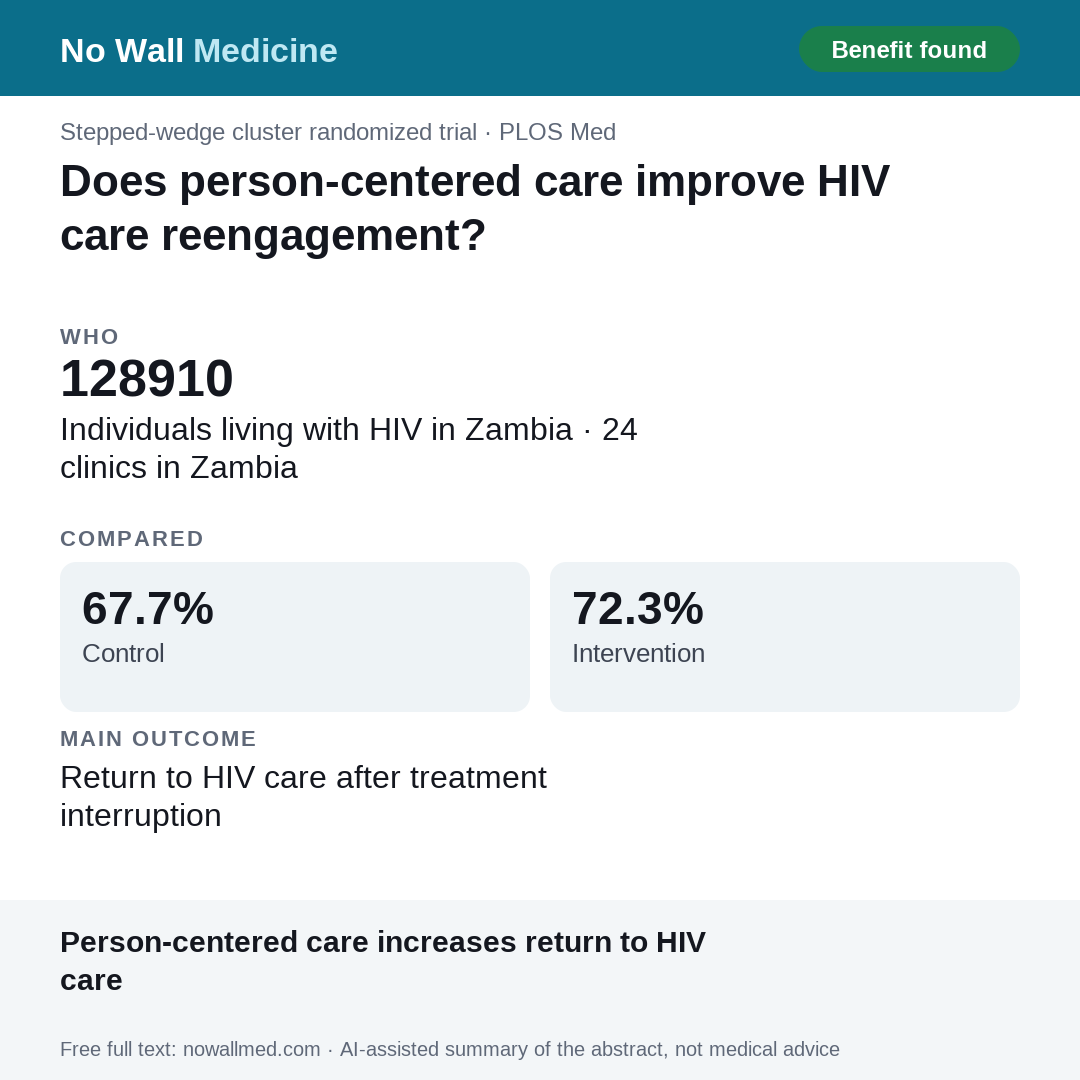
Clinical question: Does person-centered care improve HIV care reengagement?
Why it matters: Poor interactions between patients and healthcare providers can lead to cycles of treatment interruptions and fear of returning to care.
In absolute numbers
Control: 67.7% · Intervention: 72.3% → a difference of 4.6 percentage points, so about 22 people would need the treatment for 1 more to benefit (number needed to treat) over the trial’s follow-up.
Worked out by us from the two group results above, not reported by the authors. Check the paper for the exact outcome and timing.
Key points
- Researchers studied 128,910 clients in Zambia who were more than 30 days late for scheduled HIV care visits.
- The intervention increased the 12-month return rate to 72.3% compared to 67.7% in the control group.
- Among those who returned, the intervention decreased repeat treatment interruptions from 55.6% to 44.3%.
Limitation the authors note: The authors stated that this study was a post-hoc analysis and noted limitations associated with the stepped-wedge design.
Headline and key points written with AI from the paper’s abstract, with every number checked against it. Read the paper before relying on them.
Topics
Cite this article
Mody A, Sikombe K, Simbeza S, Mukamba N, Beres LK, Pry JM. Effect of a person-centered care intervention on return and sustained reengagement after treatment interruptions from HIV care in Zambia: A post-hoc analysis of a stepped-wedged cluster randomized trial. PLOS Med. 2026. doi:10.1371/journal.pmed.1005052
Spotted a mistake? Suggest a correction