Sedation and ventilator liberation protocol was associated with shorter time to successful extubation in children
Effect of a Sedation and Ventilator Liberation Protocol vs Usual Care on Duration of Invasive Mechanical Ventilation in Pediatric Intensive Care Units: A Randomized Clinical Trial
Stepped-wedge, cluster randomized clinical trialBenefit found
Does a sedation and ventilator liberation protocol reduce duration of invasive mechanical ventilation?
Who
8843
Critically ill infants and children anticipated to require prolonged mechanical ventilation · 17 hospital sites in the UK
Compared
Usual care: 66.2 hours
Sedation and ventilator liberation protocol: 64.8 hours
Main outcome
Duration of invasive mechanical ventilation until first successful extubation
Result: hazard ratio 1.11 (95% CI 1.02 to 1.20)
Bottom line: A sedation and ventilator liberation protocol significantly reduced time to first successful extubation in critically ill children.
Limitation: The clinical importance of the effect size is uncertain.
JAMA · 2021-08-03 · Save PNG
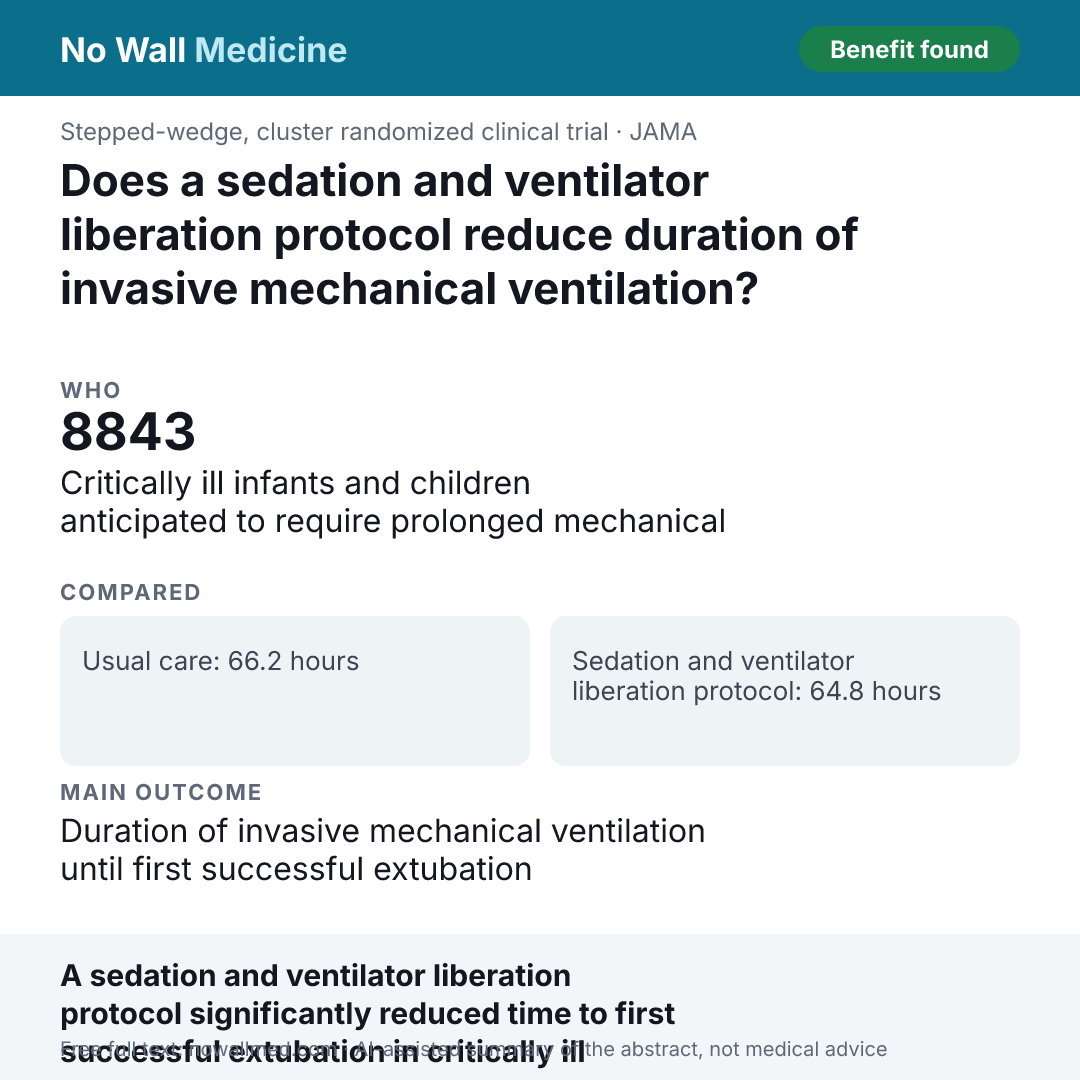
Clinical question: Does a sedation and ventilator liberation protocol reduce duration of invasive mechanical ventilation?
Key points
- The study included 8843 critically ill infants and children across 18 pediatric intensive care units in the UK.
- The protocol intervention resulted in a median time to successful extubation of 64.8 hours compared to 66.2 hours for usual care.
- Serious adverse events of hypoxia occurred in 0.2% of the protocol group and 0.3% of the usual care group.
Limitation the authors note: The clinical importance of the effect size is uncertain.
Headline and key points written with AI from the paper’s abstract, with every number checked against it. Read the paper before relying on them.
Was this summary helpful?
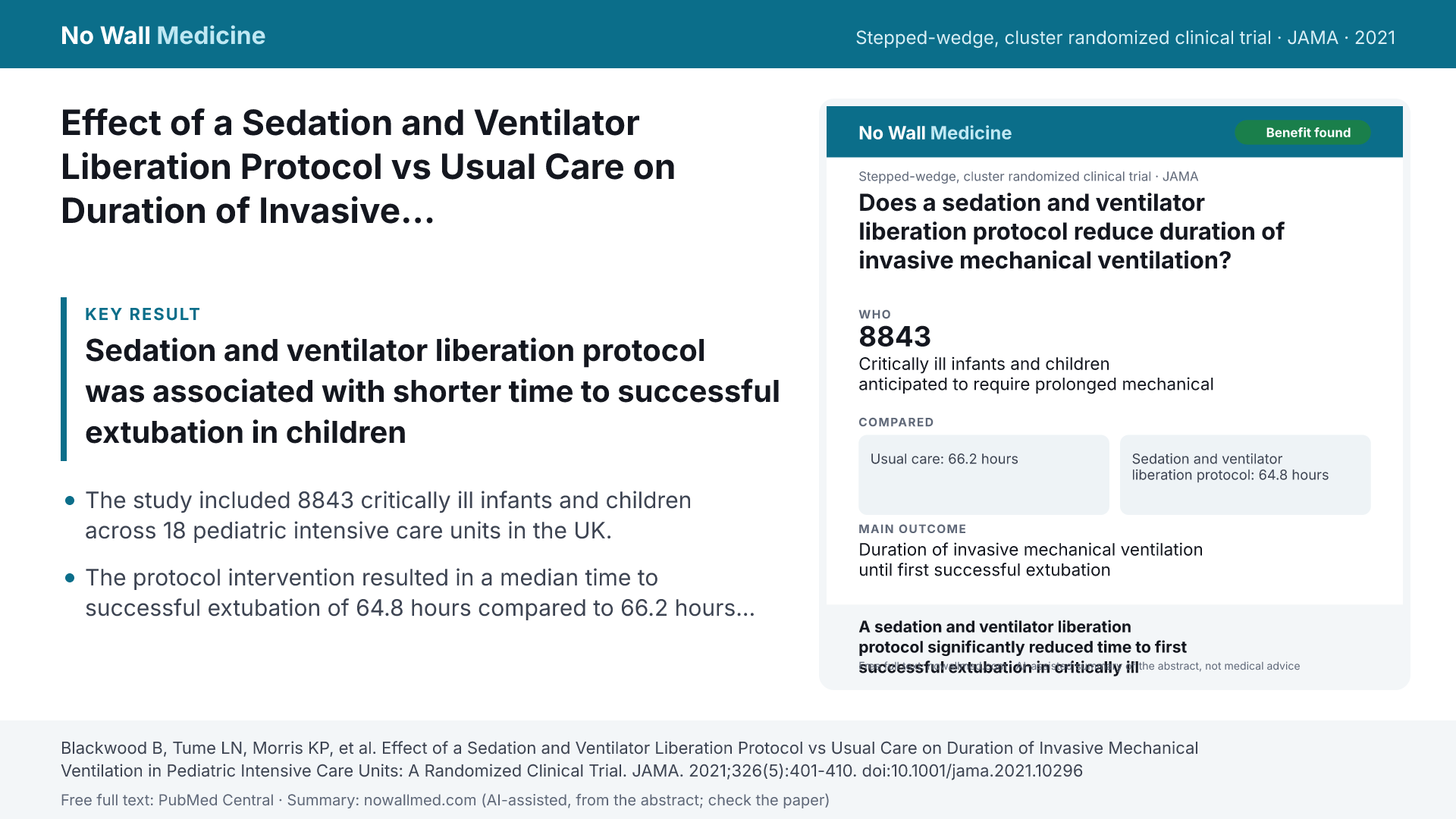
Subject terms
Headline, design, result, key points, caveat and citation as plain text.
Cite this article
Blackwood B, Tume LN, Morris KP, et al. Effect of a Sedation and Ventilator Liberation Protocol vs Usual Care on Duration of Invasive Mechanical Ventilation in Pediatric Intensive Care Units: A Randomized Clinical Trial. JAMA. 2021;326(5):401-410. doi:10.1001/jama.2021.10296
Spotted a mistake? Suggest a correction