Active workstations were associated with improved neurocognitive performance and decreased typing speed compared to sitting
Effect of Active Workstations on Neurocognitive Performance and Typing Skills: A Randomized Clinical Trial
Randomized cross-over clinical trialBenefit found
Do active workstations affect neurocognitive performance and typing skills compared to sitting?
Who
44
44 healthy subjects · An employee wellness center
Compared
Sitting station
Active workstations: neurocognitive test either improved or remained unchanged
Main outcome
Neurocognitive function and fine motor skills
Bottom line: Active workstations improved cognitive performance without impairing work performance, although typing speed decreased.
J Am Heart Assoc · 2024-04-04Download image
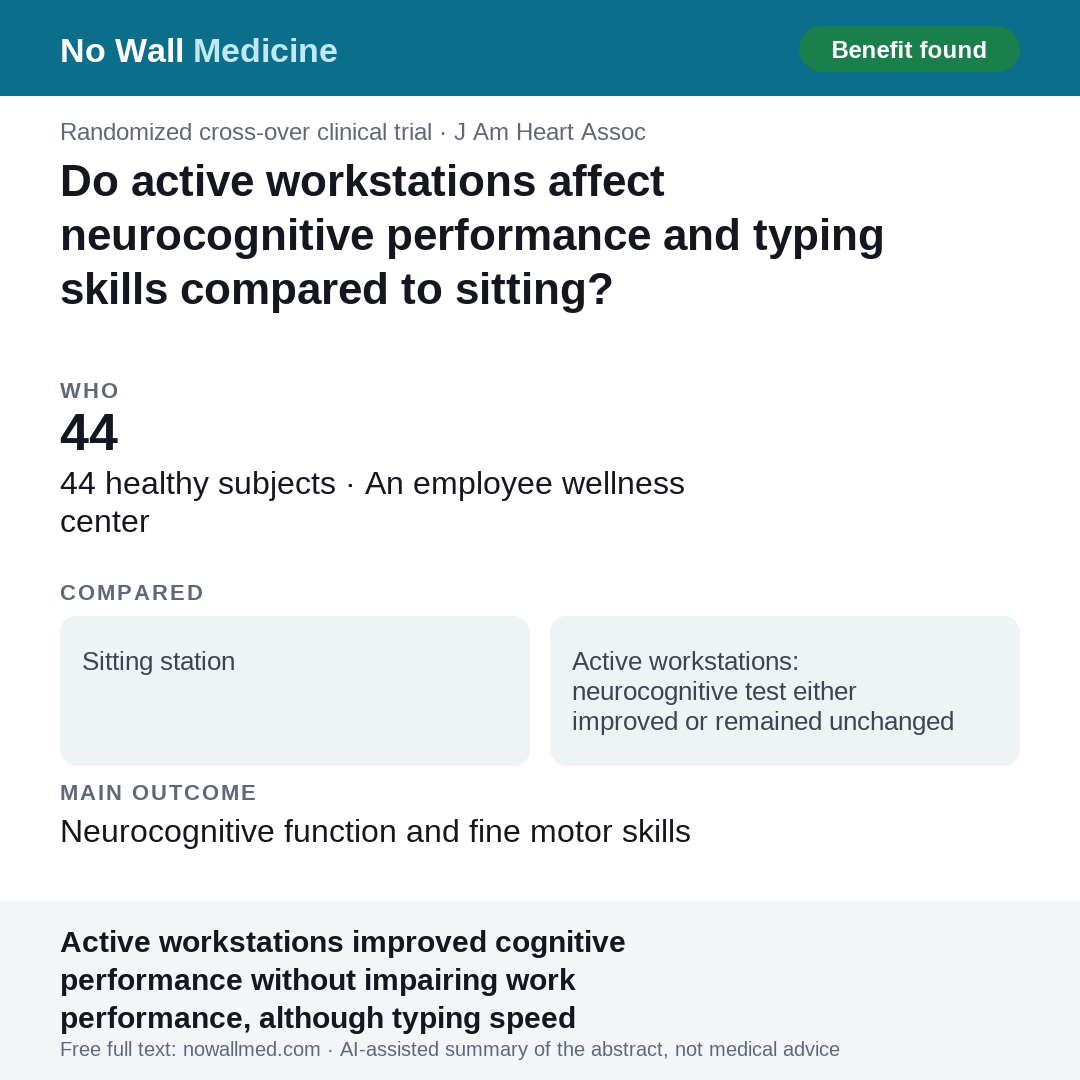
Clinical question: Do active workstations affect neurocognitive performance and typing skills compared to sitting?
Why it matters: It is unknown if using active workstations to reduce sedentary behavior during office work affects neurocognitive function or fine motor skills like typing.
Key points
- Researchers conducted a randomized cross-over trial with 44 healthy subjects, including 28 (64%) women, comparing sitting to standing, walking, or stepper workstations.
- Compared to sitting, neurocognitive test scores either improved or remained unchanged, while typing speed decreased without affecting typing errors.
- Average typing speed was 42.5 words per minute for standing versus 39.7 words per minute for stepping (P=0.003).
Headline and key points written with AI from the paper’s abstract, with every number checked against it. Read the paper before relying on them.
Topics
Cite this article
Medina-Inojosa JR, Gomez Ibarra MA, Medina-Inojosa BJ, Supervia M, Jenkins S, Johnson L. Effect of Active Workstations on Neurocognitive Performance and Typing Skills: A Randomized Clinical Trial. J Am Heart Assoc. 2024. doi:10.1161/JAHA.123.031228
Spotted a mistake? Suggest a correction
Top studies every Monday
The week’s key trials and guidelines in your specialties, plus any topics you follow. By email, free.
Get the weekly digest