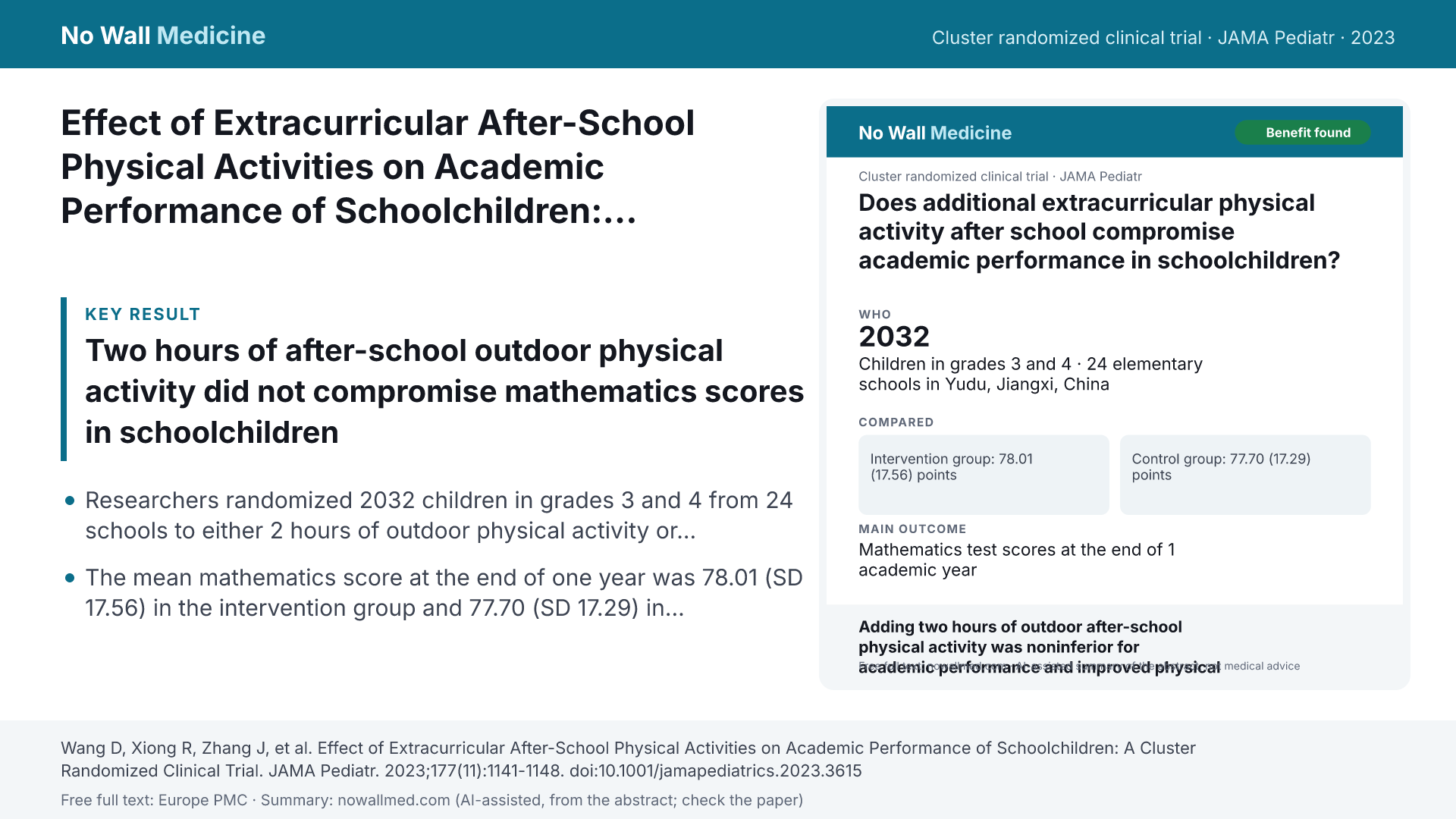
Two hours of after-school outdoor physical activity did not compromise mathematics scores in schoolchildren
Effect of Extracurricular After-School Physical Activities on Academic Performance of Schoolchildren: A Cluster Randomized Clinical Trial
Cluster randomized clinical trialBenefit found
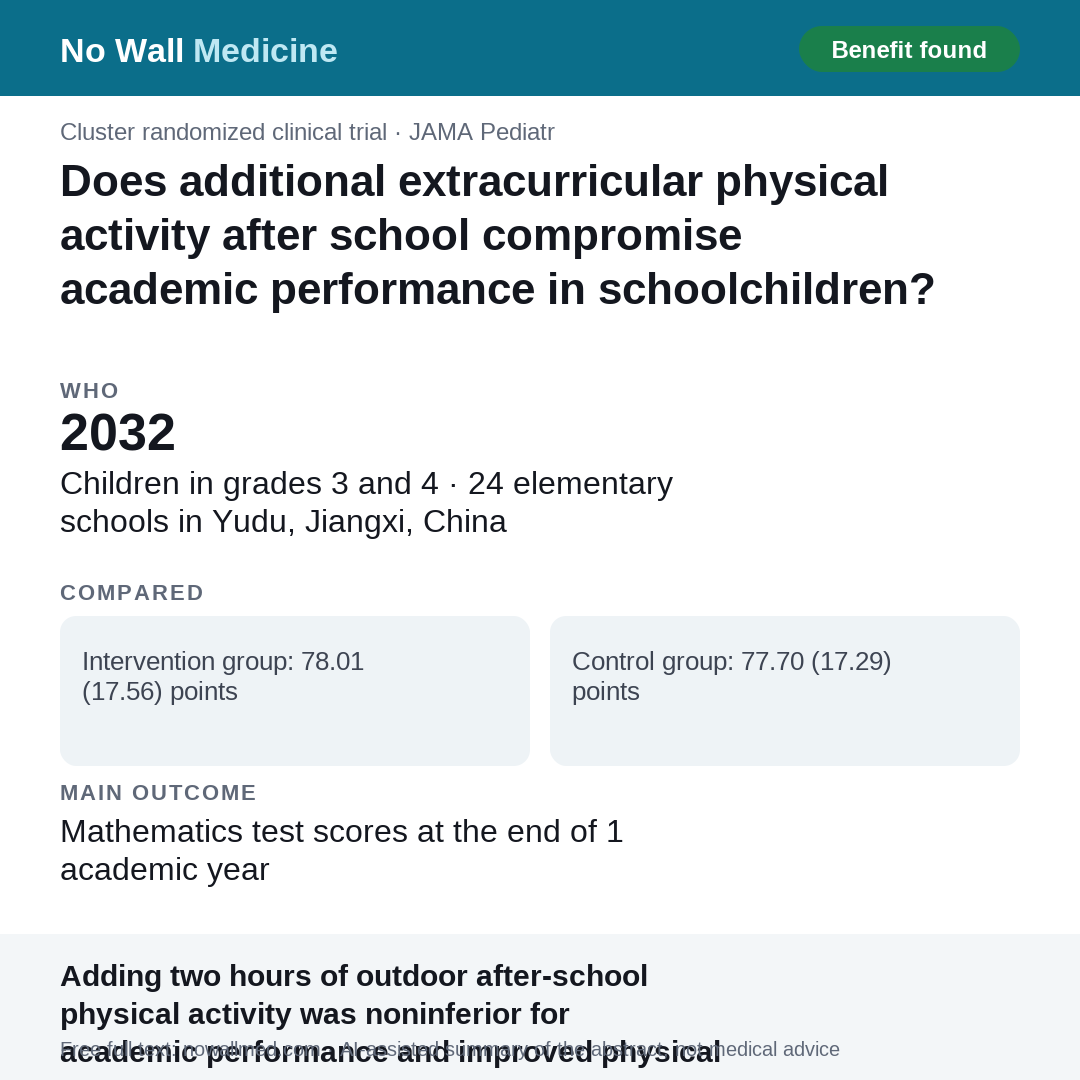
Does additional extracurricular physical activity after school compromise academic performance in schoolchildren?
Who
2032
Children in grades 3 and 4 · 24 elementary schools in Yudu, Jiangxi, China
Compared
Intervention group: 78.01 (17.56) points
Control group: 77.70 (17.29) points
Main outcome
Mathematics test scores at the end of 1 academic year
Result: adjusted between-group mean difference 0.65 points (95% CI, -2.85 to 4.15)
Bottom line: Adding two hours of outdoor after-school physical activity was noninferior for academic performance and improved physical fitness.
JAMA Pediatr · 2023-09-18Download image
Clinical question: Does additional extracurricular physical activity after school compromise academic performance in schoolchildren?
Why it matters: It is unknown whether increasing extracurricular physical activity time for children in competitive educational systems compromises their academic performance.
Key points
- Researchers randomized 2032 children in grades 3 and 4 from 24 schools to either 2 hours of outdoor physical activity or free after-school activity.
- The mean mathematics score at the end of one year was 78.01 (SD 17.56) in the intervention group and 77.70 (SD 17.29) in the control group.
- The adjusted difference in mathematics scores between groups was 0.65 points (95% CI, -2.85 to 4.15).
Headline and key points written with AI from the paper’s abstract, with every number checked against it. Read the paper before relying on them.
Was this summary helpful?
Abstract
Importance
The beneficial effects of increasing outdoor physical activity time on children's myopia onset and physical well-being are widely acknowledged. However, in countries with competitive educational systems, such as China, parents and school administrators may be relatively reluctant to increase the extracurricular physical activity time for children due to concerns that this action will compromise children's academic performance.Objective
To investigate whether additional extracurricular physical activity time after school compromises the academic performance of schoolchildren.Design, setting, and participants
This cluster randomized clinical trial was conducted from October 2020 to June 2021 in Yudu, Jiangxi, China. Eligible children in grades 3 and 4 from 24 elementary schools were randomized to the intervention or control group. Primary analysis was conducted in the full sample using the intention-to-treat principle.Interventions
The intervention group received 2 hours of after-school physical activity time outdoors on school days. The control group was free to arrange their after-school activity.Main outcomes and measures
The primary outcome was the between-group mean difference in mathematics test scores at the end of 1 academic year, with a noninferiority margin of -3.3 points. Standardized mathematics tests, physical fitness assessments (in reference to the 2018 National Physical Fitness Survey Monitoring Programme in China), and cycloplegic autorefraction were performed at baseline and the end of 1 academic year. Myopia was defined as a cycloplegic spherical equivalent refraction of -0.5 diopters or less in either eye.Results
A total of 2032 children (mean [SD] age, 9.22 [0.62] years; 1040 girls [51.2%]) from 24 schools were randomized to the intervention group (12 schools; 1012 children) or control group (12 schools; 1020 children). The mean (SD) mathematics score at the end of 1 academic year was 78.01 (17.56) points in the intervention group and 77.70 (17.29) points in the control group. The adjusted between-group mean difference was 0.65 points (95% CI, -2.85 to 4.15). The adjusted between-group mean difference in physical fitness score was 4.95 points (95% CI, 3.56-6.34; P .99) in myopia incidence.Conclusions and relevance
Results of this trial indicate that, compared with the control practice of free play after school, adding 2 hours of extracurricular physical activity outdoors after school was noninferior in academic performance and had superior efficacy in improving physical fitness.Trial registration
ClinicalTrials.gov Identifier: NCT04587765.
Abstract reproduced under the article’s CC BY licence.
Subject terms
Cite this article
Wang D, Xiong R, Zhang J, Han X, Jin L, Liu W. Effect of Extracurricular After-School Physical Activities on Academic Performance of Schoolchildren: A Cluster Randomized Clinical Trial. JAMA Pediatr. 2023. doi:10.1001/jamapediatrics.2023.3615
Spotted a mistake? Suggest a correction