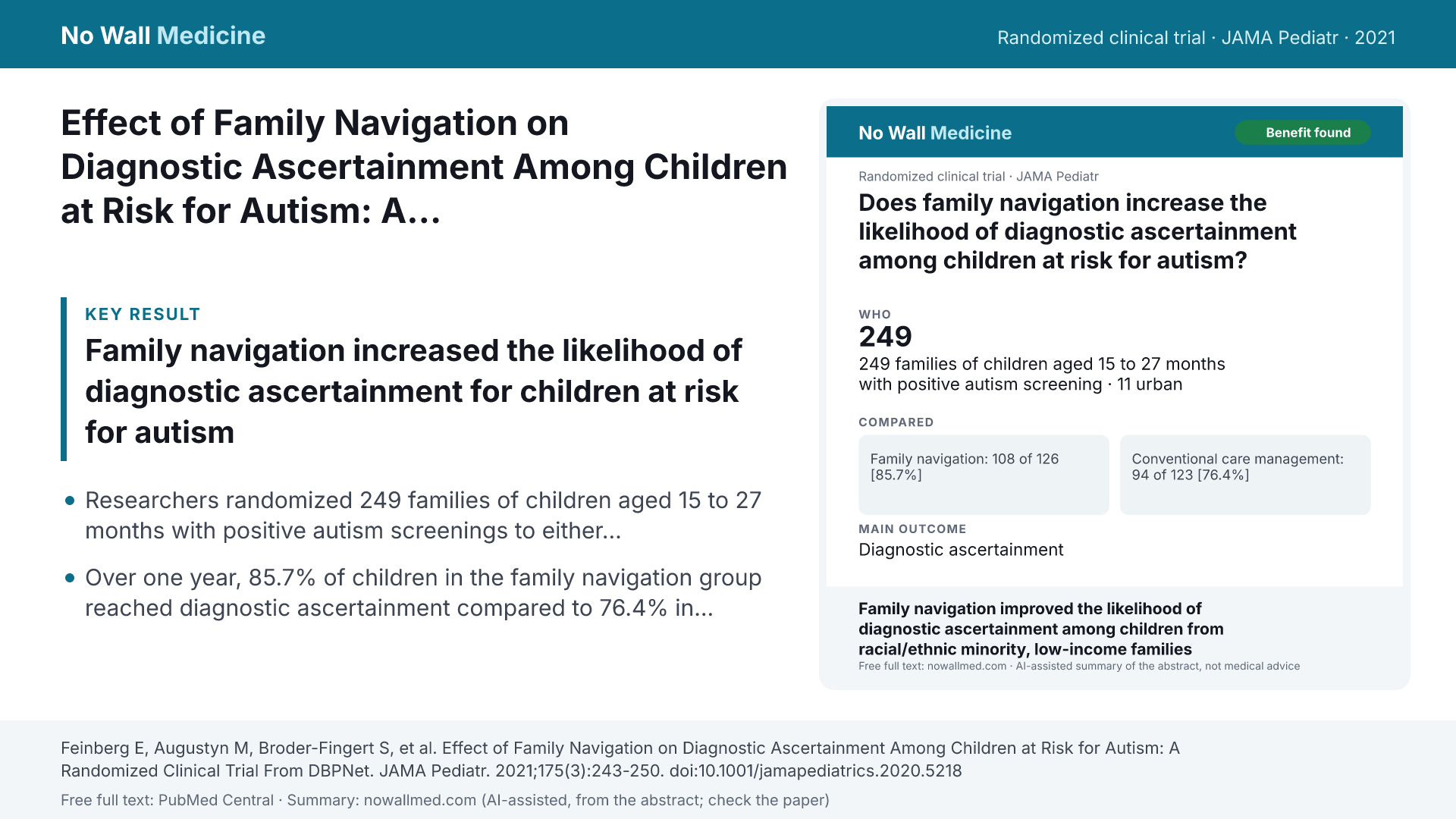
Family navigation increased the likelihood of diagnostic ascertainment for children at risk for autism
Effect of Family Navigation on Diagnostic Ascertainment Among Children at Risk for Autism: A Randomized Clinical Trial From DBPNet
Randomized clinical trialBenefit found
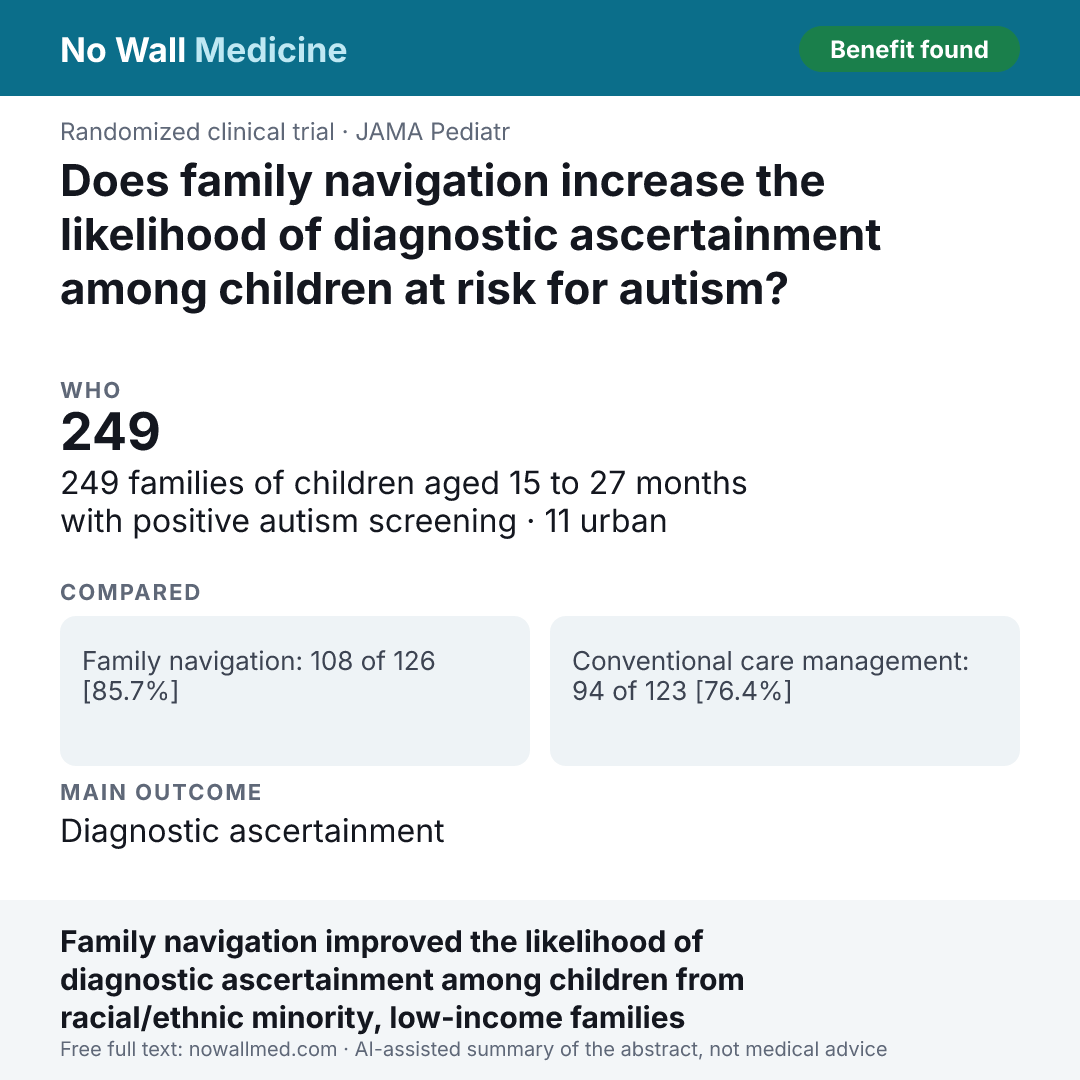
Does family navigation increase the likelihood of diagnostic ascertainment among children at risk for autism?
Who
249
249 families of children aged 15 to 27 months with positive autism screening · 11 urban primary care sites in 3 cities
Compared
Family navigation: 108 of 126 [85.7%]
Conventional care management: 94 of 123 [76.4%]
Main outcome
Diagnostic ascertainment
Result: unadjusted hazard ratio 1.39 (95% CI 1.05-1.84)
Bottom line: Family navigation improved the likelihood of diagnostic ascertainment among children from racial/ethnic minority, low-income families at risk for autism.
Limitation: Results suggest differential effects of family navigation by site and ethnicity.
JAMA Pediatr · 2021-01-12 · Save PNG
Same trial (NCT02359084)
Papers we list that report this registered trial, oldest first. Read a secondary analysis alongside the main results.
- Main results Benefit found
This paper JAMA Pediatr 2021-01 - Related analysis
Parents and navigators suggest 38 ways to adapt family navigation in pediatric primary care BMC Prim Care 2023-06
Clinical question: Does family navigation increase the likelihood of diagnostic ascertainment among children at risk for autism?
Why it matters: Targeted strategies are needed to ensure equitable access to diagnostic services for low-income and racial or ethnic minority families at risk for autism spectrum disorder.
Key points
- Researchers randomized 249 families of children aged 15 to 27 months with positive autism screenings to either family navigation or conventional care management.
- Over one year, 85.7% of children in the family navigation group reached diagnostic ascertainment compared to 76.4% in the conventional care management group.
- The effect of family navigation was significantly greater among Hispanic families, with 90.9% reaching diagnostic ascertainment compared to 53.3% in the conventional care group.
Headline and key points written with AI from the paper’s abstract, with every number checked against it. Read the paper before relying on them.
Was this summary helpful?
Subject terms
Headline, design, result, key points, caveat and citation as plain text.
Cite this article
Feinberg E, Augustyn M, Broder-Fingert S, et al. Effect of Family Navigation on Diagnostic Ascertainment Among Children at Risk for Autism: A Randomized Clinical Trial From DBPNet. JAMA Pediatr. 2021;175(3):243-250. doi:10.1001/jamapediatrics.2020.5218
Spotted a mistake? Suggest a correction