Dexmedetomidine infusion was associated with lower rates of delayed graft function after kidney transplant
Effect of Perioperative Dexmedetomidine on Delayed Graft Function Following a Donation-After-Cardiac-Death Kidney Transplant: A Randomized Clinical Trial
Single-center, double-blind, placebo-controlled randomized clinical trialBenefit found
Does perioperative dexmedetomidine reduce delayed graft function after donation-after-cardiac-death kidney transplant?
Who
111
Adults scheduled for donation-after-cardiac-death kidney transplant · The First Affiliated Hospital of Soochow University, China
Compared
17.9%dexmedetomidine
34.5%normal saline
Main outcome
incidence of delayed graft function
Result: odds ratio 0.41 (95% CI, 0.17-0.98)
Bottom line: Perioperative dexmedetomidine infusion decreased the incidence of delayed graft function after donation-after-cardiac-death kidney transplant.
JAMA Netw Open · 2022-06-01Download image
Clinical question: Does perioperative dexmedetomidine reduce delayed graft function after donation-after-cardiac-death kidney transplant?
Why it matters: It was unknown whether using dexmedetomidine during and after surgery would improve kidney function in patients receiving transplants from donors after cardiac death.
Key points
- Researchers studied 111 adults undergoing kidney transplants from deceased donors after cardiac death, comparing a 24-hour dexmedetomidine infusion to a saline placebo.
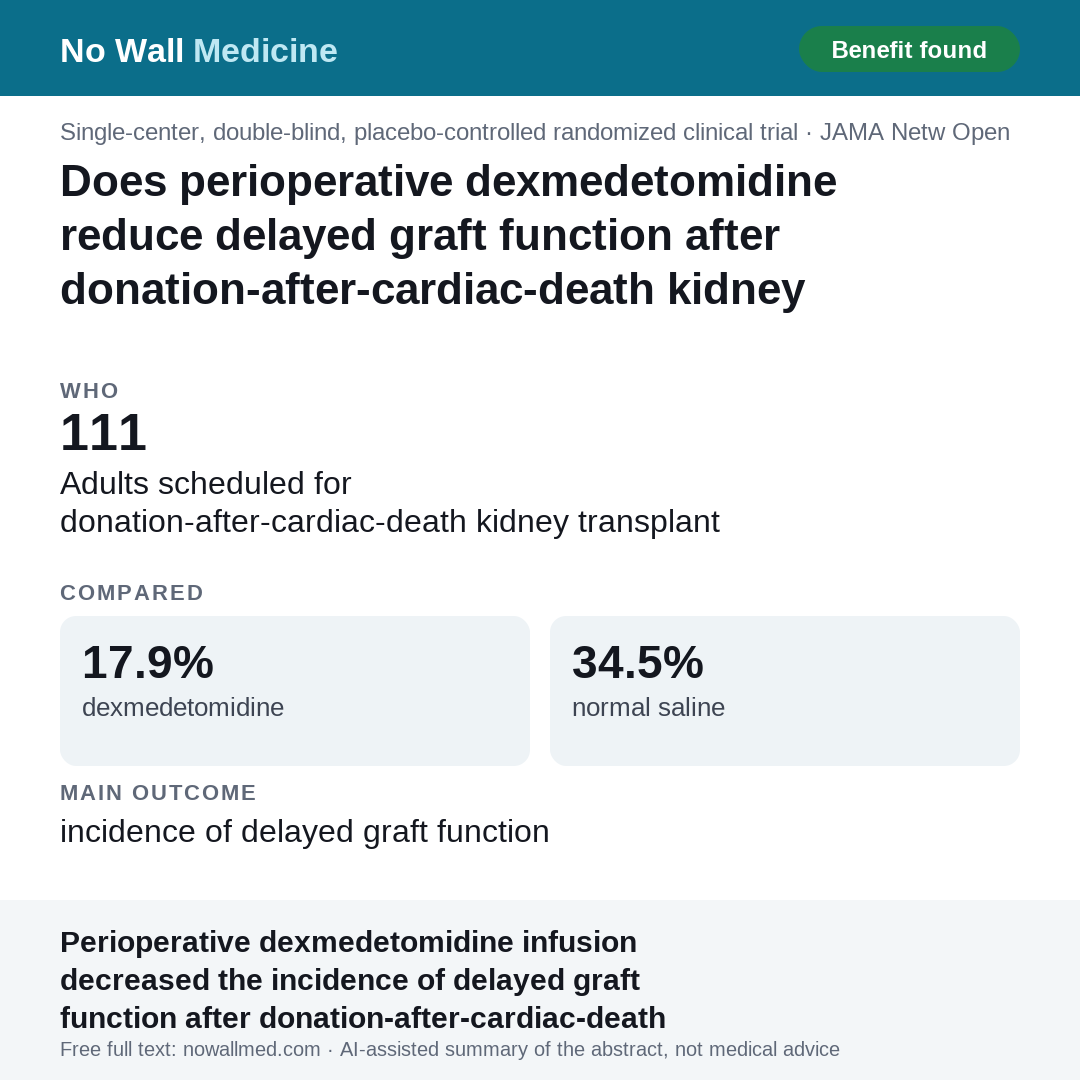
- The dexmedetomidine group had a lower incidence of delayed graft function, defined as needing dialysis in the first week, at 17.9% compared to 34.5% in the placebo group.
- Dexmedetomidine was also associated with a lower rate of repeated dialysis in the first week, though this result was not statistically significant after multiple testing corrections.
Headline and key points written with AI from the paper’s abstract, with every number checked against it. Read the paper before relying on them.
Was this summary helpful?
Subject terms
Cite this article
Shan XS, Hu LK, Wang Y, Liu HY, Chen J, Meng XW. Effect of Perioperative Dexmedetomidine on Delayed Graft Function Following a Donation-After-Cardiac-Death Kidney Transplant: A Randomized Clinical Trial. JAMA Netw Open. 2022. doi:10.1001/jamanetworkopen.2022.15217
Spotted a mistake? Suggest a correction
Top studies every Monday
The week’s key trials and guidelines in your specialties, plus any topics you follow. By email, free.
Get the weekly digest