Blinatumomab did not significantly improve disease-free survival compared to chemotherapy in relapsed B-cell leukemia
Effect of Postreinduction Therapy Consolidation With Blinatumomab vs Chemotherapy on Disease-Free Survival in Children, Adolescents, and Young Adults With First Relapse of B-Cell Acute Lymphoblastic Leukemia: A Randomized Clinical Trial
Randomized phase 3 clinical trialNo clear difference
Does blinatumomab improve disease-free survival compared to chemotherapy in first relapse B-cell acute lymphoblastic leukemia?
Who
208
Children, adolescents, and young adults with first relapse B-cell acute lymphoblastic leukemia · 155 hospitals in US, Canada, Australia, and New Zealand
Compared
54.4%Blinatumomab
39.0%Chemotherapy
Main outcome
Disease-free survival
Result: hazard ratio 0.70 (95% CI 0.47-1.03)
Bottom line: Blinatumomab did not result in a statistically significant difference in disease-free survival compared with chemotherapy.
Limitation: Study interpretation is limited by early termination with possible underpowering for the primary end point.
JAMA · 2021-03-02Download image
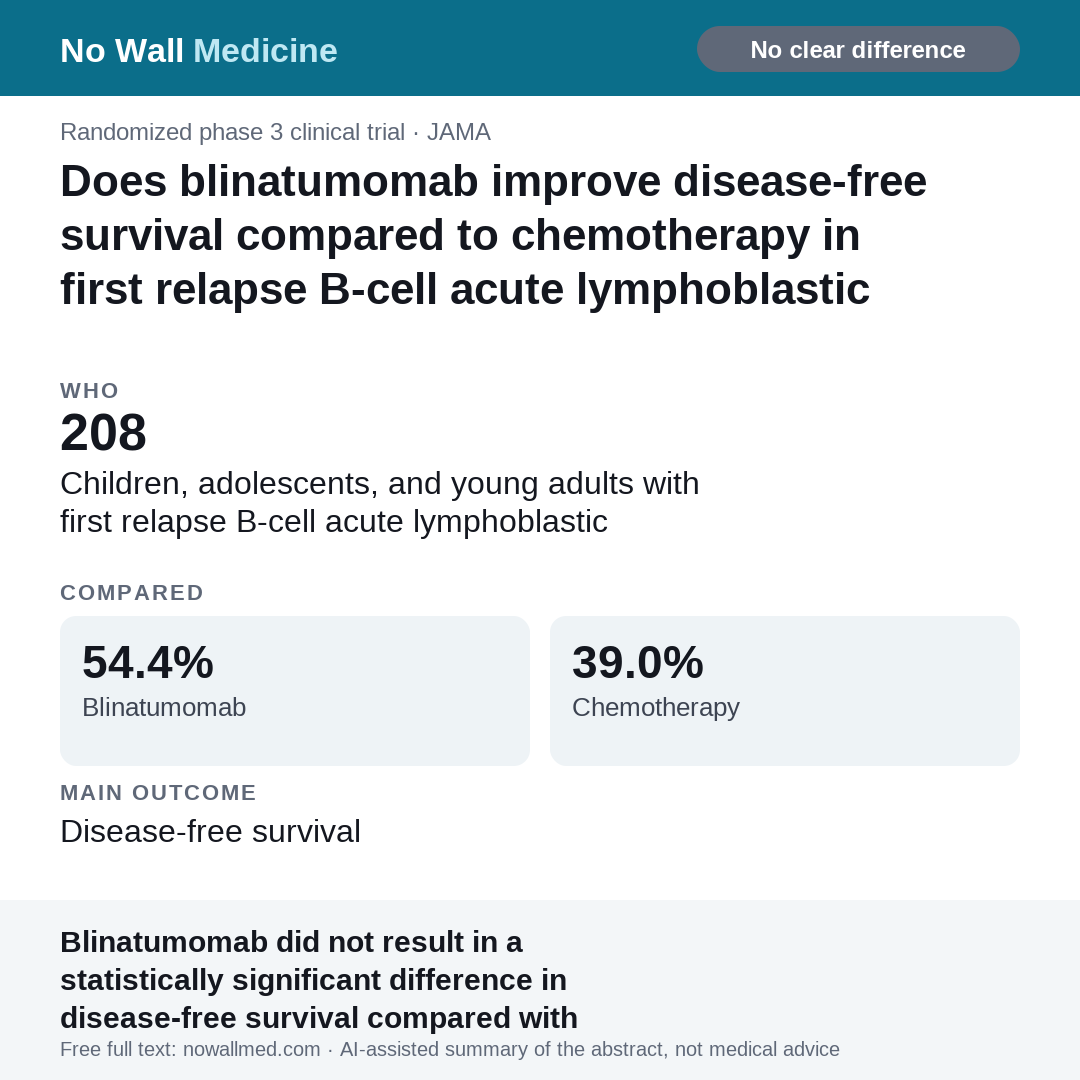
Clinical question: Does blinatumomab improve disease-free survival compared to chemotherapy in first relapse B-cell acute lymphoblastic leukemia?
Why it matters: Standard chemotherapy for first relapse of B-cell acute lymphoblastic leukemia is associated with high rates of severe toxicities, relapse, and death.
Key points
- The trial studied 208 patients aged 1 to 30 years with first relapse of B-cell acute lymphoblastic leukemia who were randomized to receive either blinatumomab or multiagent chemotherapy.
- The 2-year disease-free survival was 54.4% for the blinatumomab group versus 39.0% for the chemotherapy group, but this difference was not statistically significant.
- Serious adverse events like infection occurred in 15% of the blinatumomab group compared to 65% of the chemotherapy group.
Limitation the authors note: The authors state that study interpretation is limited by early termination with possible underpowering for the primary end point.
Headline and key points written with AI from the paper’s abstract, with every number checked against it. Read the paper before relying on them.
Was this summary helpful?
Subject terms
Cite this article
Brown PA, Ji L, Xu X, Devidas M, Hogan LE, Borowitz MJ. Effect of Postreinduction Therapy Consolidation With Blinatumomab vs Chemotherapy on Disease-Free Survival in Children, Adolescents, and Young Adults With First Relapse of B-Cell Acute Lymphoblastic Leukemia: A Randomized Clinical Trial. JAMA. 2021. doi:10.1001/jama.2021.0669
Spotted a mistake? Suggest a correction
Top studies every Monday
The week’s key trials and guidelines in your specialties, plus any topics you follow. By email, free.
Get the weekly digest