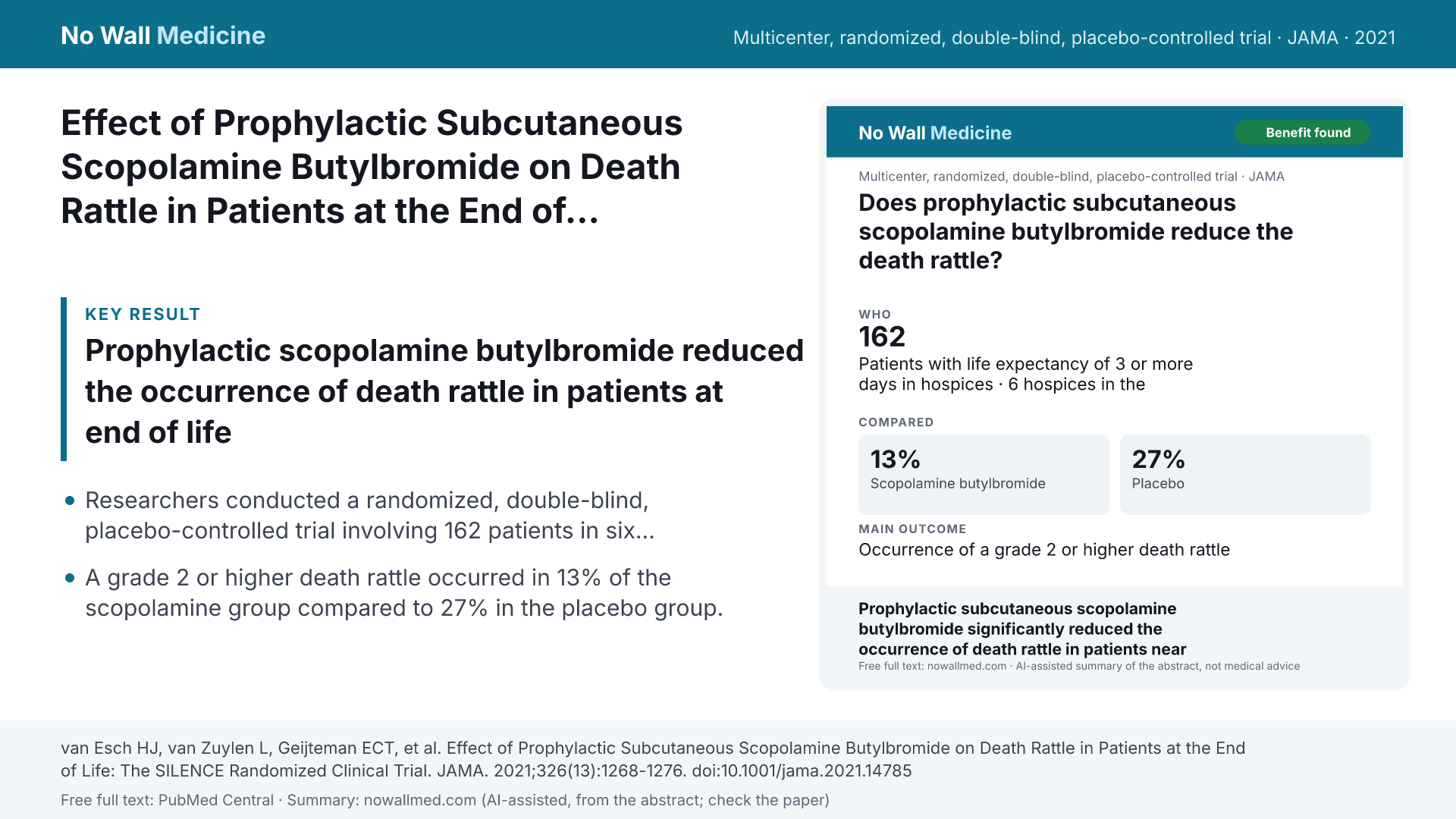
Prophylactic scopolamine butylbromide reduced the occurrence of death rattle in patients at end of life
Effect of Prophylactic Subcutaneous Scopolamine Butylbromide on Death Rattle in Patients at the End of Life: The SILENCE Randomized Clinical Trial
Multicenter, randomized, double-blind, placebo-controlled trialBenefit found
Does prophylactic subcutaneous scopolamine butylbromide reduce the death rattle?
Who
162
Patients with life expectancy of 3 or more days in hospices · 6 hospices in the Netherlands
Compared
13%Scopolamine butylbromide
27%Placebo
Main outcome
Occurrence of a grade 2 or higher death rattle
Result: difference, 14%; 95% CI, 2%-27%
Bottom line: Prophylactic subcutaneous scopolamine butylbromide significantly reduced the occurrence of death rattle in patients near the end of life.
JAMA · 2021-10-05Download image
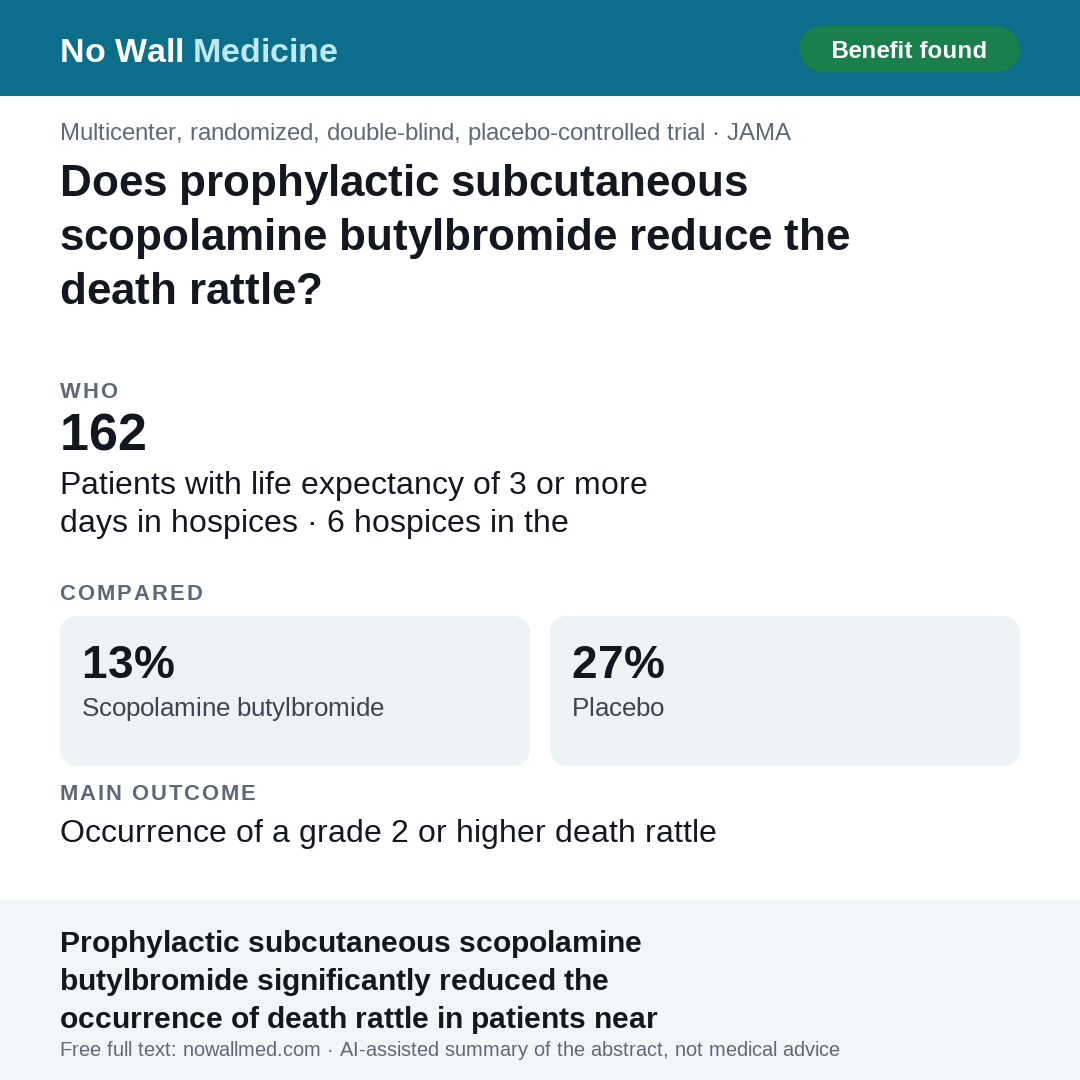
Clinical question: Does prophylactic subcutaneous scopolamine butylbromide reduce the death rattle?
In absolute numbers
Scopolamine butylbromide: 13% · Placebo: 27% → a difference of 14 percentage points, so about 8 people would need the treatment for 1 more to benefit (number needed to treat) over the trial’s follow-up.
Worked out by us from the two group results above, not reported by the authors. Check the paper for the exact outcome and timing.
Key points
- Researchers conducted a randomized, double-blind, placebo-controlled trial involving 162 patients in six Dutch hospices.
- A grade 2 or higher death rattle occurred in 13% of the scopolamine group compared to 27% in the placebo group.
- The cumulative incidence of death rattle at 48 hours was 8% in the scopolamine group versus 17% in the placebo group.
Headline and key points written with AI from the paper’s abstract, with every number checked against it. Read the paper before relying on them.
Was this summary helpful?
Subject terms
Headline, design, result, key points, caveat and citation as plain text.
Cite this article
van Esch HJ, van Zuylen L, Geijteman ECT, et al. Effect of Prophylactic Subcutaneous Scopolamine Butylbromide on Death Rattle in Patients at the End of Life: The SILENCE Randomized Clinical Trial. JAMA. 2021. doi:10.1001/jama.2021.14785
Spotted a mistake? Suggest a correction