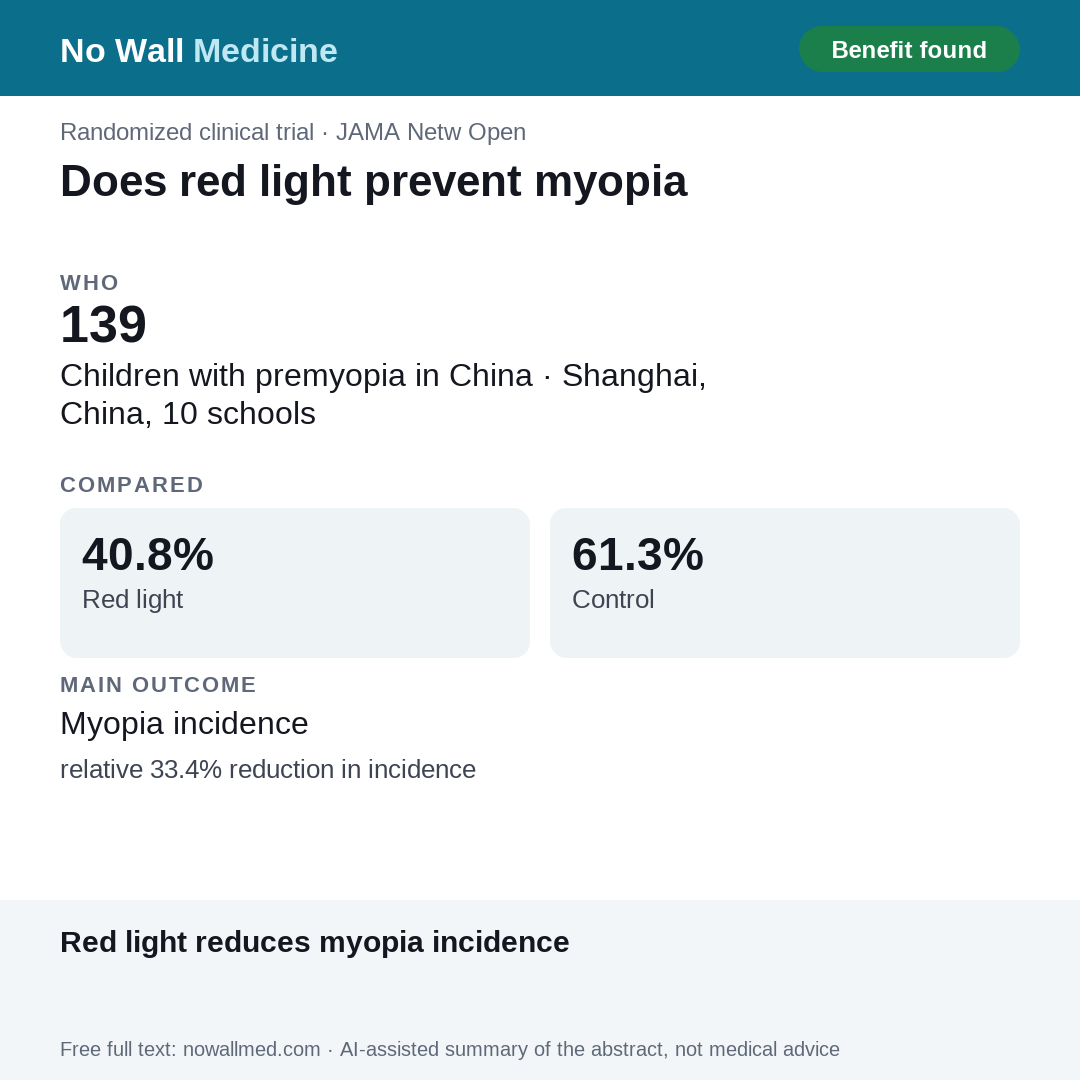
Red light therapy reduced myopia incidence in children with premyopia by 33.4%
Effect of Repeated Low-level Red Light on Myopia Prevention Among Children in China With Premyopia: A Randomized Clinical Trial
Randomized clinical trialBenefit found
Does red light prevent myopia
Who
139
Children with premyopia in China · Shanghai, China, 10 schools
Compared
40.8%Red light (49/120)
61.3%Control (68/111)
Main outcome
Myopia incidence
Result: relative 33.4% reduction in incidence
Bottom line: Red light reduces myopia incidence
Limitation: COVID-19 pandemic interruption
JAMA Netw Open · 2023-04-03Download image
Why it matters: Effective prevention measures for myopia remain limited
In absolute numbers
Red light: 40.8% · Control: 61.3% → a difference of 20.5 percentage points, so about 5 people would need the treatment for 1 more to benefit (number needed to treat) over the trial’s follow-up.
Worked out by us from the two group results above, not reported by the authors. Check the paper for the exact outcome and timing.
Key points
- 139 children with premyopia were randomly assigned to intervention or control groups.
- The 12-month myopia incidence was 40.8% in the intervention group and 61.3% in the control group.
- The intervention also reduced myopic shifts in axial length and spherical equivalence refraction.
Limitation the authors note: The COVID-19 pandemic caused treatment interruption in some participants
Headline and key points written with AI from the paper’s abstract, with every number checked against it. Read the paper before relying on them.
Was this summary helpful?
Subject terms
Cite this article
He X, Wang J, Zhu Z, Xiang K, Zhang X, Zhang B. Effect of Repeated Low-level Red Light on Myopia Prevention Among Children in China With Premyopia: A Randomized Clinical Trial. JAMA Netw Open. 2023. doi:10.1001/jamanetworkopen.2023.9612
Spotted a mistake? Suggest a correction
Top studies every Monday
The week’s key trials and guidelines in your specialties, plus any topics you follow. By email, free.
Get the weekly digest