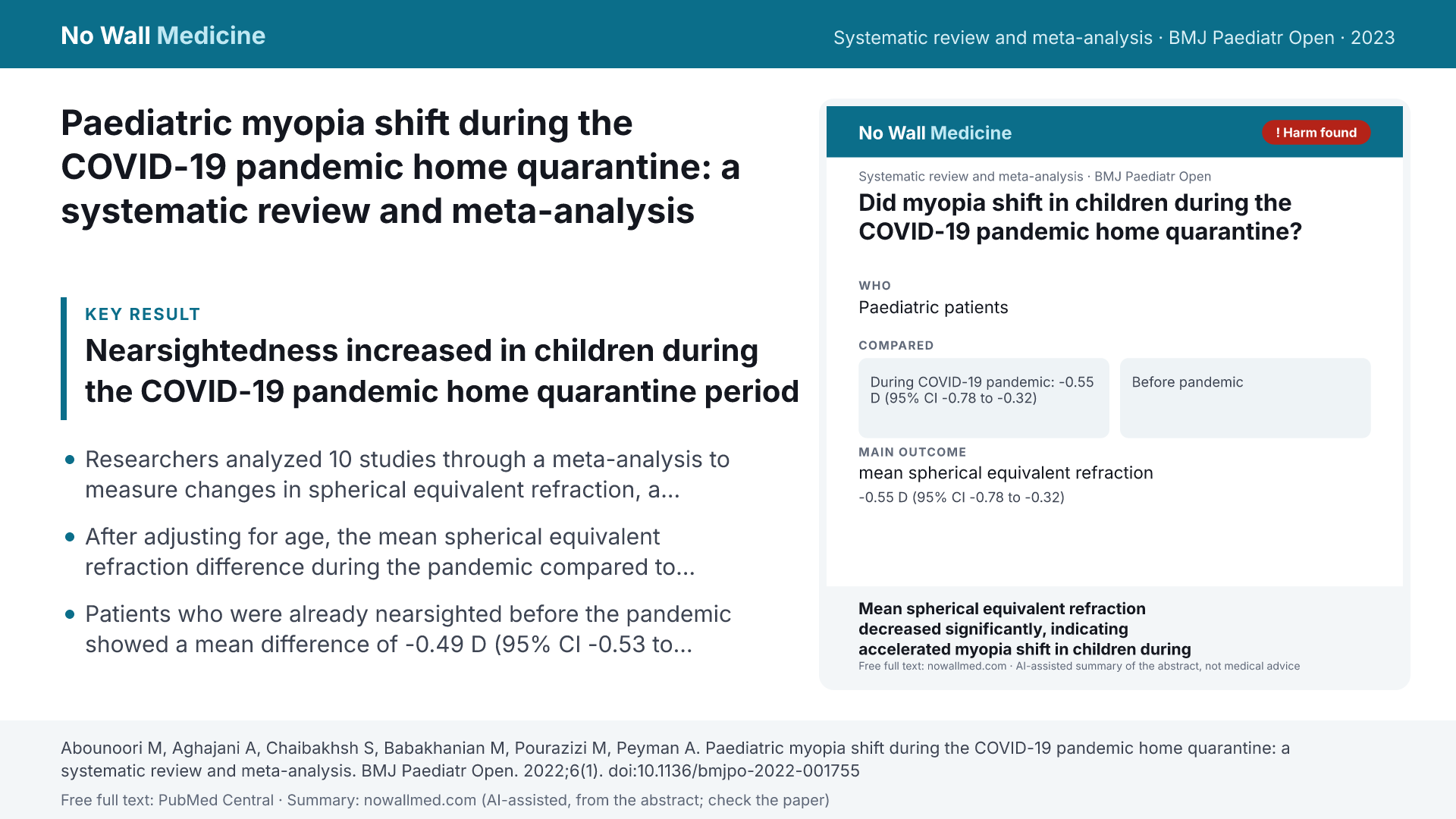
Nearsightedness increased in children during the COVID-19 pandemic home quarantine period
Paediatric myopia shift during the COVID-19 pandemic home quarantine: a systematic review and meta-analysis
Systematic review and meta-analysisHarm found
Did myopia shift in children during the COVID-19 pandemic home quarantine?
Who
Paediatric patients
Compared
During COVID-19 pandemic: -0.55 D (95% CI -0.78 to -0.32)
Before pandemic
Main outcome
mean spherical equivalent refraction
Result: -0.55 D (95% CI -0.78 to -0.32)
Bottom line: Mean spherical equivalent refraction decreased significantly, indicating accelerated myopia shift in children during the COVID-19 pandemic.
BMJ Paediatr Open · 2023-01-16 · Save PNG
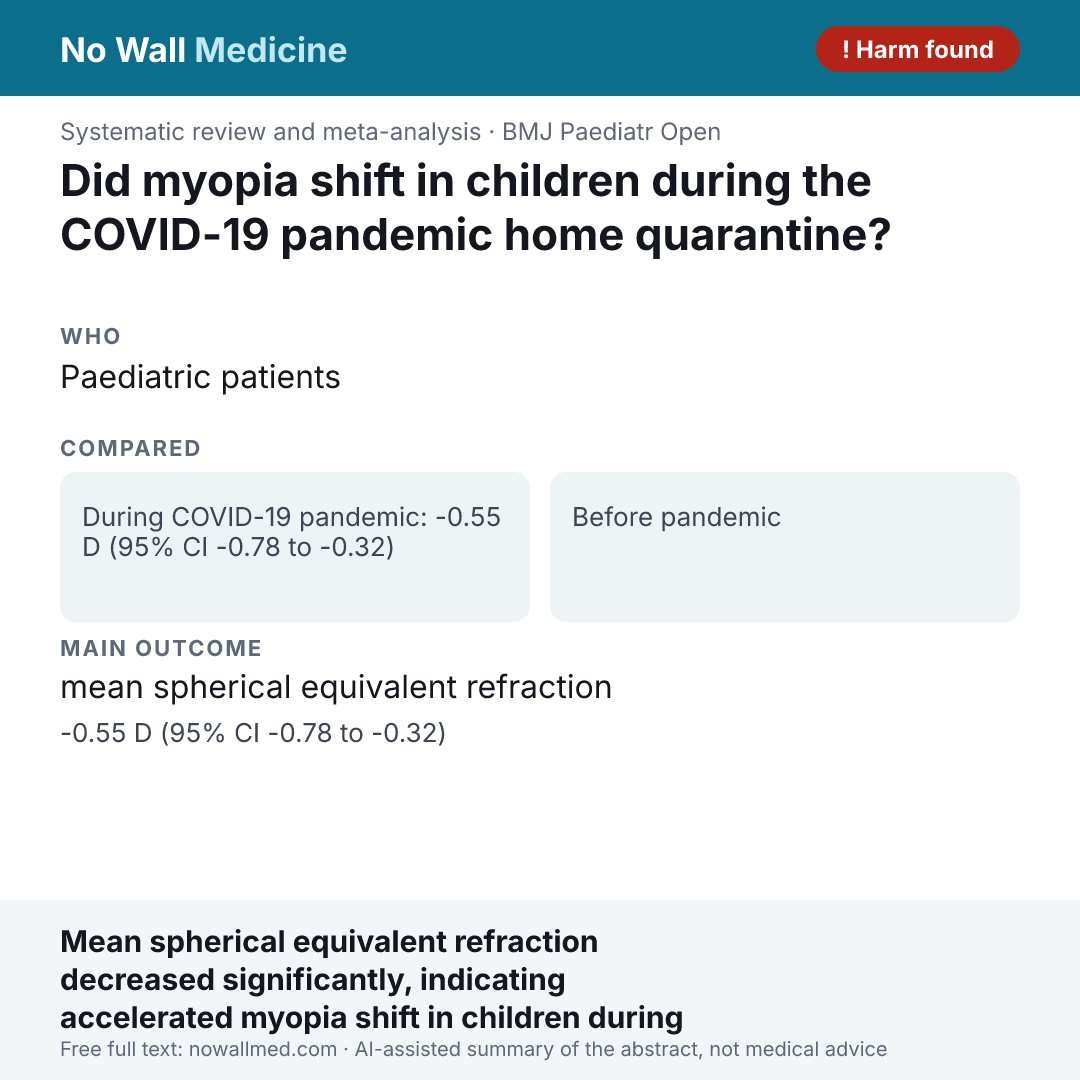
Clinical question: Did myopia shift in children during the COVID-19 pandemic home quarantine?
Key points
- Researchers analyzed 10 studies through a meta-analysis to measure changes in spherical equivalent refraction, a measure of nearsightedness, during the pandemic.
- After adjusting for age, the mean spherical equivalent refraction difference during the pandemic compared to before the pandemic was -0.46 D (95% CI -0.59 to -0.34, p<0.001).
- Patients who were already nearsighted before the pandemic showed a mean difference of -0.49 D (95% CI -0.53 to -0.45, p=0.00) during the follow-up.
Headline and key points written with AI from the paper’s abstract, with every number checked against it. Read the paper before relying on them.
Was this summary helpful?
Abstract
Background
Outdoor activities were restricted during the COVID-19 outbreak, although digital learning grew. Concerns have been raised about the impact of these environmental changes on myopia status. This research aimed to examine myopia shift during the COVID-19 pandemic and offer the community evidence-based data. Methods
The literature search was undertaken in PubMed, SCOPUS, Science Direct, Web of Science and Google Scholar databases on published papers before 17 May 2022. The main outcome was mean spherical equivalent refraction (SER) before, at the onset and at the end of follow-up during the COVID-19 pandemic. Results
Among 518 articles, 10 studies were included in the meta-analysis. The mean SER differences during the COVID-19 pandemic follow-up (mean follow-up time was 10 months) compared with before the pandemic was 0.15 dioptre (D) (95% CI -0.39 to 0.69, p=0.58). After age adjustment using meta-regression, the mean SER differences during the COVID-19 follow-up compared with before the pandemic was - 0.46 D (95% CI -0.59 to -0.34, p<0.001). Over the mean follow-up time during the COVID-19 pandemic, the SER mean difference was -0.55 D (95% CI -0.78 to -0.32, p<0.001), showing that the mean SER had decreased significantly during the COVID-19 pandemic. The mean SER differences in myopic patients before COVID-19 compared with during the pandemic follow-up was -0.49 D (95% CI -0.53 to -0.45, p=0.00). So the prior pandemic myopic patients became more myopic during the pandemic follow-up time. Conclusion
During home quarantine, the mean SRE shifting in paediatrics accelerated. This phenomenon should be given more attention by policymakers, eyecare experts, educators and parents.
Abstract reproduced under the article’s CC BY NC licence.
Subject terms
Headline, design, result, key points, caveat and citation as plain text.
Cite this article
Abounoori M, Aghajani A, Chaibakhsh S, Babakhanian M, Pourazizi M, Peyman A. Paediatric myopia shift during the COVID-19 pandemic home quarantine: a systematic review and meta-analysis. BMJ Paediatr Open. 2022;6(1). doi:10.1136/bmjpo-2022-001755
Spotted a mistake? Suggest a correction