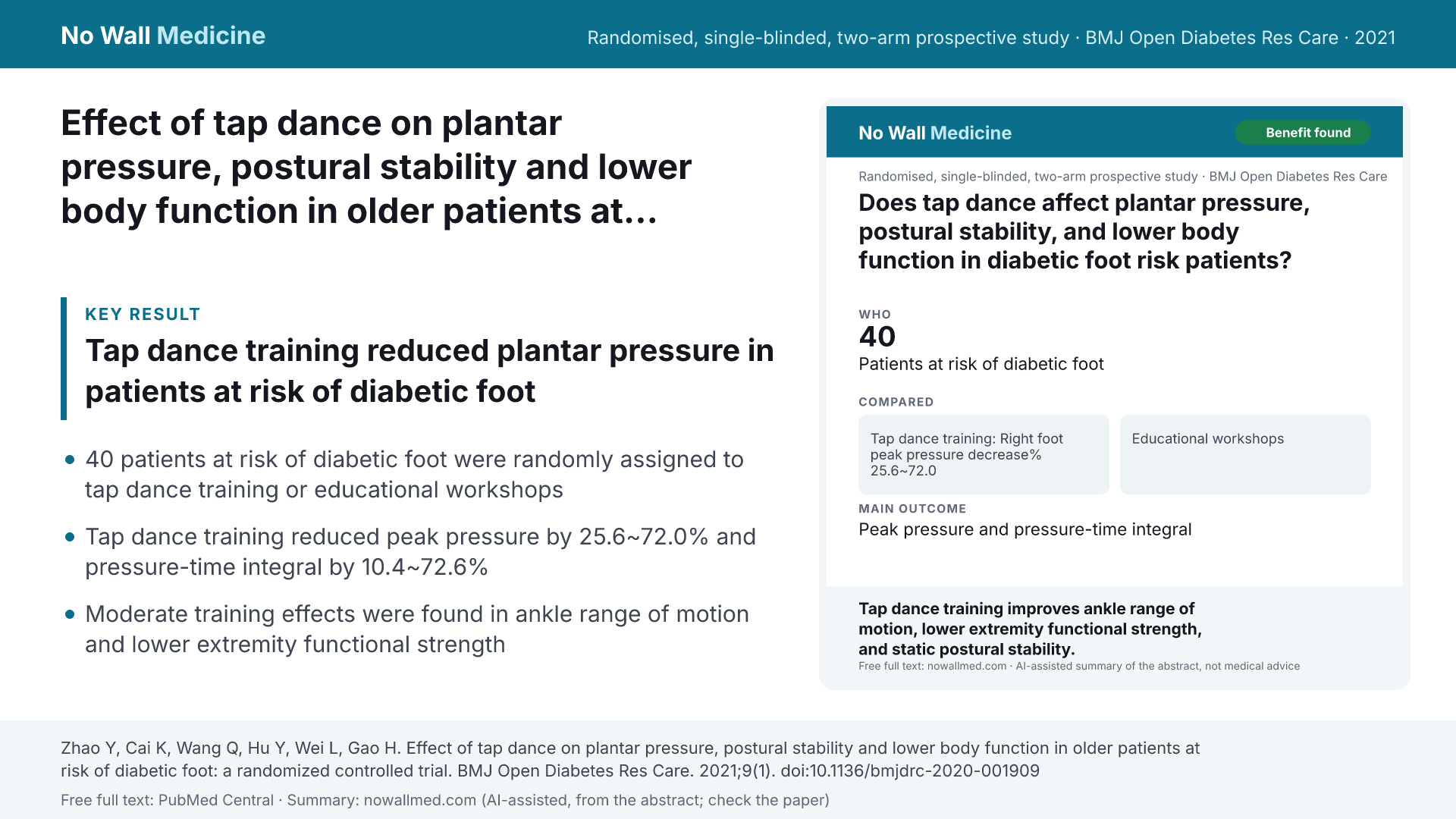
Tap dance training reduced plantar pressure in patients at risk of diabetic foot
Effect of tap dance on plantar pressure, postural stability and lower body function in older patients at risk of diabetic foot: a randomized controlled trial
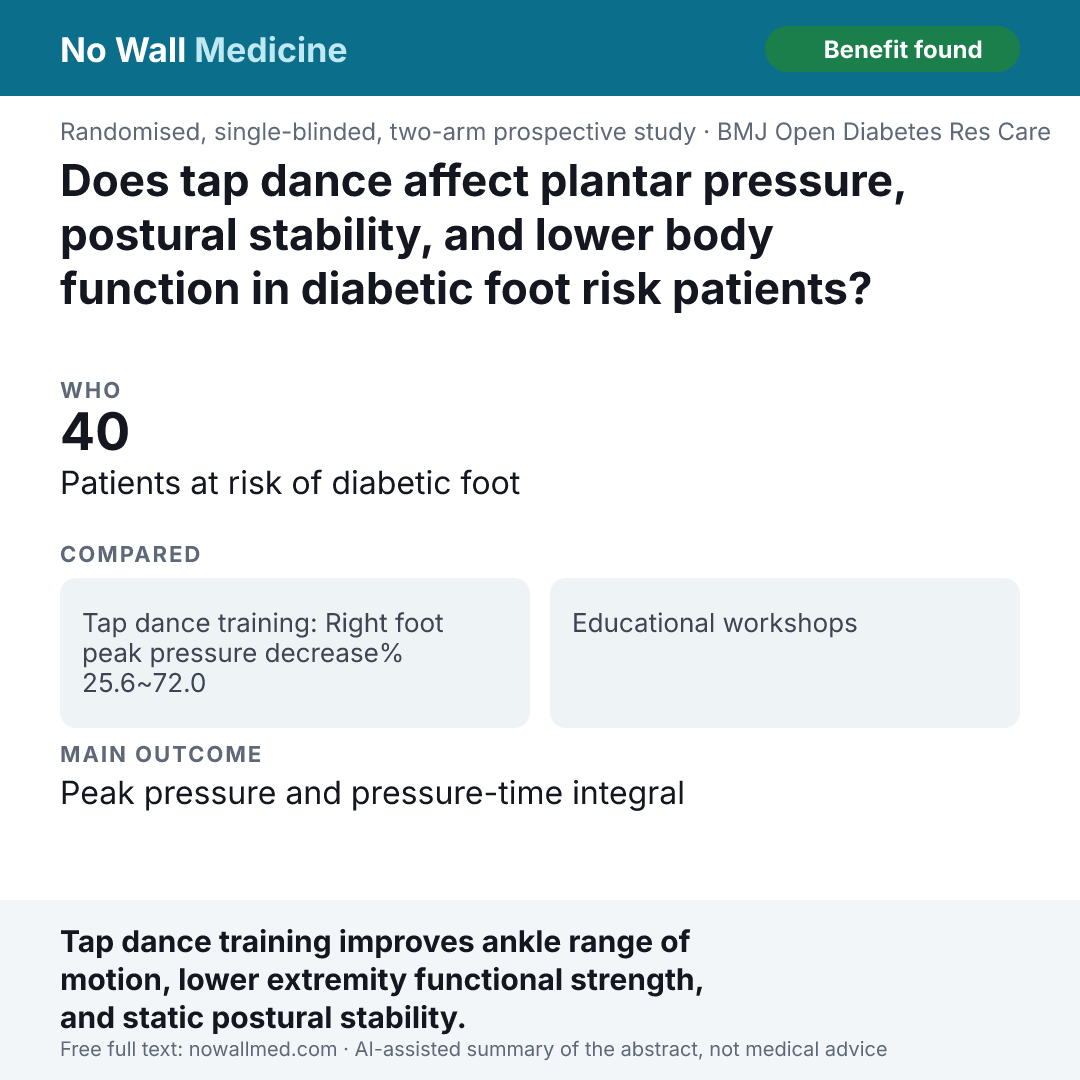
Randomised, single-blinded, two-arm prospective studyBenefit found
Does tap dance affect plantar pressure, postural stability, and lower body function in diabetic foot risk patients?
Who
40
Patients at risk of diabetic foot
Compared
Tap dance training: Right foot peak pressure decrease% 25.6~72.0
Educational workshops
Main outcome
Peak pressure and pressure-time integral
Bottom line: Tap dance training improves ankle range of motion, lower extremity functional strength, and static postural stability.
BMJ Open Diabetes Res Care · 2021-03-19 · ChiCTR1800014714
Headline and visual abstract written with AI from the paper’s abstract, with every number checked against it. Read the paper before relying on them.
Was this summary helpful?
Abstract
Introduction
To examine the effects of tap dance (TD) on dynamic plantar pressure, static postural stability, ankle range of motion (ROM), and lower extremity functional strength in patients at risk of diabetic foot (DF). Research design and methods
A randomised, single-blinded, two-arm prospective study of 40 patients at risk of DF was conducted. The intervention group (n=20) received 16 weeks of TD training (60 min/session×3 sessions/week). The control group attended four educational workshops (1 hour/session×1 session/month). Plantar pressure, represented by the primary outcomes of peak pressure (PP) and pressure-time integral (PTI) over 10 areas on each foot, was measured using the Footscan platform system. Secondary outcomes comprised static postural stability, ankle ROM and lower extremity functional strength. Results
Reductions in intervention group PP (right foot: mean differences=4.50~27.1, decrease%=25.6~72.0; left foot: mean differences=-5.90~6.33, decrease%=-22.6~53.2) and PTI at 10 areas of each foot (right foot: mean differences=1.00~12.5, decrease%=10.4~63.6; left foot: mean differences=0.590~25.3, decrease%=21.9~72.6) were observed. Substantial PP and PTI differences were noted at the second through fourth metatarsals, medial heel and lateral heel in the right foot. Substantial PP and PTI differences were detected at metatarsals 1 and 2 and metatarsal 2 in the left foot, respectively. Moderate training effects were found in plantar flexion ROM of both feet, lower extremity functional strength, and length of center-of-pressure trajectory with eyes closed and open (r=0.321-0.376, p<0.05). Conclusions
A 16-week TD training program can significantly improve ankle ROM, lower extremity functional strength, and static postural stability. To attain greater improvements in plantar pressure, a longer training period is necessary. Trial registration number
ChiCTR1800014714.
Abstract reproduced under the article’s CC BY NC licence.
Subject terms
Cite this article
Zhao Y, Cai K, Wang Q, Hu Y, Wei L, Gao H. Effect of tap dance on plantar pressure, postural stability and lower body function in older patients at risk of diabetic foot: a randomized controlled trial. BMJ Open Diabetes Res Care. 2021;9(1). doi:10.1136/bmjdrc-2020-001909
Spotted a mistake? Suggest a correction