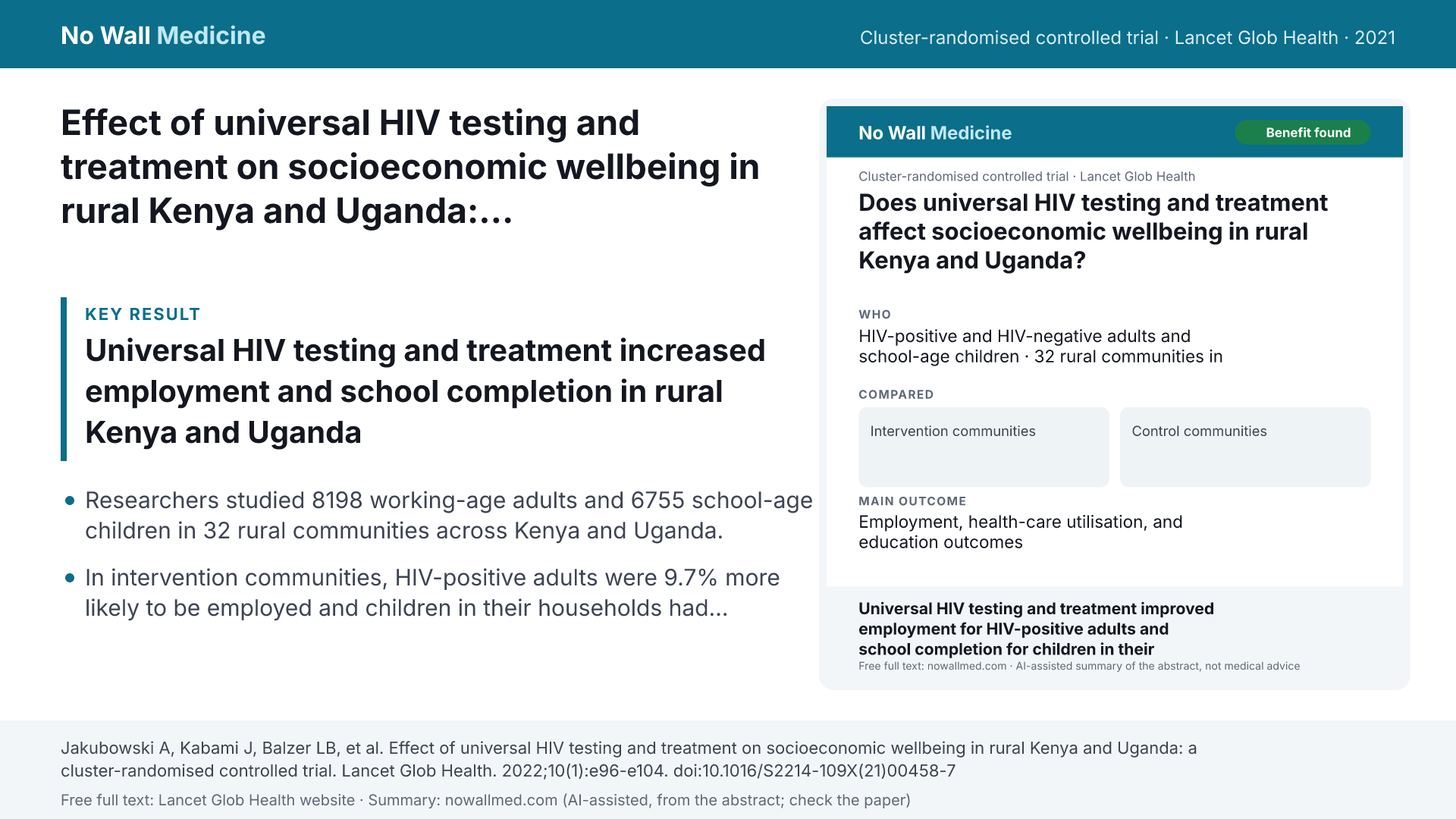
Universal HIV testing and treatment increased employment and school completion in rural Kenya and Uganda
Effect of universal HIV testing and treatment on socioeconomic wellbeing in rural Kenya and Uganda: a cluster-randomised controlled trial
Cluster-randomised controlled trialBenefit found
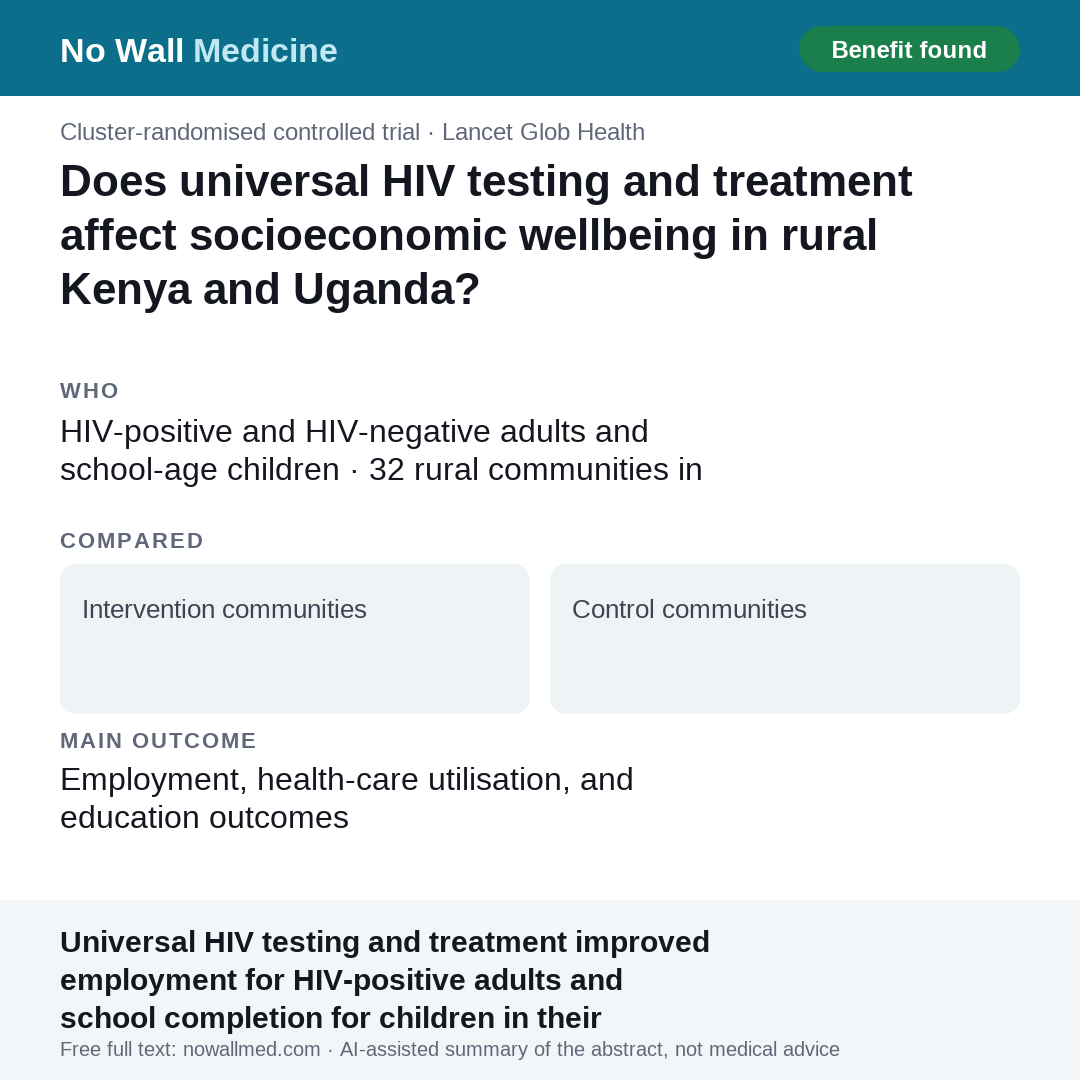
Does universal HIV testing and treatment affect socioeconomic wellbeing in rural Kenya and Uganda?
Who
HIV-positive and HIV-negative adults and school-age children · 32 rural communities in Kenya and Uganda
Compared
Intervention communities
Control communities
Main outcome
Employment, health-care utilisation, and education outcomes
Bottom line: Universal HIV testing and treatment improved employment for HIV-positive adults and school completion for children in their households.
Funded by: National Institutes of Health
Lancet Glob Health · 2021-12-17Download image
Clinical question: Does universal HIV testing and treatment affect socioeconomic wellbeing in rural Kenya and Uganda?
Key points
- Researchers studied 8198 working-age adults and 6755 school-age children in 32 rural communities across Kenya and Uganda.
- In intervention communities, HIV-positive adults were 9.7% more likely to be employed and children in their households had 7.3% higher primary school completion rates.
- HIV-positive adults in intervention communities were 10.3% less likely to seek health care and spent 12.7% less money on health care.
Headline and key points written with AI from the paper’s abstract, with every number checked against it. Read the paper before relying on them.
Was this summary helpful?
Abstract
Background
Universal testing and treatment for HIV has shown promise as an approach to reduce mortality and lower HIV incidence. Evidence on the economic effects of this approach on individuals and households in low-resource settings is scarce. We aimed to examine the effect of universal HIV testing and treatment on a range of economic outcomes. Methods
We collected data in household surveys done over a 3-year period in a sample of HIV-positive and HIV-negative adults participating in a cluster-randomised trial of universal HIV testing and treatment in 32 rural communities in Kenya and Uganda. Communities of approximately 10 000 people were pair-matched on the basis of geographical and population characteristics, with the best-matching 16 pairs randomly assigned (1:1) to intervention or control groups. Participants in intervention communities received annual HIV and multidisease testing, universal antiretroviral therapy (ART) eligibility, and patient-centred care. Participants in control communities received baseline testing and medical care according to national guidelines. We analysed employment and health-care utilisation outcomes for working-age adults (age 18-65 years) and education outcomes for school-age children (6-17 years) using data from 3 years after the intervention. This trial is now complete, and is registered with ClinicalTrials.gov, NCT01864603. Findings
Between July 9, 2013, and June 15, 2017, we collected survey data on 8198 working-age adults and 6755 school-age children. Compared with adults living with HIV in control communities, adults living with HIV in intervention communities were more likely to be employed (difference 9·7% [95% CI 2·1 to 18·3]), less likely to seek health care (-10·3% [-22·0 to 0·1]), and less likely to spend money on health care (-12·7% [-22·4 to 0·6]) 3 years after the intervention. We found no significant differences in outcomes between HIV-negative adults in intervention and control communities. Among children in households with HIV-positive adults, the intervention led to a 7·3% (95% CI 1·0 to 15·1) increase in primary school completion after 3 years in intervention communities compared with control communities. Interpretation
Universal HIV testing and treatment improved employment outcomes and other indicators of socioeconomic wellbeing for HIV-positive adults and children in their households, but had no effect on HIV-negative adults. Our findings suggest that the considerable investments needed to expand ART access might have substantial short-term and long-term economic returns. Funding
National Institutes of Health.
Abstract reproduced under the article’s CC BY licence.
Subject terms
Headline, design, result, key points, caveat and citation as plain text.
Cite this article
Jakubowski A, Kabami J, Balzer LB, et al. Effect of universal HIV testing and treatment on socioeconomic wellbeing in rural Kenya and Uganda: a cluster-randomised controlled trial. Lancet Glob Health. 2022;10(1):e96-e104. doi:10.1016/S2214-109X(21)00458-7
Spotted a mistake? Suggest a correction