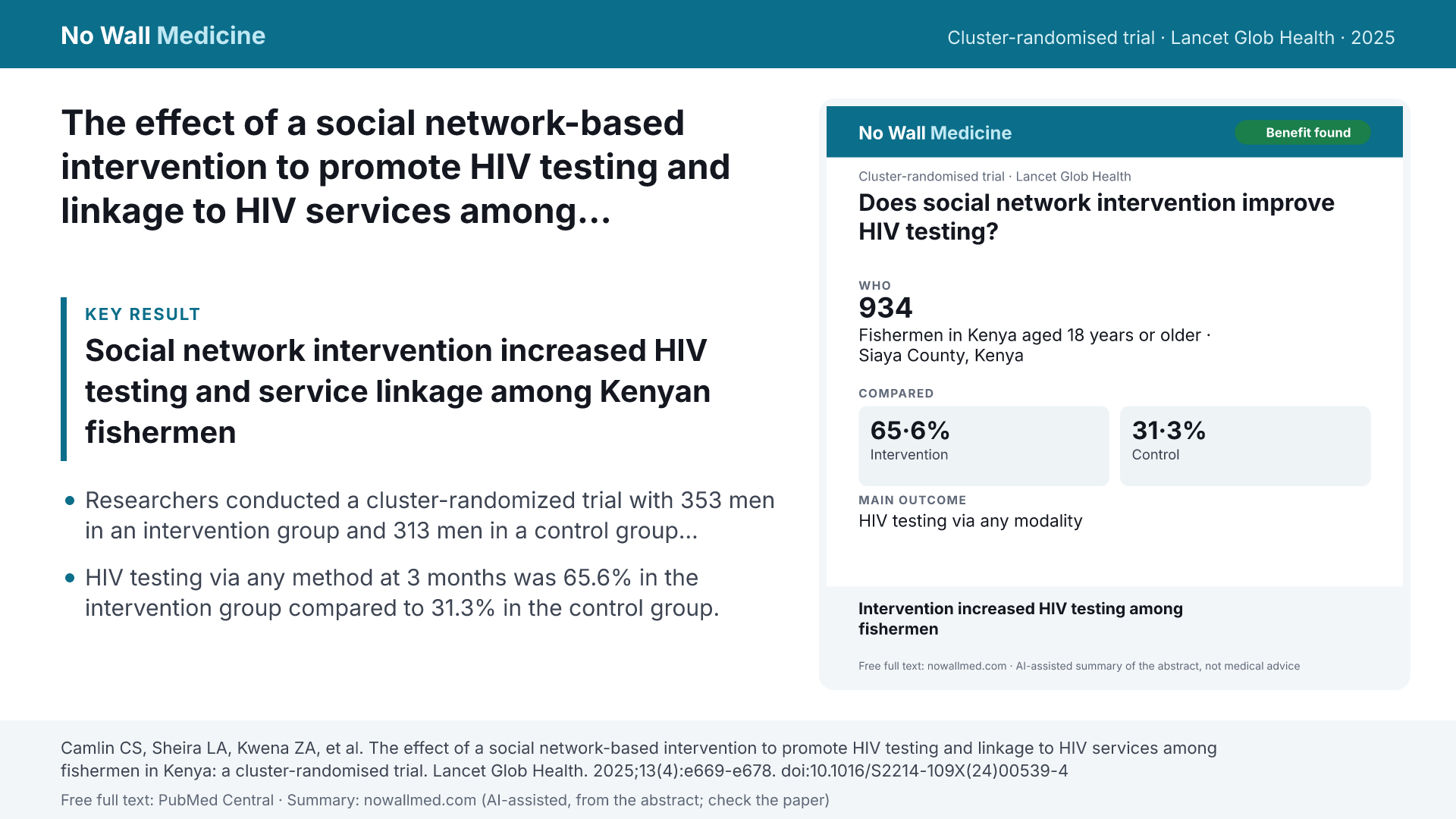
Social network intervention increased HIV testing and service linkage among Kenyan fishermen
The effect of a social network-based intervention to promote HIV testing and linkage to HIV services among fishermen in Kenya: a cluster-randomised trial
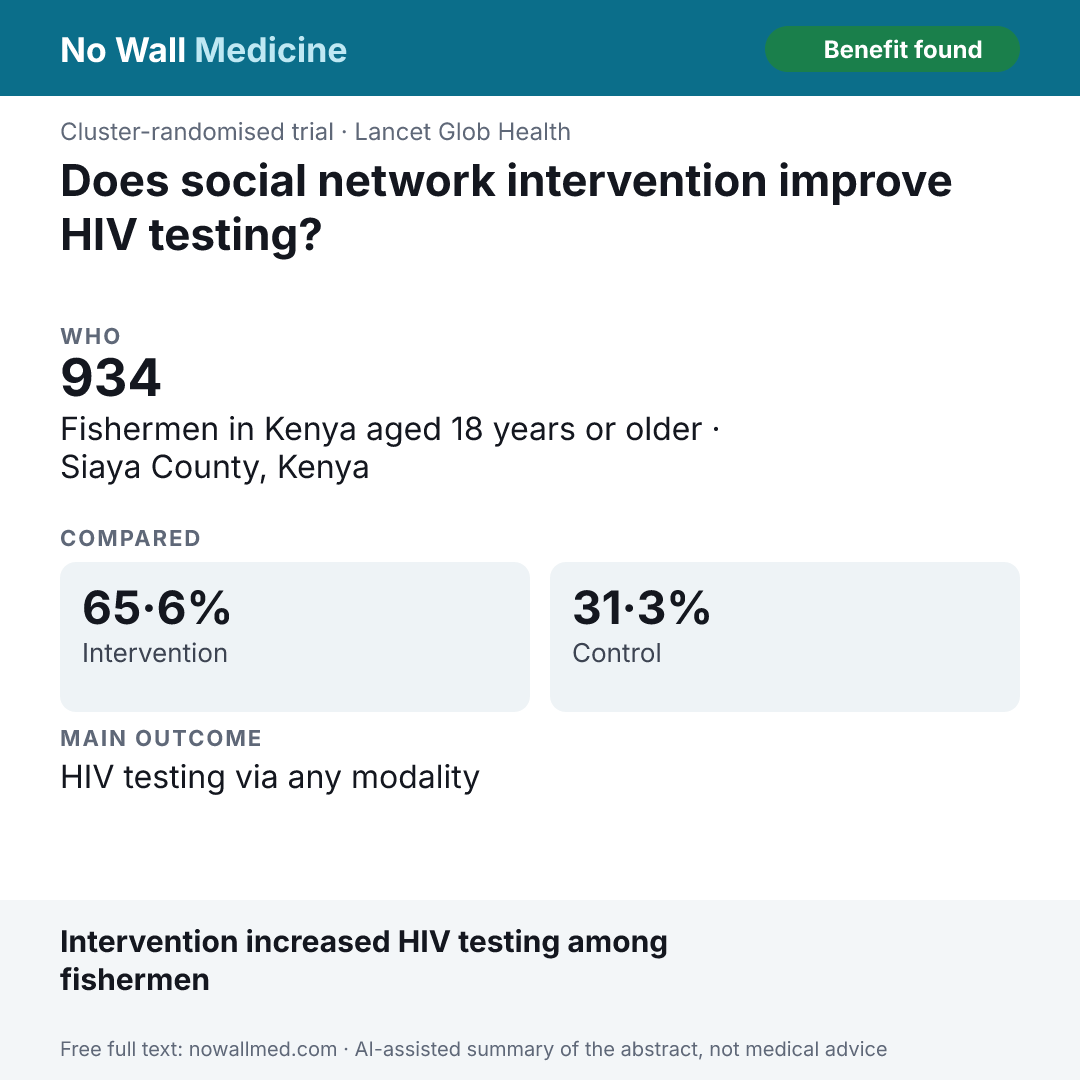
Cluster-randomised trialBenefit found
Does social network intervention improve HIV testing?
Who
934
Fishermen in Kenya aged 18 years or older · Siaya County, Kenya
Compared
65·6%Intervention (95% CI 59·5-71·7)
31·3%Control (25·4-37·2)
Main outcome
HIV testing via any modality
Bottom line: Intervention increased HIV testing among fishermen
Funded by: National Institute of Mental Health
Lancet Glob Health · 2025-03-29 · Save PNG
Why it matters: Highly mobile men such as fishermen in sub-Saharan Africa have low rates of HIV testing, prevention, and treatment uptake.
Headline and visual abstract written with AI from the paper’s abstract, with every number checked against it. Read the paper before relying on them.
Was this summary helpful?
Abstract
Background
In sub-Saharan Africa, highly mobile men such as fishermen have a low uptake of HIV testing, prevention, and treatment. This study aimed to examine whether a HIV status-neutral, social network-based intervention could improve testing and linkage to prevention and treatment among fishermen in Kenya. Methods
The Owete cluster-randomised trial mapped the male social networks of fishermen in three communities along Lake Victoria in Siaya County, Kenya, and identified distinct social networks (clusters) with a highly connected, network-central man (promoter) in each network. Participant inclusion criteria were age 18 years or older, a listing in the Beach Management Unit registry, a governmental requirement to work as a fisherman at each site, and no participation in any other HIV-related study. Clusters were randomly assigned to an intervention group in which promoters were trained and offered multiple HIV self-tests to offer to cluster members, and transport vouchers (US$4) to encourage those members to link to HIV treatment or pre-exposure prophylaxis (PrEP). In control clusters, promoters received HIV information and referral vouchers for a free self-test or provider-administered test in nearby clinics that they were encouraged to offer to cluster members. We compared self-reported HIV testing in the past 3 months and linkage to HIV services among participants in intervention and control clusters at the 3-month follow-up visit in the intention-to-treat sample, defined as members of the social networks who were successfully contacted at 3 months using a cluster-adjusted two-sample test of proportions. The trial is registered at ClinicalTrials.gov, NCT04772469, and is completed. Findings
Between July 17, 2020 and Feb 2, 2022, 1509 eligible men participated in the beach census. 575 were excluded due to not being mapped to a close social network, and 934 men in 156 social network clusters were mapped. 453 men were randomly assigned to the intervention group and 481 were randomly assigned to the control group. 733 men completed a baseline survey (374 in the intervention group and 359 in the control group). 353 men in the intervention group and 313 in the control group completed the 3-month follow-up assessments and were included in the analysis of the primary outcome. Participants' median age was 35·5 years (IQR 30·1-42·3); 85% were married, with 22% in polygynous relationships. HIV testing via any modality at 3 months was higher in intervention compared with control clusters (65·6 [95% CI 59·5-71·7] vs 31·3% [25·4-37·2], p<0·0001). Self-reported HIV testing at 3 months was also higher in intervention clusters (60·4% [95% CI 54·2-66·7] vs 10·0% [6·8-13·3], p<0·0001). Additionally, following testing, linkage to HIV treatment or PrEP among those who tested was higher in intervention clusters (67·3% [95% CI 61·2-73·5] vs 15·6% [10·9-20·2], p<0·0001). Interpretation
A status-neutral social network intervention that utilised HIV self-screening tests proved to be highly effective in engaging hard-to-reach, highly mobile Kenyan men in HIV testing and care. This strategy holds promise for improving early detection and care engagement for other infectious and non-communicable diseases globally. Similar approaches that leverage peer influence within social networks and the growing accessibility of self-screening tests could be adapted for conditions such as tuberculosis, hepatitis, and hypertension in diverse global health settings. Funding
National Institute of Mental Health.
Abstract reproduced under the article’s CC BY licence.
Subject terms
Headline, design, result, bottom line, caveat and citation as plain text.
Cite this article
Camlin CS, Sheira LA, Kwena ZA, et al. The effect of a social network-based intervention to promote HIV testing and linkage to HIV services among fishermen in Kenya: a cluster-randomised trial. Lancet Glob Health. 2025;13(4):e669-e678. doi:10.1016/S2214-109X(24)00539-4
Spotted a mistake? Suggest a correction