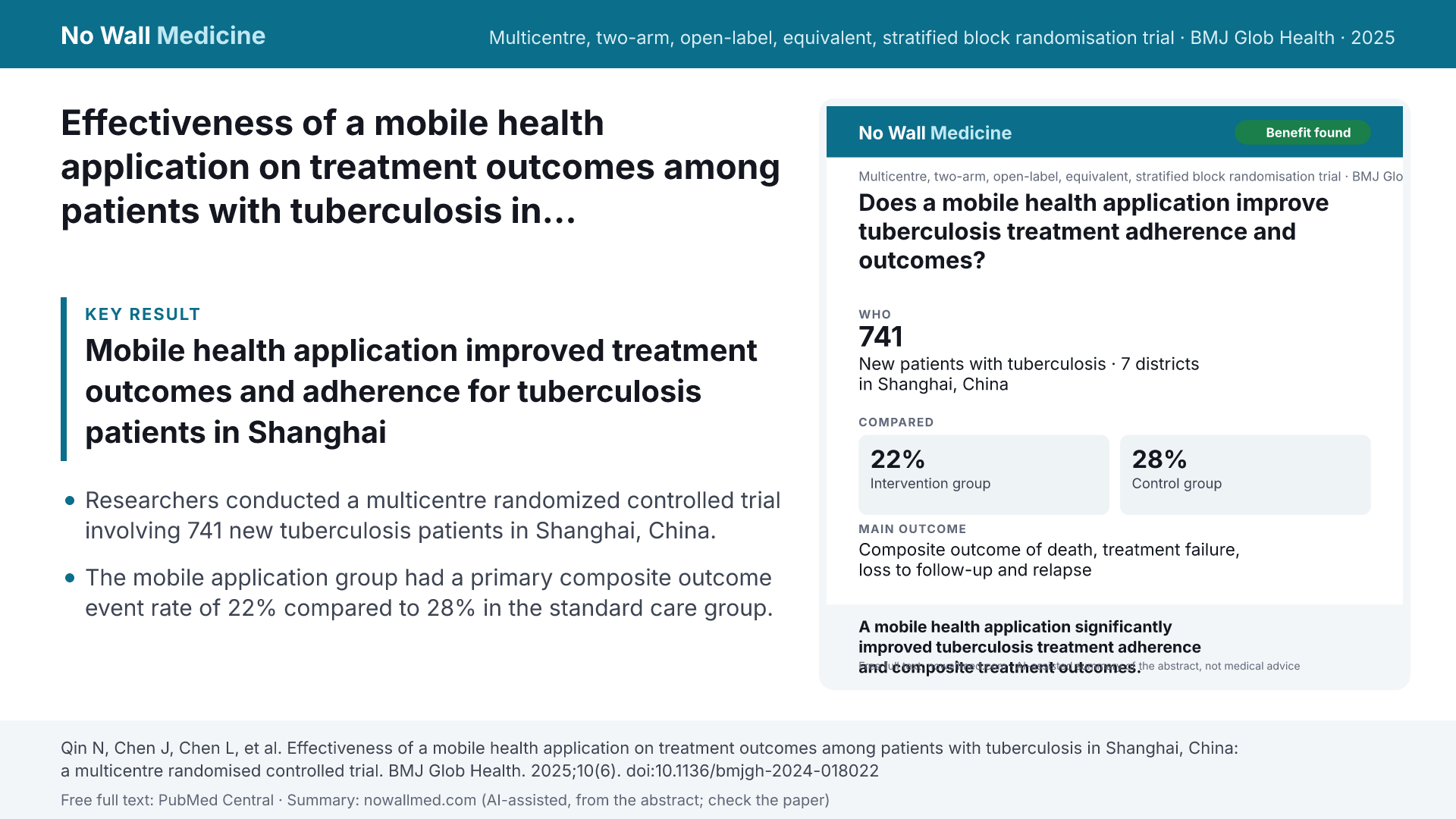
Mobile health application improved treatment outcomes and adherence for tuberculosis patients in Shanghai
Effectiveness of a mobile health application on treatment outcomes among patients with tuberculosis in Shanghai, China: a multicentre randomised controlled trial
Multicentre, two-arm, open-label, equivalent, stratified block randomisation trialBenefit found
Does a mobile health application improve tuberculosis treatment adherence and outcomes?
Who
741
New patients with tuberculosis · 7 districts in Shanghai, China
Compared
22%Intervention group
28%Control group
Main outcome
Composite outcome of death, treatment failure, loss to follow-up and relapse
Result: -7.04 percentage points (95% CI -13.25 to -1.14)
Bottom line: A mobile health application significantly improved tuberculosis treatment adherence and composite treatment outcomes.
BMJ Glob Health · 2025-06-06 · Save PNG
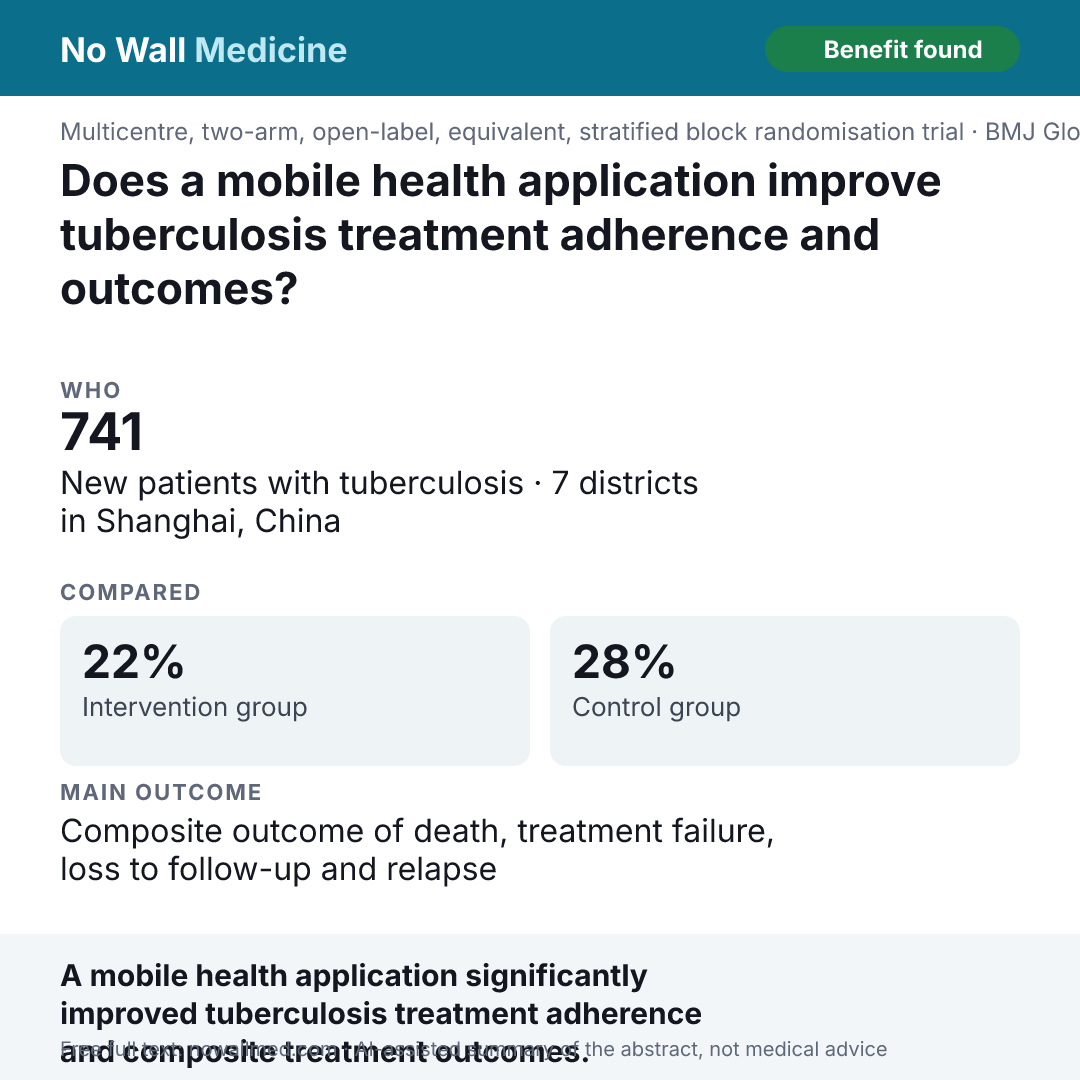
Clinical question: Does a mobile health application improve tuberculosis treatment adherence and outcomes?
Why it matters: The effectiveness of digital adherence technologies, such as mobile applications, on tuberculosis treatment outcomes remains indefinite.
In absolute numbers
Intervention group: 22% · Control group: 28% → a difference of 6 percentage points, so about 17 people would need the treatment for 1 more to benefit (number needed to treat) over the trial’s follow-up.
Worked out by us from the two group results above, not reported by the authors. Check the paper for the exact outcome and timing.
Key points
- Researchers conducted a multicentre randomized controlled trial involving 741 new tuberculosis patients in Shanghai, China.
- The mobile application group had a primary composite outcome event rate of 22% compared to 28% in the standard care group.
- Using the mobile application was associated with an adjusted risk difference of -16.39 percentage points for overall poor treatment adherence.
Headline and key points written with AI from the paper’s abstract, with every number checked against it. Read the paper before relying on them.
Was this summary helpful?
Abstract
Introduction
Treatment compliance is considered significant for curing tuberculosis (TB). Digital adherence technologies (DATs) have been recommended for improving treatment compliance and outcomes of patients with TB. Whereas the effectiveness of DATs on TB treatment remains indefinite, we estimated whether a mobile application has an effect on treatment adherence and outcomes among patients with TB in an urban area in China. Methods
We conducted a multicentre, two-arm, open-label, equivalent, stratified block randomisation trial from 7 districts involving 4670 eligible new patients with TB in Shanghai, China. Patients in the intervention group were instructed to get access to the app through WeChat. In the control group, patients were treated with standard of care. The primary outcome of this study was a composite outcome, which included death, treatment failure, loss to follow-up and relapse. The secondary outcomes were mainly described as overall poor treatment adherence and monthly poor treatment adherence. A generalised estimating equation is used to estimate the correlation between the two groups' outcomes after adjusting for concomitant variables. Results
Between 1 March 2021 and 31 December 2022, 741 patients (371 in the intervention group and 370 in the control group) were included in the intention-to-treat population, 430 (58%) were male and the median age was 33 years (IQR 27-49). 80 (22%) patients in the intervention group and 104 (28%) patients in the control group had a primary composite outcome event. The adjusted risk difference for the intervention versus control was -7.04 percentage points (95% CI -13.25 to -1.14, p=0.025); secondary outcome included overall poor treatment adherence with an adjusted risk difference -16.39 percentage points (95% CI -22.13 to -9.62, p<0.001). Conclusions
The mobile health application improved TB treatment adherence and outcomes significantly, especially for loss to follow-up. Future research should be focused on implementation problems in various settings and the improvement of patient-centred management strategies. Trial registration number
ChiCTR2000037575.
Abstract reproduced under the article’s CC BY NC licence.
Subject terms
Headline, design, result, key points, caveat and citation as plain text.
Cite this article
Qin N, Chen J, Chen L, et al. Effectiveness of a mobile health application on treatment outcomes among patients with tuberculosis in Shanghai, China: a multicentre randomised controlled trial. BMJ Glob Health. 2025;10(6). doi:10.1136/bmjgh-2024-018022
Spotted a mistake? Suggest a correction