Remote stepped-care intervention reduced anxiety and depression symptoms among Polish migrant workers in the Netherlands
Effectiveness of a scalable, remotely delivered stepped-care intervention for psychological distress among Polish migrant workers in the Netherlands: The RESPOND randomised controlled trial
Parallel-group, two-arm, superiority randomised controlled trialBenefit found
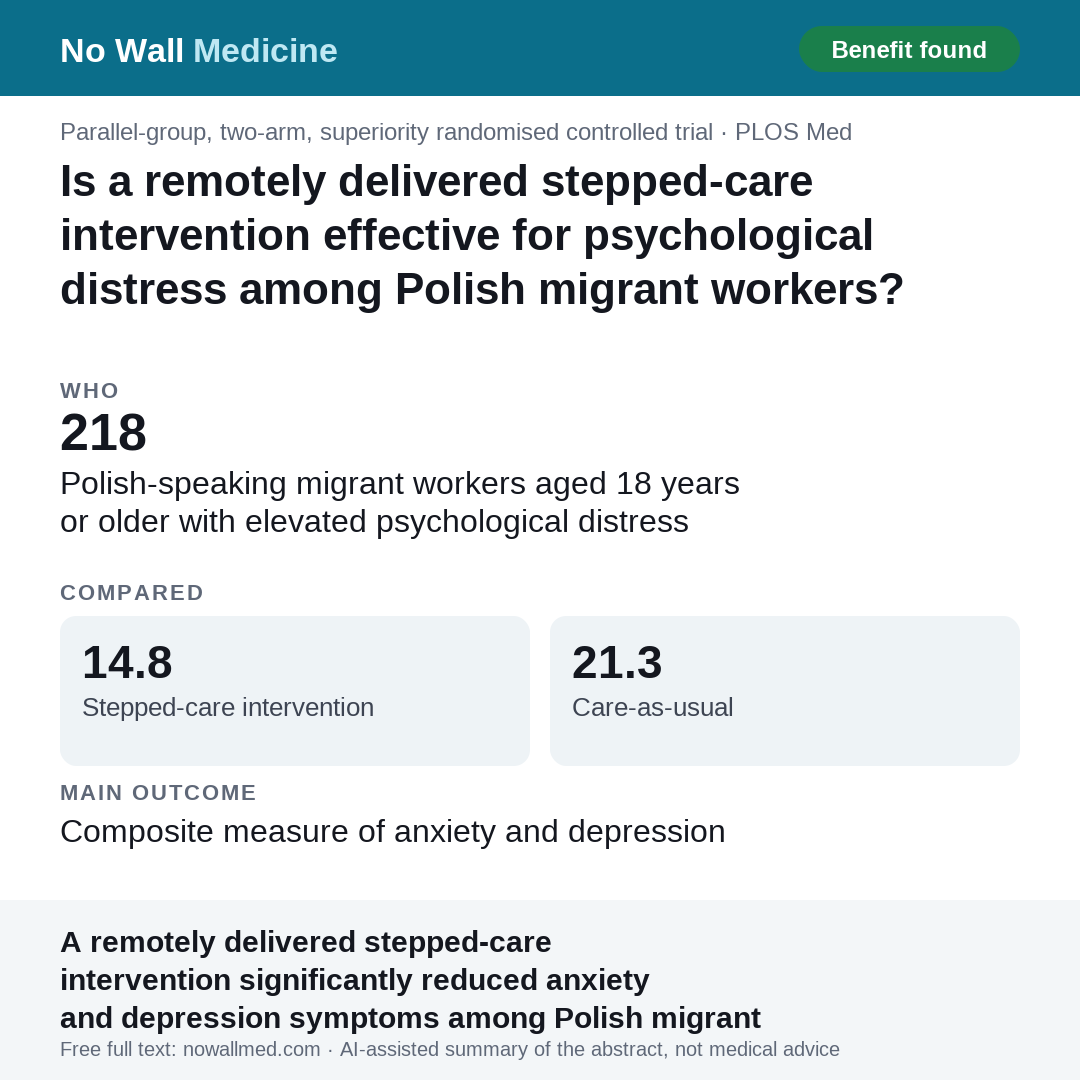
Is a remotely delivered stepped-care intervention effective for psychological distress among Polish migrant workers?
Who
218
Polish-speaking migrant workers aged 18 years or older with elevated psychological distress · The Netherlands
Compared
14.8Stepped-care intervention
21.3Care-as-usual
Main outcome
Composite measure of anxiety and depression
Result: -6.52 (95% CI [-8.73, -4.31])
Bottom line: A remotely delivered stepped-care intervention significantly reduced anxiety and depression symptoms among Polish migrant workers in the Netherlands.
Limitation: Limited generalisability due to participant demographics and short follow-up period.
PLOS Med · 2026-08-17Download image
Clinical question: Is a remotely delivered stepped-care intervention effective for psychological distress among Polish migrant workers?
Why it matters: International migrant workers often experience anxiety and depression but frequently underutilise mental healthcare services.
Key points
- Researchers studied 218 Polish migrant workers with high psychological distress, comparing a stepped-care model to care-as-usual.
- At the 21-week follow-up, the intervention group had lower anxiety and depression scores of 14.8 compared to 21.3 in the control group.
- The intervention group showed significant improvements after the first step of online self-help and again after the second step of videoconferencing support.
Limitation the authors note: The authors noted limited generalisability because most participants were women who had lived in the Netherlands for several years, and the short follow-up limited conclusions about long-term effects.
Headline and key points written with AI from the paper’s abstract, with every number checked against it. Read the paper before relying on them.
Topics
Cite this article
Roos R, Witteveen AB, Ayuso-Mateos JL, Barbui C, Bryant RA, Dontsova Z. Effectiveness of a scalable, remotely delivered stepped-care intervention for psychological distress among Polish migrant workers in the Netherlands: The RESPOND randomised controlled trial. PLOS Med. 2026. doi:10.1371/journal.pmed.1005197
Spotted a mistake? Suggest a correction