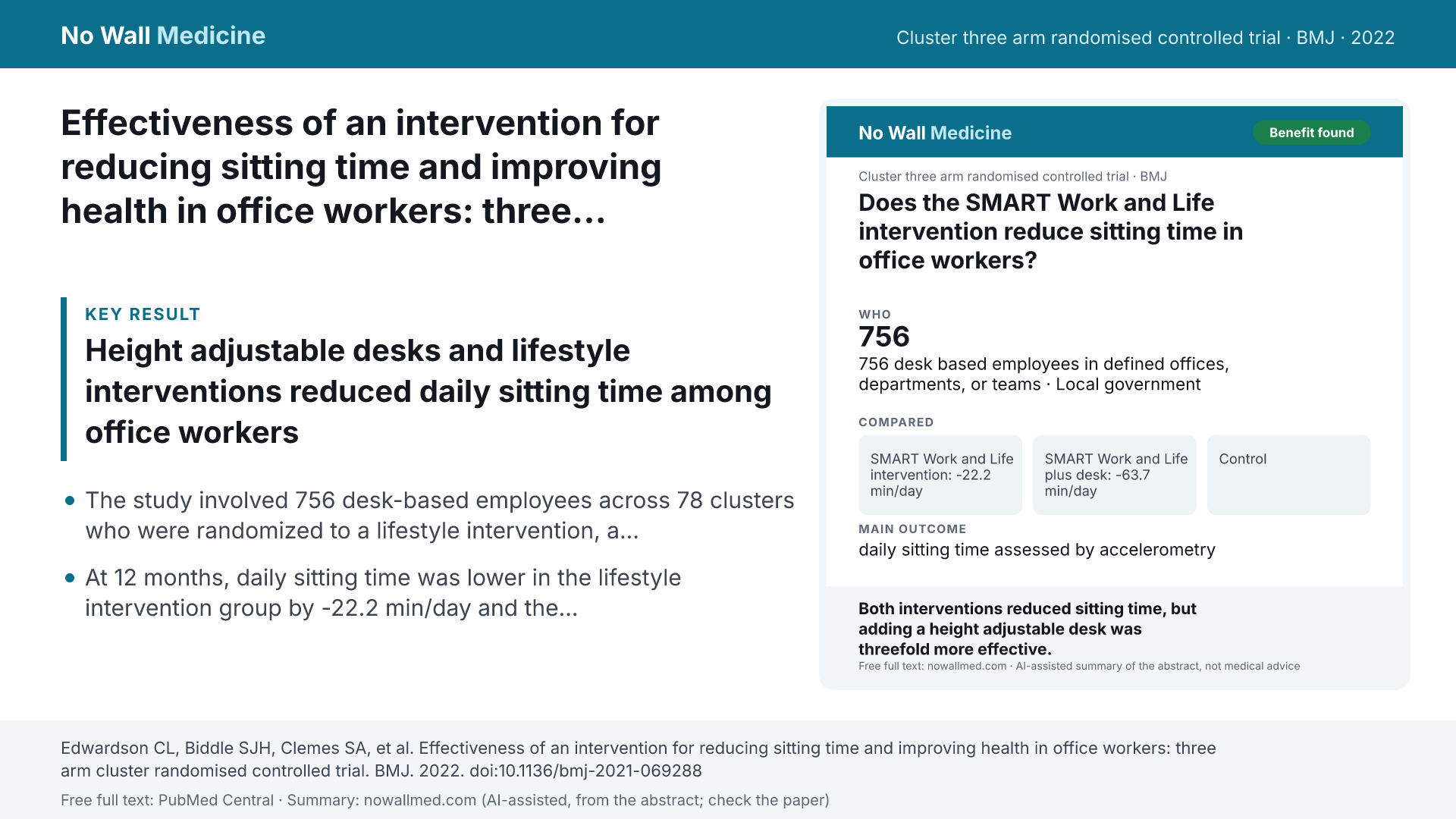
Height adjustable desks and lifestyle interventions reduced daily sitting time among office workers
Effectiveness of an intervention for reducing sitting time and improving health in office workers: three arm cluster randomised controlled trial
Cluster three arm randomised controlled trialBenefit found
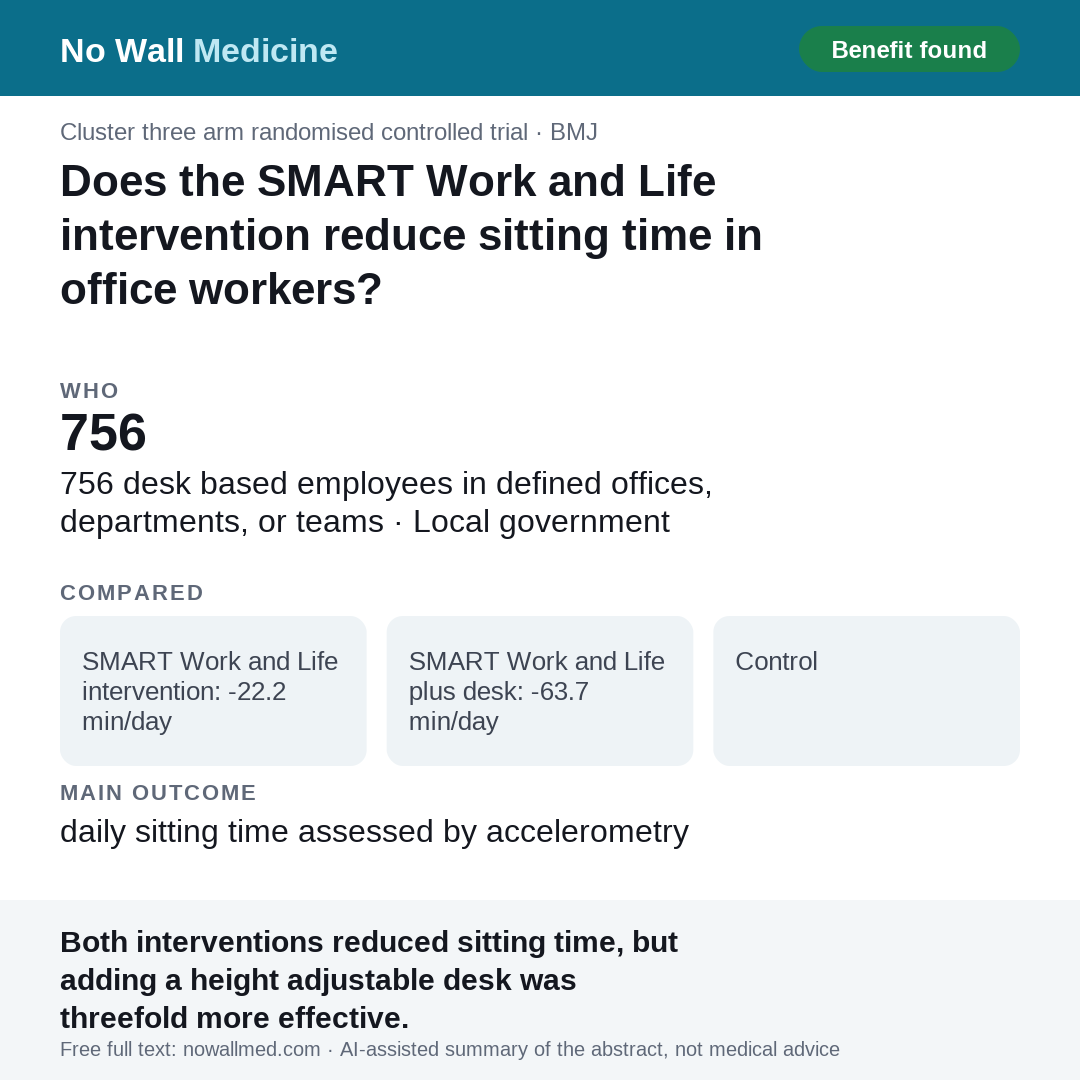
Does the SMART Work and Life intervention reduce sitting time in office workers?
Who
756
756 desk based employees in defined offices, departments, or teams · Local government councils in United Kingdom
Compared
SMART Work and Life intervention: -22.2 min/day
SMART Work and Life plus desk: -63.7 min/day
Control
Main outcome
daily sitting time assessed by accelerometry
Result: -41.7 min/day (-56.3 to -27.0 min/day) difference between interventions
Bottom line: Both interventions reduced sitting time, but adding a height adjustable desk was threefold more effective.
BMJ · 2022-08-17Download image
Clinical question: Does the SMART Work and Life intervention reduce sitting time in office workers?
Key points
- The study involved 756 desk-based employees across 78 clusters who were randomized to a lifestyle intervention, a lifestyle intervention with a height adjustable desk, or usual practice.
- At 12 months, daily sitting time was lower in the lifestyle intervention group by -22.2 min/day and the lifestyle intervention with a desk group by -63.7 min/day compared to control.
- The lifestyle intervention with a height adjustable desk was more effective than the lifestyle intervention alone at changing sitting time by -41.7 min/day.
Headline and key points written with AI from the paper’s abstract, with every number checked against it. Read the paper before relying on them.
Was this summary helpful?
Abstract
Objectives
To evaluate the effectiveness of an intervention, with and without a height adjustable desk, on daily sitting time, and to investigate the relative effectiveness of the two interventions, and the effectiveness of both interventions on physical behaviours and physical, biochemical, psychological, and work related health and performance outcomes. Design
Cluster three arm randomised controlled trial with follow-up at three and 12 months. Setting
Local government councils in Leicester, Liverpool, and Greater Manchester, UK. Participants
78 clusters including 756 desk based employees in defined offices, departments, or teams from two councils in Leicester, three in Greater Manchester, and one in Liverpool. Interventions
Clusters were randomised to one of three conditions: the SMART Work and Life (SWAL) intervention, the SWAL intervention with a height adjustable desk (SWAL plus desk), or control (usual practice). Main outcomes measures
The primary outcome measure was daily sitting time, assessed by accelerometry, at 12 month follow-up. Secondary outcomes were accelerometer assessed sitting, prolonged sitting, standing and stepping time, and physical activity calculated over any valid day, work hours, workdays, and non-workdays, self-reported lifestyle behaviours, musculoskeletal problems, cardiometabolic health markers, work related health and performance, fatigue, and psychological measures. Results
Mean age of participants was 44.7 years, 72.4% (n=547) were women, and 74.9% (n=566) were white. Daily sitting time at 12 months was significantly lower in the intervention groups (SWAL -22.2 min/day, 95% confidence interval -38.8 to -5.7 min/day, P=0.003; SWAL plus desk -63.7 min/day, -80.1 to -47.4 min/day, P<0.001) compared with the control group. The SWAL plus desk intervention was found to be more effective than SWAL at changing sitting time (-41.7 min/day, -56.3 to -27.0 min/day, P<0.001). Favourable differences in sitting and prolonged sitting time at three and 12 month follow-ups for both intervention groups and for standing time for the SWAL plus desk group were observed during work hours and on workdays. Both intervention groups were associated with small improvements in stress, wellbeing, and vigour, and the SWAL plus desk group was associated with improvements in pain in the lower extremity, social norms for sitting and standing at work, and support. Conclusions
Both SWAL and SWAL plus desk were associated with a reduction in sitting time, although the addition of a height adjustable desk was found to be threefold more effective. Trial registration
ISRCTN Registry ISRCTN11618007.
Abstract reproduced under the article’s CC BY licence.
Subject terms
Cite this article
Edwardson CL, Biddle SJH, Clemes SA, et al. Effectiveness of an intervention for reducing sitting time and improving health in office workers: three arm cluster randomised controlled trial. BMJ. 2022. doi:10.1136/bmj-2021-069288
Spotted a mistake? Suggest a correction