Early treatment for thyroid eye disease shows more benefit than treatment in chronic phases
Effectiveness of Different Treatment Modalities in Initial and Chronic Phases of Thyroid Eye Disease: A Systematic Review With Meta-analysis
Systematic review with meta-analysisBenefit found
How do different treatments affect thyroid eye disease in initial versus chronic phases?
Who
Patients with thyroid eye disease
Compared
Initial phase (within 6 months): significant improvements in clinical activity score, proptosis, and diplopia
Subacute/chronic phase (after 6 months): efficacy of methylprednisolone and teprotumumab is reduced
Main outcome
inflammatory markers and severity endpoints
Bottom line: Early intervention within the first 6 months maximizes treatment benefits for thyroid eye disease.
J Clin Endocrinol Metab · 2024-07-30Download image
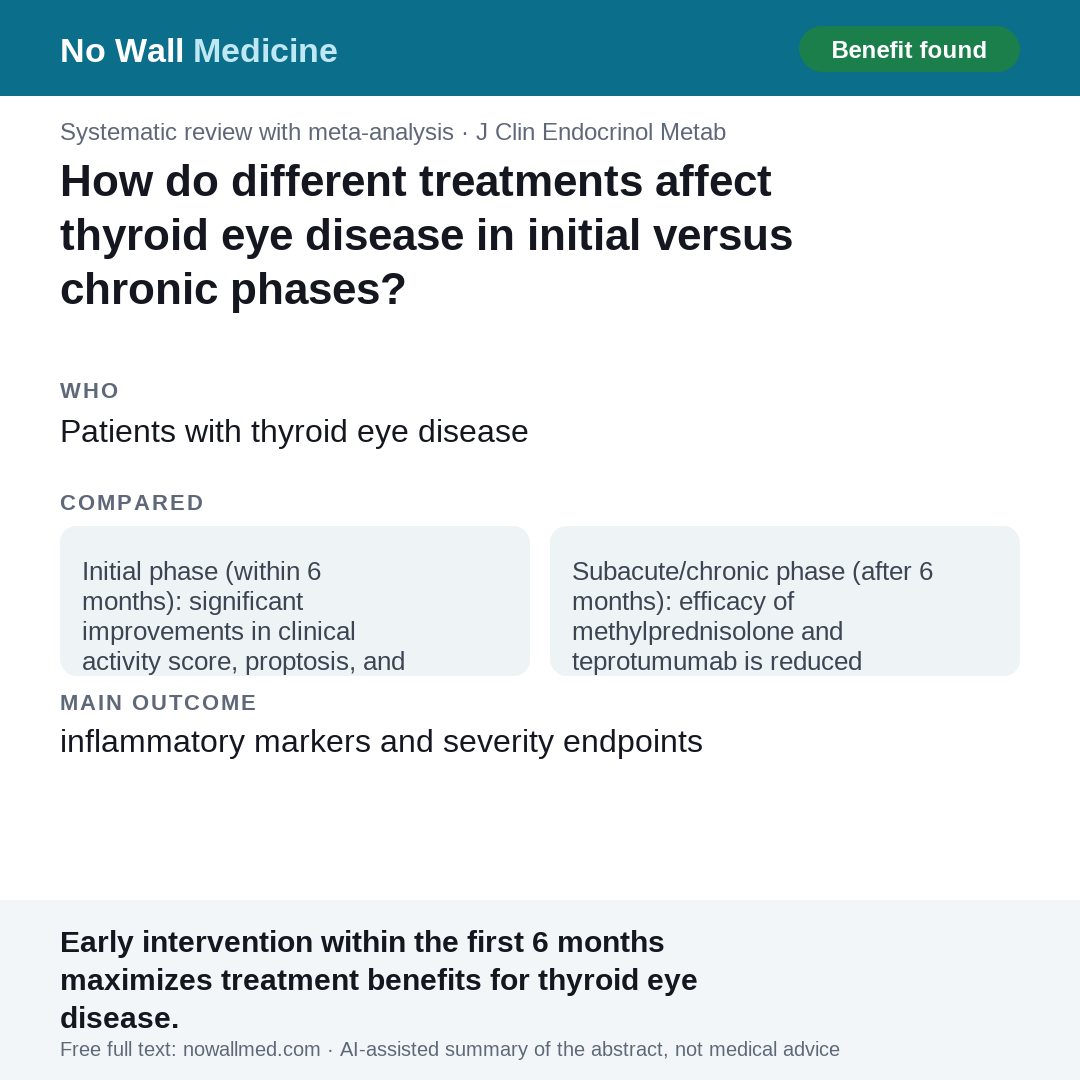
Clinical question: How do different treatments affect thyroid eye disease in initial versus chronic phases?
Why it matters: It is uncertain which treatment approaches are most effective depending on whether thyroid eye disease is in its initial or chronic phase.
Key points
- Researchers analyzed 26 studies to compare how different treatments affect inflammation and severity in thyroid eye disease based on how long the disease had lasted.
- In the initial phase within 6 months, corticosteroids and teprotumumab were associated with improvements in clinical activity score, bulging eyes (proptosis), and double vision (diplopia).
- The efficacy of methylprednisolone and teprotumumab was reduced during the subacute or chronic phase after the 6 month mark.
Headline and key points written with AI from the paper’s abstract, with every number checked against it. Read the paper before relying on them.
Topics
Cite this article
Alves Junior JM, Bernardo W, Villagelin D. Effectiveness of Different Treatment Modalities in Initial and Chronic Phases of Thyroid Eye Disease: A Systematic Review With Meta-analysis. J Clin Endocrinol Metab. 2024. doi:10.1210/clinem/dgae526
Spotted a mistake? Suggest a correction
Top studies every Monday
The week’s key trials and guidelines in your specialties, plus any topics you follow. By email, free.
Get the weekly digest