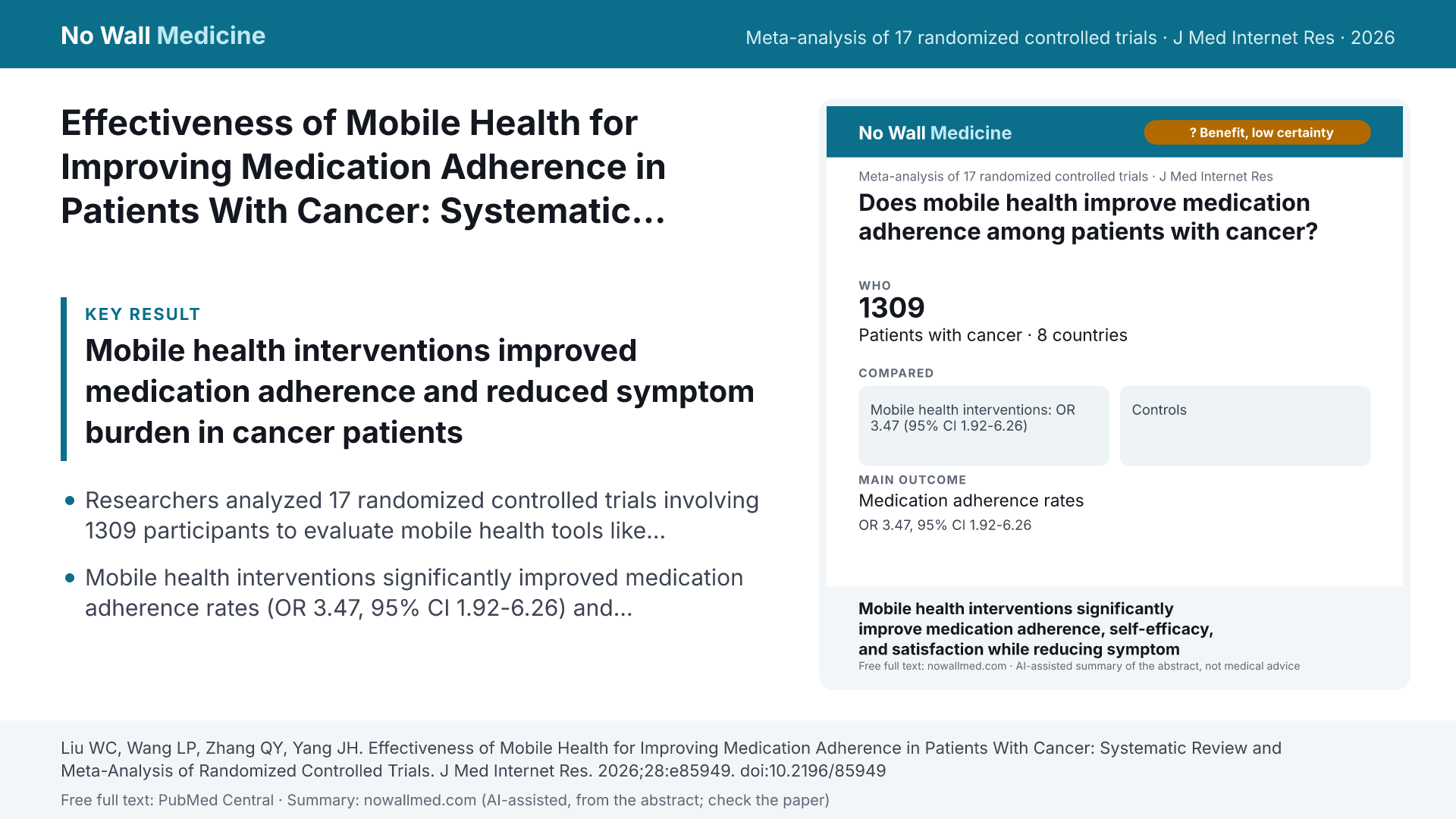
Mobile health interventions improved medication adherence and reduced symptom burden in cancer patients
Effectiveness of Mobile Health for Improving Medication Adherence in Patients With Cancer: Systematic Review and Meta-Analysis of Randomized Controlled Trials
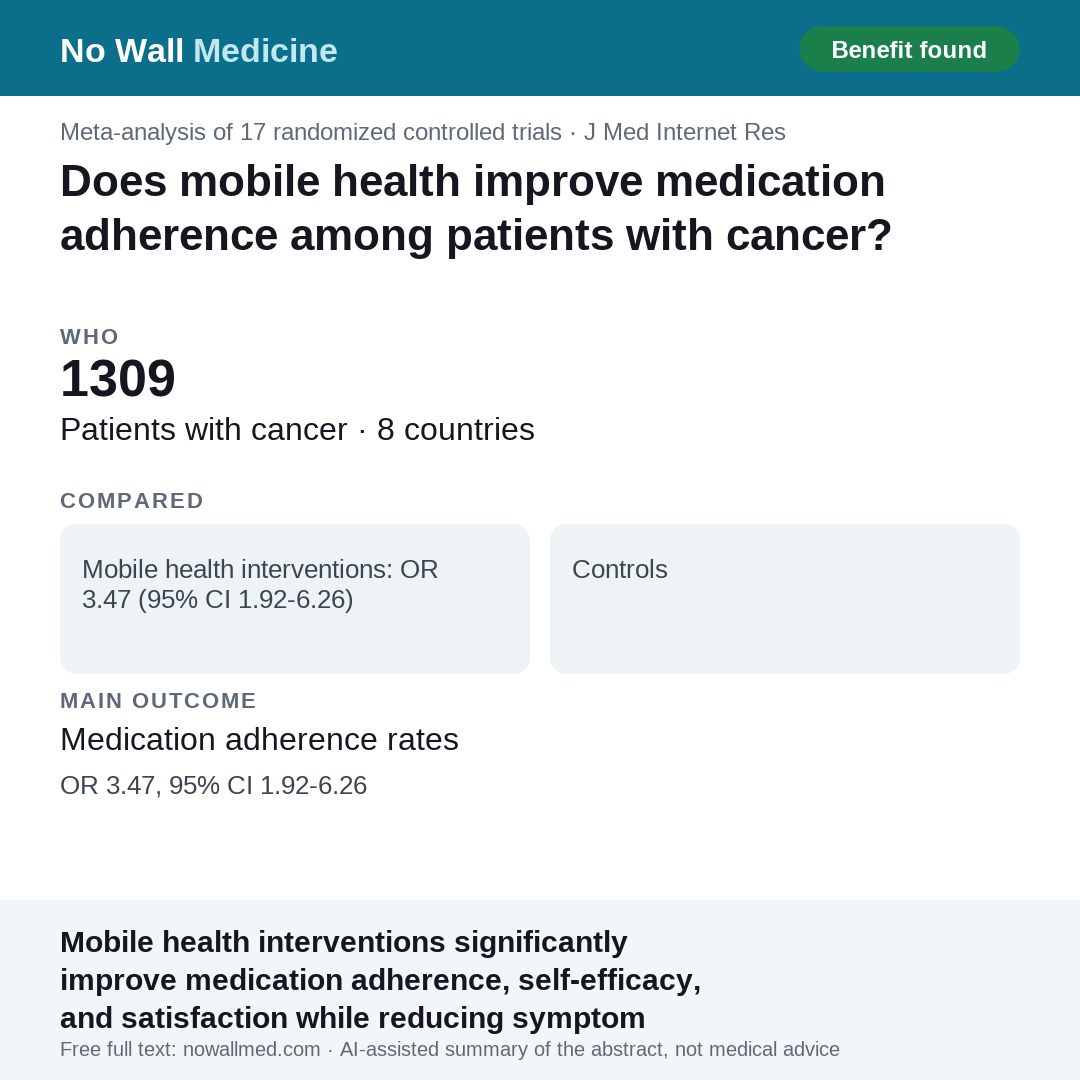
Meta-analysis of 17 randomized controlled trialsBenefit found
Does mobile health improve medication adherence among patients with cancer?
Who
1309
Patients with cancer · 8 countries
Compared
Mobile health interventions: OR 3.47 (95% CI 1.92-6.26)
Controls
Main outcome
Medication adherence rates
Result: OR 3.47, 95% CI 1.92-6.26
Bottom line: Mobile health interventions significantly improve medication adherence, self-efficacy, and satisfaction while reducing symptom burden in cancer patients.
Limitation: Substantial heterogeneity, moderate risk of bias, and low certainty of evidence.
J Med Internet Res · 2026-03-30Download image
Clinical question: Does mobile health improve medication adherence among patients with cancer?
Why it matters: Systematic evidence regarding the effectiveness of mobile health for improving medication adherence in patients with cancer has been lacking.
Key points
- Researchers analyzed 17 randomized controlled trials involving 1309 participants to evaluate mobile health tools like apps, websites, and text messaging.
- Mobile health interventions significantly improved medication adherence rates (OR 3.47, 95% CI 1.92-6.26) and adherence scores (SMD 1.01, 95% CI 0.51-1.52).
- These digital tools also improved self-efficacy and service satisfaction while reducing symptom burden (SMD -0.38, 95% CI -0.61 to -0.14), but had no significant effect on health literacy.
Limitation the authors note: The authors noted substantial heterogeneity, a moderate risk of bias, and a low certainty of evidence.
Headline and key points written with AI from the paper’s abstract, with every number checked against it. Read the paper before relying on them.
Was this summary helpful?
Subject terms
Cite this article
Liu WC, Wang LP, Zhang QY, Yang JH. Effectiveness of Mobile Health for Improving Medication Adherence in Patients With Cancer: Systematic Review and Meta-Analysis of Randomized Controlled Trials. J Med Internet Res. 2026. doi:10.2196/85949
Spotted a mistake? Suggest a correction