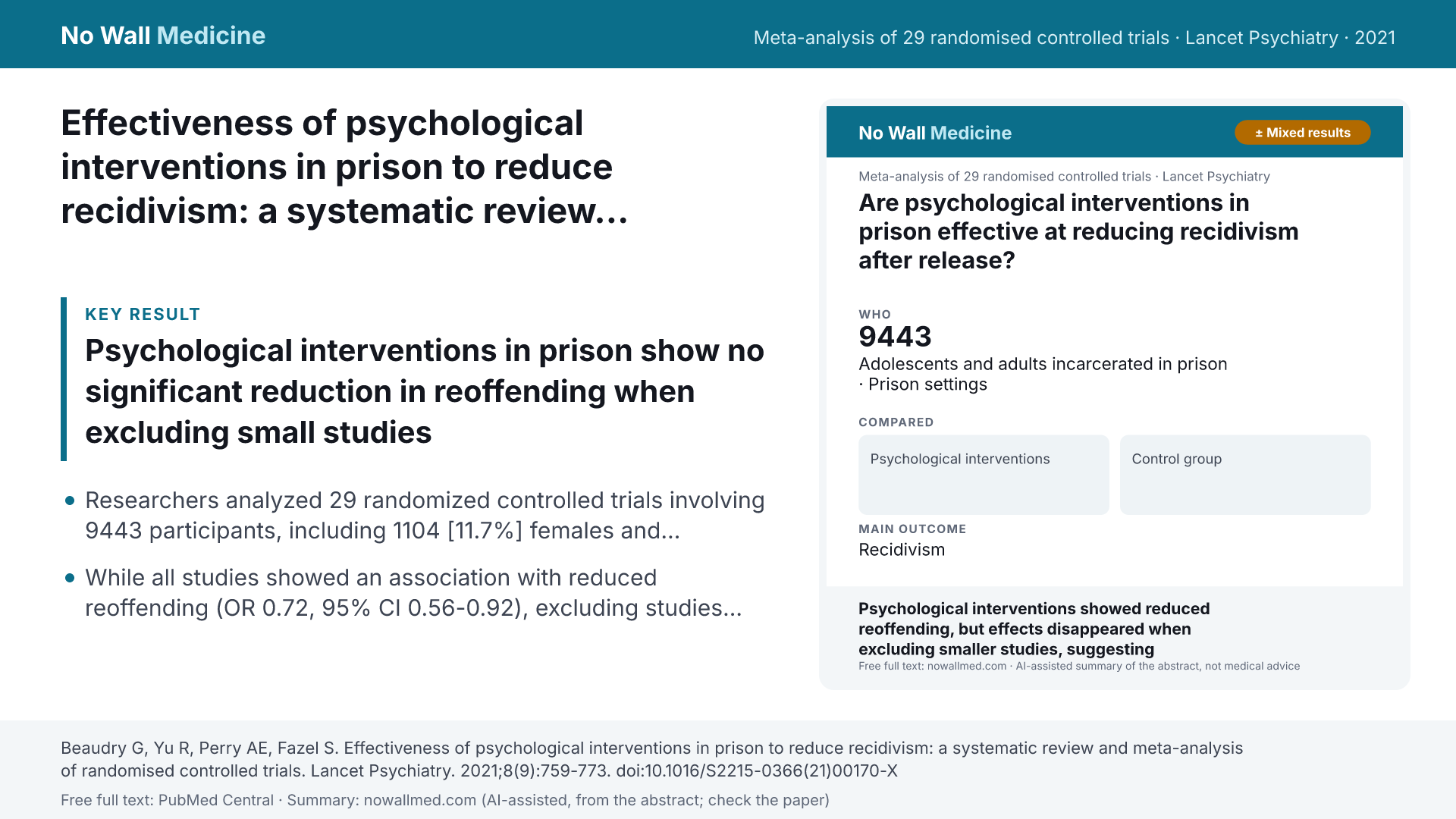
Psychological interventions in prison show no significant reduction in reoffending when excluding small studies
Effectiveness of psychological interventions in prison to reduce recidivism: a systematic review and meta-analysis of randomised controlled trials
Psychiatry & Mental HealthAdult and pediatric
Meta-analysis of 29 randomised controlled trialsMixed results
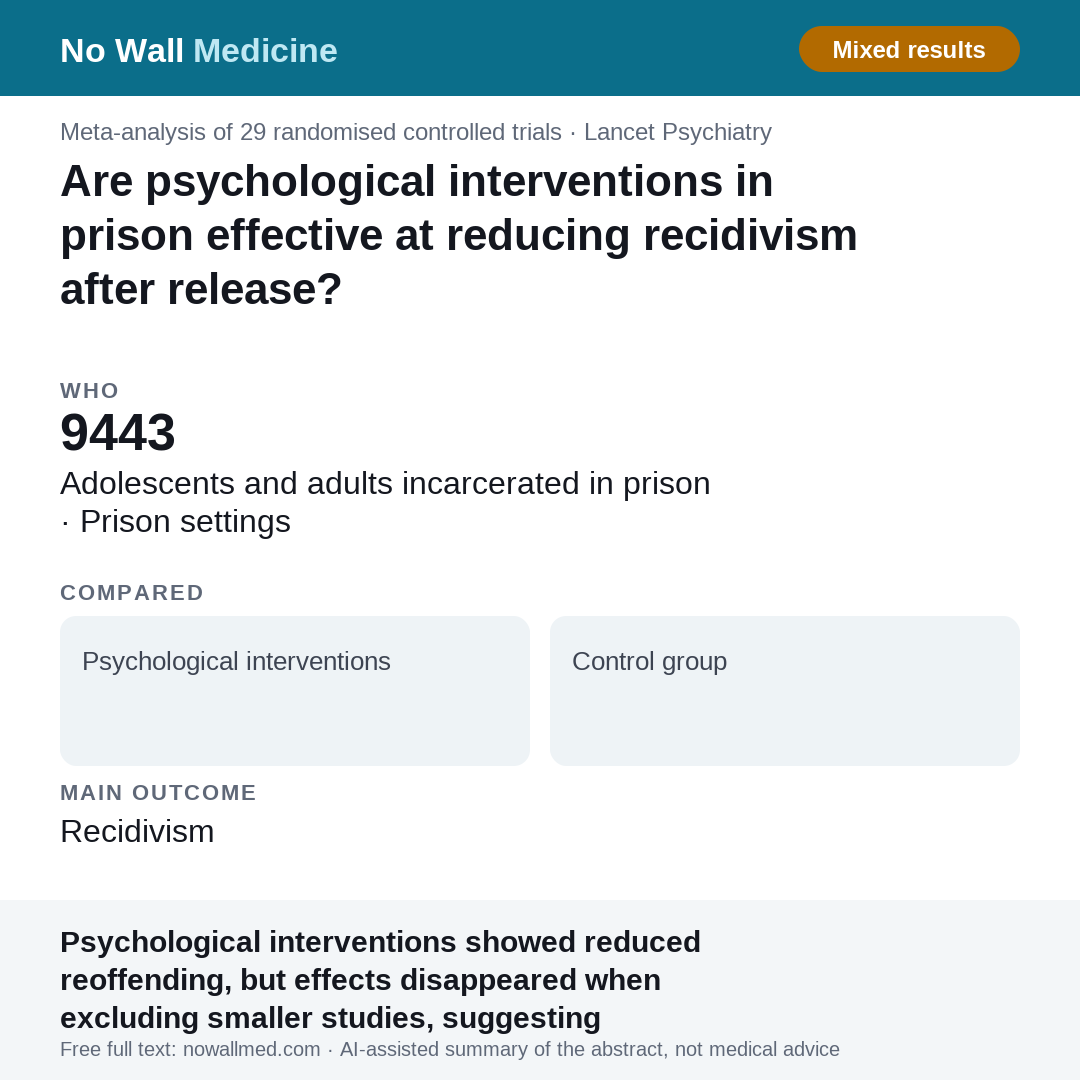
Are psychological interventions in prison effective at reducing recidivism after release?
Who
9443
Adolescents and adults incarcerated in prison · Prison settings
Compared
Psychological interventions
Control group
Main outcome
Recidivism
Result: odds ratio 0.72 (95% CI 0.56-0.92)
Bottom line: Psychological interventions showed reduced reoffending, but effects disappeared when excluding smaller studies, suggesting potential overestimation.
Limitation: Publication bias and small-study effects appear to have overestimated the reported modest effects.
Funded by: Wellcome Trust, Fonds de recherche du Québec - Santé
Lancet Psychiatry · 2021-08-22Download image
Clinical question: Are psychological interventions in prison effective at reducing recidivism after release?
Why it matters: It is unknown if psychological treatments delivered during incarceration effectively reduce the rate of people reoffending after they are released from prison.
Key points
- Researchers analyzed 29 randomized controlled trials involving 9443 participants, including 1104 [11.7%] females and 8111 [85.9%] males, to measure the effect of prison-based psychological treatments.
- While all studies showed an association with reduced reoffending (OR 0.72, 95% CI 0.56-0.92), excluding studies with fewer than 50 participants resulted in no significant reduction (OR 0.87, 95% CI 0.68-1.11).
- Therapeutic communities, which are structured group treatment settings, were associated with decreased rates of recidivism in two studies (OR 0.64, 95% CI 0.46-0.91).
Limitation the authors note: Publication bias and small-study effects appear to have overestimated the reported modest effects of these interventions.
Headline and key points written with AI from the paper’s abstract, with every number checked against it. Read the paper before relying on them.
Was this summary helpful?
Abstract
Background
Repeat offending, also known as criminal recidivism, in people released from prison has remained high over many decades. To address this, psychological treatments have been increasingly used in criminal justice settings; however, there is little evidence about their effectiveness. We aimed to evaluate the effectiveness of interventions in prison to reduce recidivism after release. Methods
For this systematic review and meta-analysis, we searched the Cochrane Central Register of Controlled Trials, Embase, Global Health, MEDLINE, PsycINFO, and Google Scholar for articles published from database inception to Feb 17, 2021, without any language restrictions. We searched for randomised controlled trials (RCTs) that evaluated the effect of psychological interventions, delivered to adolescents and adults during incarceration, on recidivism outcomes after release. We excluded studies of solely pharmacological interventions and of participants in secure psychiatric hospitals or special residential units, or attending therapies mainly delivered outside of the prison setting. We extracted summary estimates from eligible RCTs. Data were extracted and appraised according to a prespecified protocol, with effect sizes converted to odds ratios. We used a standardised form to extract the effects of interventions on recidivism and estimated risk of bias for each RCT. Planned sensitivity analyses were done by removing studies with fewer than 50 participants. Our primary outcome was recidivism. Data from individual RCTs were combined in a random-effects meta-analysis as pooled odds ratios (ORs) and we explored sources of heterogeneity by comparing effect sizes by study size, control group, and intervention type. The protocol was pre-registered with PROSPERO, CRD42020167228. Findings
Of 6345 articles retrieved, 29 RCTs (9443 participants, 1104 [11·7%] females, 8111 [85·9%] males, and 228 [2·4%] unknown) met the inclusion criteria for the primary outcome. Mean ages were 31·4 years (SD 4·9, range 24·5-41·5) for adult participants and 17·5 years (SD 1·9; range 14·6-20·2) for adolescent participants. Race or ethnicity data were not sufficiently reported to be aggregated. If including all 29 RCTs, psychological interventions were associated with reduced reoffending outcomes (OR 0·72, 95% CI 0·56-0·92). However, after excluding smaller studies (<50 participants in the intervention group), there was no significant reduction in recidivism (OR 0.87, 95% CI 0·68-1·11). Based on two studies, therapeutic communities were associated with decreased rates of recidivism (OR 0·64, 95% CI 0·46-0·91). These risk estimates did not significantly differ by type of control group and other study characteristics. Interpretation
Widely implemented psychological interventions for people in prison to reduce offending after release need improvement. Publication bias and small-study effects appear to have overestimated the reported modest effects of such interventions, which were no longer present when only larger studies were included in analyses. Findings suggest that therapeutic communities and interventions that ensure continuity of care in community settings should be prioritised for future research. Developing new treatments should focus on addressing modifiable risk factors for reoffending. Funding
Wellcome Trust, Fonds de recherche du Québec - Santé.
Abstract reproduced under the article’s CC BY licence.
Subject terms
Cite this article
Beaudry G, Yu R, Perry AE, Fazel S. Effectiveness of psychological interventions in prison to reduce recidivism: a systematic review and meta-analysis of randomised controlled trials. Lancet Psychiatry. 2021. doi:10.1016/S2215-0366(21)00170-X
Spotted a mistake? Suggest a correction