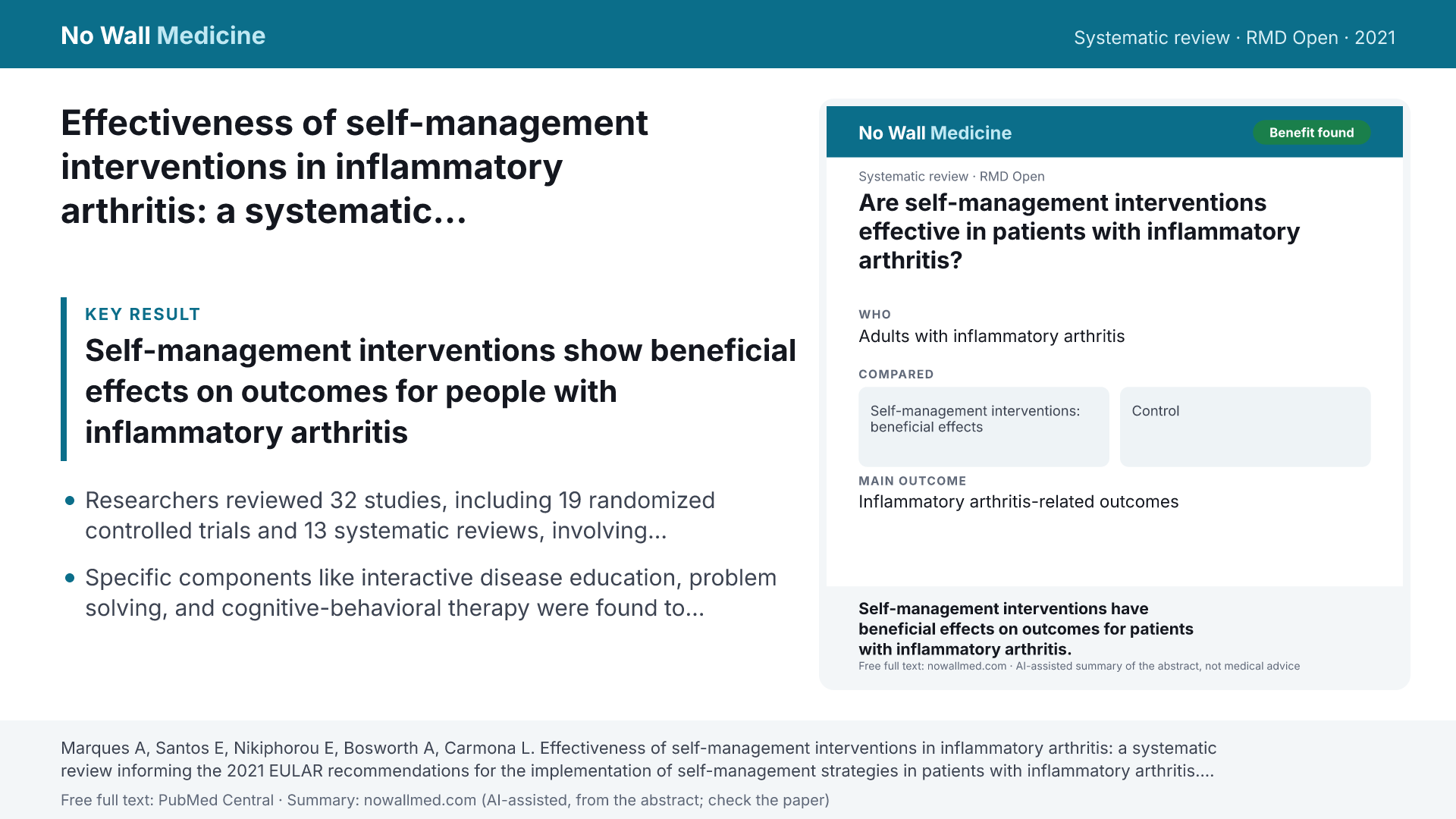
Self-management interventions show beneficial effects on outcomes for people with inflammatory arthritis
Effectiveness of self-management interventions in inflammatory arthritis: a systematic review informing the 2021 EULAR recommendations for the implementation of self-management strategies in patients with inflammatory arthritis
Systematic reviewBenefit found
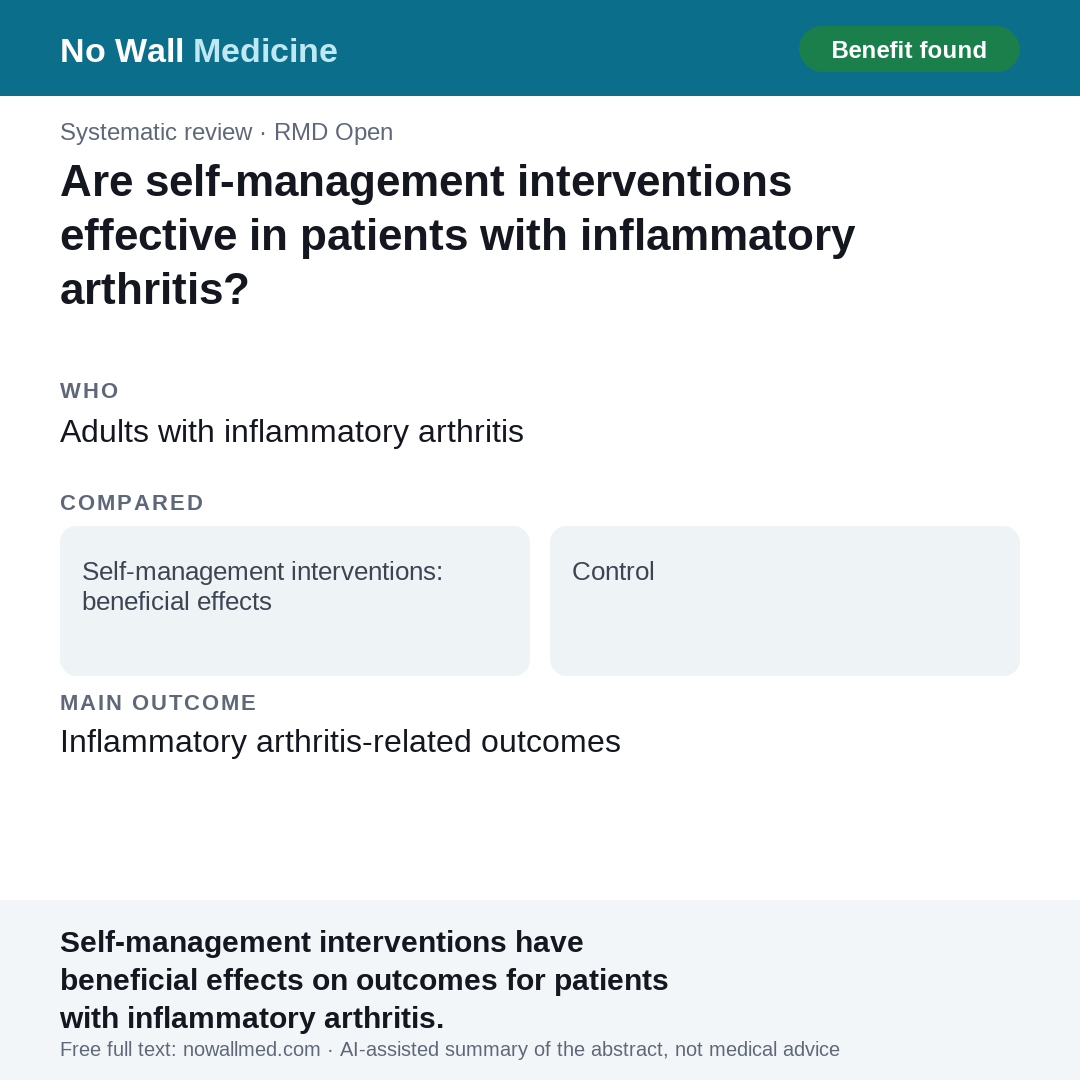
Are self-management interventions effective in patients with inflammatory arthritis?
Who
Adults with inflammatory arthritis
Compared
Self-management interventions: beneficial effects
Control
Main outcome
Inflammatory arthritis-related outcomes
Bottom line: Self-management interventions have beneficial effects on outcomes for patients with inflammatory arthritis.
Limitation: Self-management is a complex intervention making it difficult to isolate component effectiveness.
RMD Open · 2021-05-29Download image
Clinical question: Are self-management interventions effective in patients with inflammatory arthritis?
Why it matters: The effectiveness of various self-management components for patients with inflammatory arthritis needed to be determined to inform clinical recommendations.
Key points
- Researchers reviewed 32 studies, including 19 randomized controlled trials and 13 systematic reviews, involving adults with inflammatory arthritis.
- Specific components like interactive disease education, problem solving, and cognitive-behavioral therapy were found to have beneficial effects on outcomes.
- The most frequently studied interventions included multicomponent programs, physical activity, psychosocial interventions, and education.
Limitation the authors note: Further research is needed to understand how to isolate the effectiveness of different components within complex self-management interventions.
Headline and key points written with AI from the paper’s abstract, with every number checked against it. Read the paper before relying on them.
Was this summary helpful?
Abstract
Objective
To perform a systematic review (SR) on the effectiveness of self-management interventions, in order to inform the European League Against Rheumatism Recommendations for its implementation in patients with inflammatory arthritis (IA). Methods
The SR was conducted according to the Cochrane Handbook and included adults (≥18 years) with IA. The search strategy was run in Medline through PubMed, Embase, Cochrane Library, CINAHL Plus with Full Text, and PEDro. The assessment of risk of bias, data extraction and synthesis were performed by two reviewers independently. A narrative Summary of Findings was provided according to the Grading of Recommendations, Assessment, Development and Evaluation. Results
From a total 1577 references, 57 were selected for a full-text review, and 32 studies fulfilled the inclusion criteria (19 randomised controlled trials (RCTs) and 13 SRs). The most studied self-management components were specific interactive disease education in ten RCTs, problem solving in nine RCTs, cognitive-behavioural therapy in eight RCTs, goal setting in six RCTs, patient education in five RCTs and response training in two RCTs. The most studied interventions were multicomponent or single exercise/physical activity in six SRs, psychosocial interventions in five SRs and education in two SRs. Overall, all these specific components and interventions of self-management have beneficial effects on IAs-related outcomes. Conclusions
The findings confirm the beneficial effect of the self-management interventions in IA and the importance of their implementation. Further research should focus on the understanding that self-management is a complex intervention to allow the isolation of the effectiveness of its different components.
Abstract reproduced under the article’s CC BY licence.
Subject terms
Cite this article
Marques A, Santos E, Nikiphorou E, Bosworth A, Carmona L. Effectiveness of self-management interventions in inflammatory arthritis: a systematic review informing the 2021 EULAR recommendations for the implementation of self-management strategies in patients with inflammatory arthritis. RMD Open. 2021. doi:10.1136/rmdopen-2021-001647
Spotted a mistake? Suggest a correction