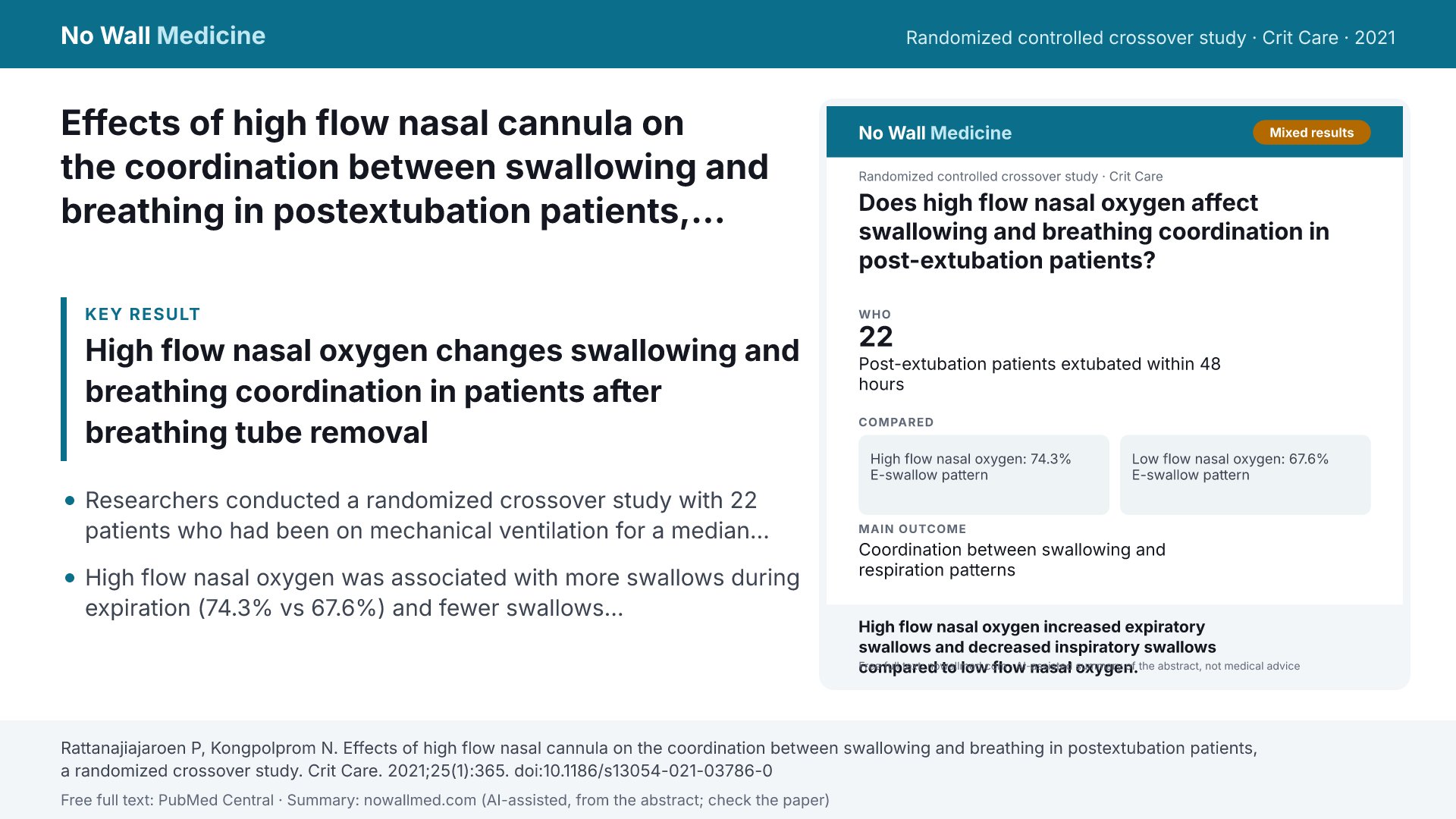
High flow nasal oxygen changes swallowing and breathing coordination in patients after breathing tube removal
Effects of high flow nasal cannula on the coordination between swallowing and breathing in postextubation patients, a randomized crossover study
Randomized controlled crossover studyMixed results
Does high flow nasal oxygen affect swallowing and breathing coordination in post-extubation patients?
Who
22
Post-extubation patients extubated within 48 hours
Compared
High flow nasal oxygen: 74.3% E-swallow pattern
Low flow nasal oxygen: 67.6% E-swallow pattern
Main outcome
Coordination between swallowing and respiration patterns
Bottom line: High flow nasal oxygen increased expiratory swallows and decreased inspiratory swallows compared to low flow nasal oxygen.
Crit Care · 2021-10-19Download image
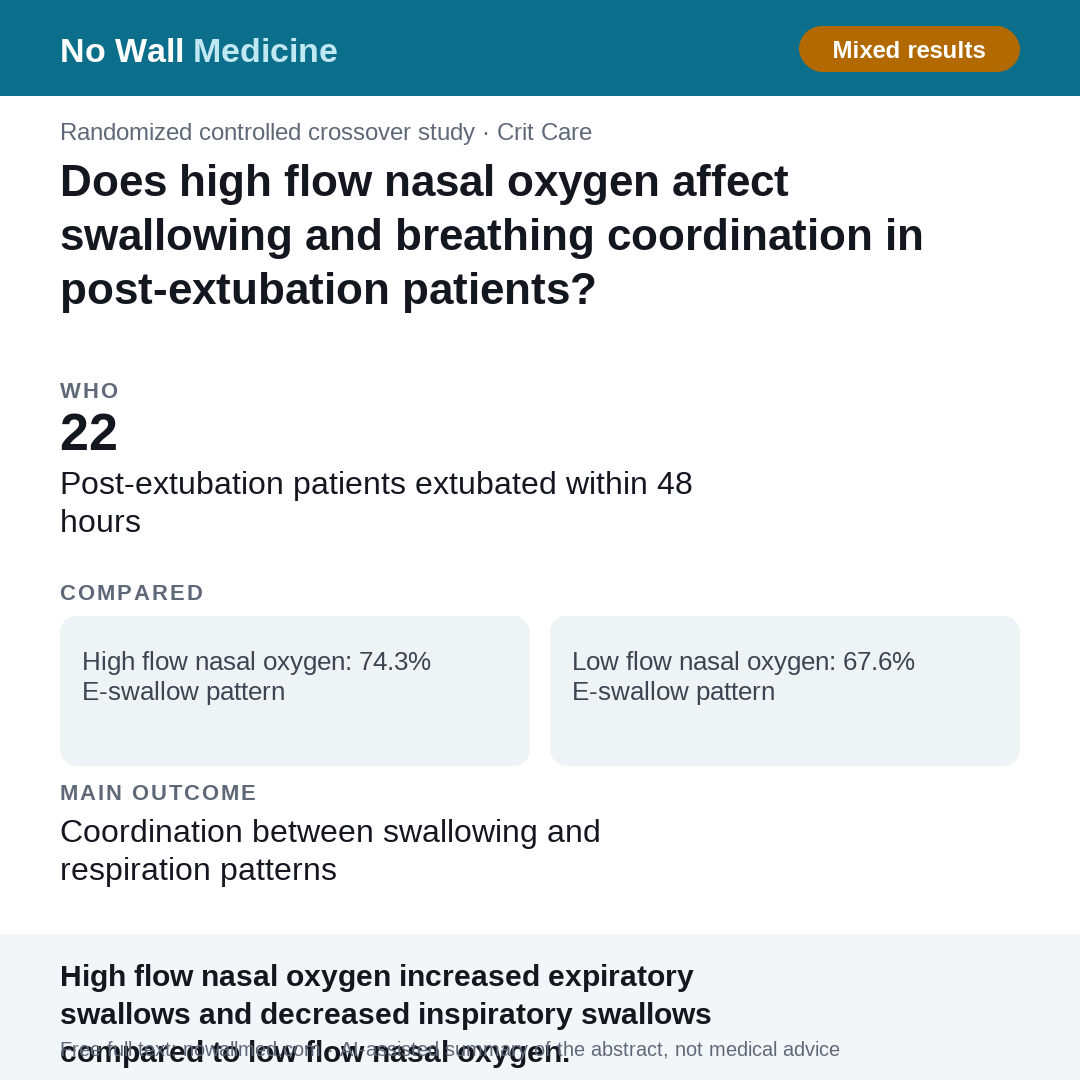
Clinical question: Does high flow nasal oxygen affect swallowing and breathing coordination in post-extubation patients?
Why it matters: It is unknown how different types of oxygen therapy affect the timing of swallowing in relation to breathing phases after a breathing tube is removed.
Key points
- Researchers conducted a randomized crossover study with 22 patients who had been on mechanical ventilation for a median of 2.5 days.
- High flow nasal oxygen was associated with more swallows during expiration (74.3% vs 67.6%) and fewer swallows during inspiration (14.3% vs 23.1%) compared to low flow nasal oxygen.
- The median total number of swallows over three minutes was 18.5 times during high flow oxygen and 21 times during low flow oxygen, which was not a statistically significant difference.
Headline and key points written with AI from the paper’s abstract, with every number checked against it. Read the paper before relying on them.
Was this summary helpful?
Abstract
Background
Timing of swallows in relation to respiratory phases is associated with aspiration events. Oxygen therapy possibly affects the timing of swallows, which may alter airway protective mechanisms. Objectives
To compare the coordination between swallowing and respiration during water infusion in post-extubation patients using high flow nasal oxygen (HFNO) with the coordination in those using low flow nasal oxygen (LFNO). Methods
We conducted a randomized controlled crossover study in post-extubation patients. The patients extubated within 48 h were randomly assigned to two groups, namely, HFNO and LFNO. The eligible patients in each group received either HFNO with fraction of inspired oxygen (FiO2) 0.35, flow 50 L per minute (LPM), and temperature 34 °C or LFNO 5 LPM for 5 min. The coordination between swallowing and respiration was observed during continuous infusion of 10-ml water one minute three times. Respiratory phases and swallowing were monitored using electrocardiogram (EKG)-derived respiratory signals and submental electromyography (EMG), respectively. The swallowing frequency and timing of swallows in relation to respiratory phases were recorded. The coordination between swallowing and respiration was classified into 4 patterns, namely I, E, I-E, and E-I swallows. (I; inspiration and E; expiration) Subsequently, after a 5-min washout period, the patients were switched to the other type of oxygen therapy using the same procedure. The Wilcoxon Signed-Rank Test was used for statistical analysis. Results
A total of 22 patients with a mean age of 56 years were enrolled in the study. The major indication for invasive mechanical ventilation was pneumonia with a median duration of endotracheal intubation of 2.5 days. The median total swallowing numbers (three minutes) were 18.5 times in the HFNO period and 21 times in the LFNO period (p = NS). The most common swallowing pattern was E-swallow. The patients using HFNO had higher numbers of E-swallow pattern (74.3% in HFNO vs 67.6% in LFNO; p = 0.048) and lower numbers of I-swallow pattern (14.3% in HFNO vs 23.1% in LFNO; p = 0.044). The numbers of other swallowing patterns were not different between the 2 groups. Conclusions
Compared with LFNO, HFNO significantly increased the E-swallow and decreased the I-swallow in post-extubation patients. The findings indicated that HFNO might reduce a risk of aspiration during the post-extubation period. Clinical trial No.: Thai clinical trial TCTR20200206004 Registered February 4, 2020. URL: http://www.clinicaltrials.in.th/index.php?tp=regtrials&menu=trialsearch&smenu=fulltext&task=search&task2=view1&id=5740 .
Abstract reproduced under the article’s CC BY licence.
Subject terms
Cite this article
Rattanajiajaroen P, Kongpolprom N. Effects of high flow nasal cannula on the coordination between swallowing and breathing in postextubation patients, a randomized crossover study. Crit Care. 2021. doi:10.1186/s13054-021-03786-0
Spotted a mistake? Suggest a correction