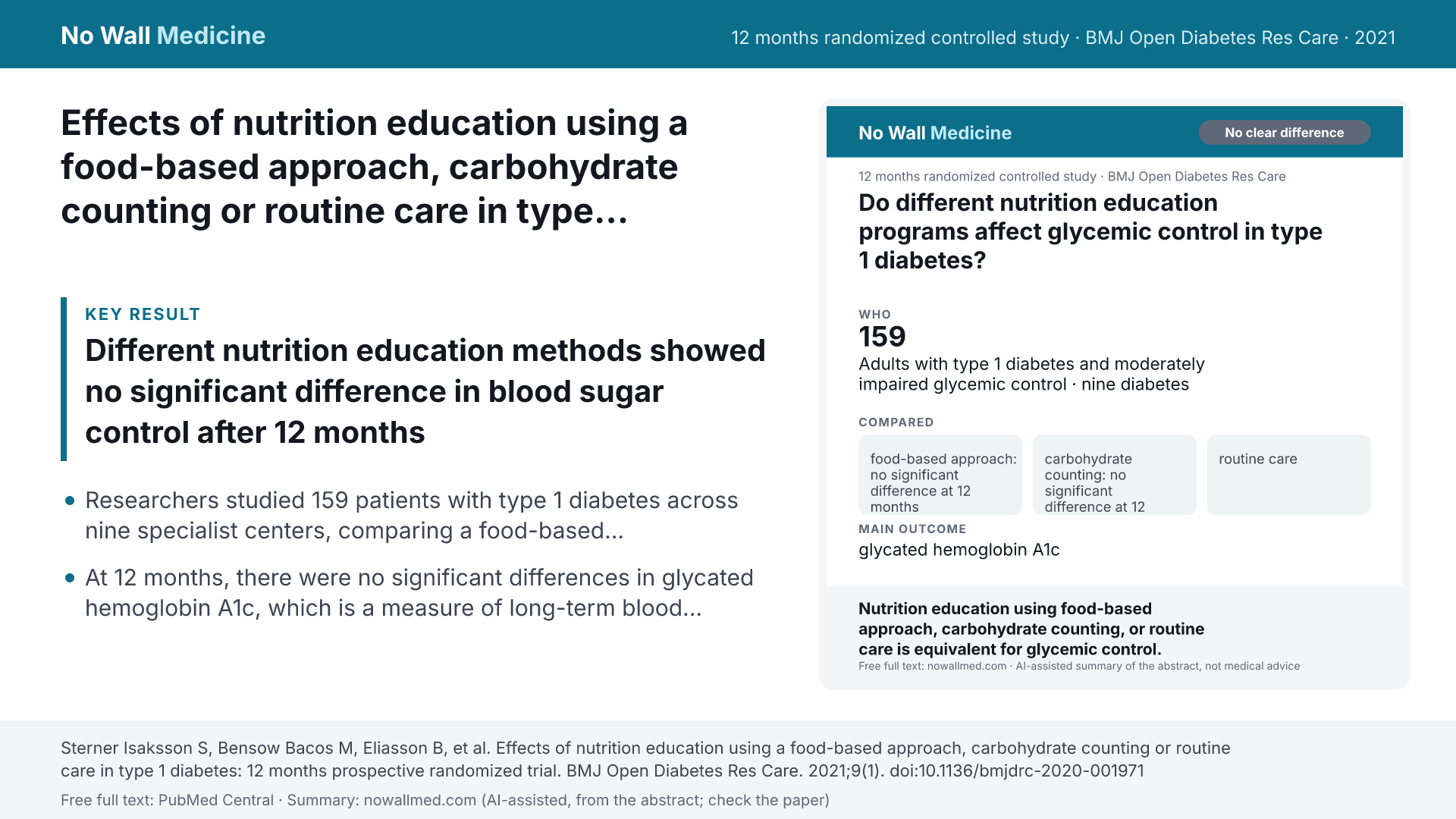
Different nutrition education methods showed no significant difference in blood sugar control after 12 months
Effects of nutrition education using a food-based approach, carbohydrate counting or routine care in type 1 diabetes: 12 months prospective randomized trial
12 months randomized controlled studyNo clear difference
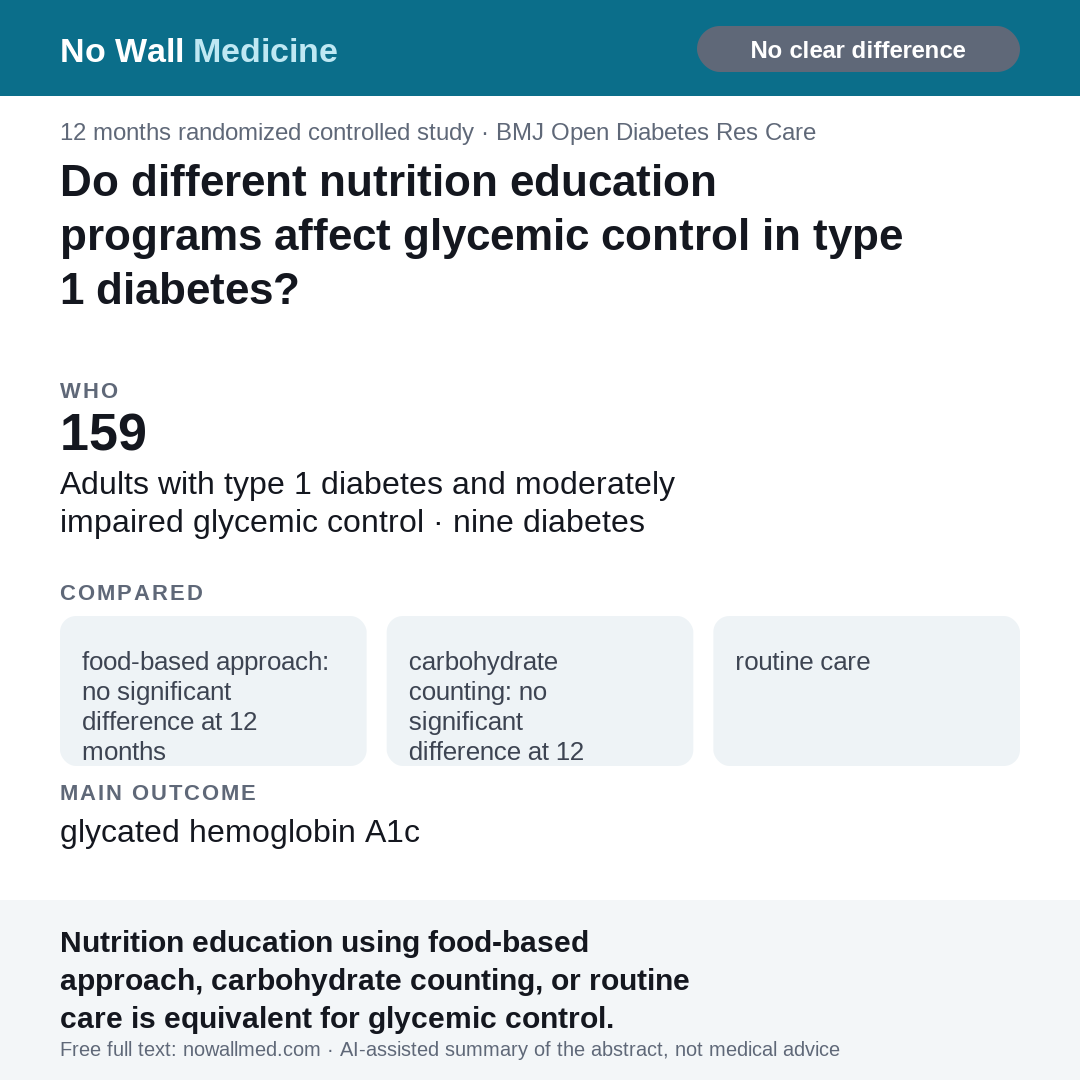
Do different nutrition education programs affect glycemic control in type 1 diabetes?
Who
159
Adults with type 1 diabetes and moderately impaired glycemic control · nine diabetes specialist centers
Compared
food-based approach: no significant difference at 12 months
carbohydrate counting: no significant difference at 12 months
routine care
Main outcome
glycated hemoglobin A1c
Bottom line: Nutrition education using food-based approach, carbohydrate counting, or routine care is equivalent for glycemic control.
BMJ Open Diabetes Res Care · 2021-04-01Download image
Clinical question: Do different nutrition education programs affect glycemic control in type 1 diabetes?
Why it matters: Evidence is weak regarding how different structured nutrition education programs affect glycemic control and cardiovascular risk in adults with type 1 diabetes and moderately impaired blood sugar levels.
Key points
- Researchers studied 159 patients with type 1 diabetes across nine specialist centers, comparing a food-based approach, carbohydrate counting, and routine care.
- At 12 months, there were no significant differences in glycated hemoglobin A1c, which is a measure of long-term blood sugar, between the three groups.
- The food-based approach was associated with an improved intake of legumes, nuts, vegetables, dietary fiber, and healthy fats compared to the other groups.
Headline and key points written with AI from the paper’s abstract, with every number checked against it. Read the paper before relying on them.
Was this summary helpful?
Abstract
Introduction
Evidence on the effects of structured nutrition education is weak in adults with type 1 diabetes mellitus (T1D) with moderately impaired glycemic control. Objective was to compare the effects of different types of nutrition education programs on glycemic control, cardiovascular risk factors, quality of life, diet quality and food choices in T1D. Research design and methods
A 12 months randomized controlled study conducted at nine diabetes specialist centers with three parallel arms: (i) a food-based approach (FBA) including foods with low glycemic index or (ii) carbohydrate counting (CC) according to today's standard practice or (iii) individual sessions according to routine care (RC). The primary end point was difference in glycated hemoglobin A1c (HbA1c) between groups at 12 months. Results
159 patients were randomized (FBA: 51; CC: 52; RC: 55). Mean (SD) age 48.6 (12.0) years, 57.9% females and mean (SD) HbA1c level 63.9 (7.9) mmol/mol, 8% (0.7%). After 3 months, HbA1c improved in both FBA and CC compared with RC. However, there were no significant differences at 12 months in HbA1c; FBA versus RC (-0.4 mmol/mol (1.3), 0.04% (0.1%)), CC versus RC (-0.8 mmol/mol (1.2), 0.1% (0.1%)), FBA versus CC (0.4 mmol/mol (0.3), 0.04% (0.01%)). At 12 months, intake of legumes, nuts and vegetables was improved in FBA versus CC and RC. FBA also reported higher intake of monounsaturated and polyunsaturated fats compared with RC, and dietary fiber, monounsaturated and polyunsaturated fats compared with CC (all p values <0.05). There were no differences in blood pressure levels, lipids, body weight or quality of life. Conclusions
Nutrition education using an FBA, CC or RC is equivalent in terms of HbA1c and cardiovascular risk factors in persons with T1D with moderately impaired glycemic control. An FBA had benefits regarding food choices compared with CC and RC.
Abstract reproduced under the article’s CC BY NC licence.
Subject terms
Cite this article
Sterner Isaksson S, Bensow Bacos M, Eliasson B, et al. Effects of nutrition education using a food-based approach, carbohydrate counting or routine care in type 1 diabetes: 12 months prospective randomized trial. BMJ Open Diabetes Res Care. 2021. doi:10.1136/bmjdrc-2020-001971
Spotted a mistake? Suggest a correction