Auditory cue exposure during slow-wave sleep reduced cravings and playtime in internet gaming disorder
Efficacy and mechanisms of repeated closed-loop auditory exposure during slow-wave sleep for internet gaming disorder
Randomized trialBenefit found
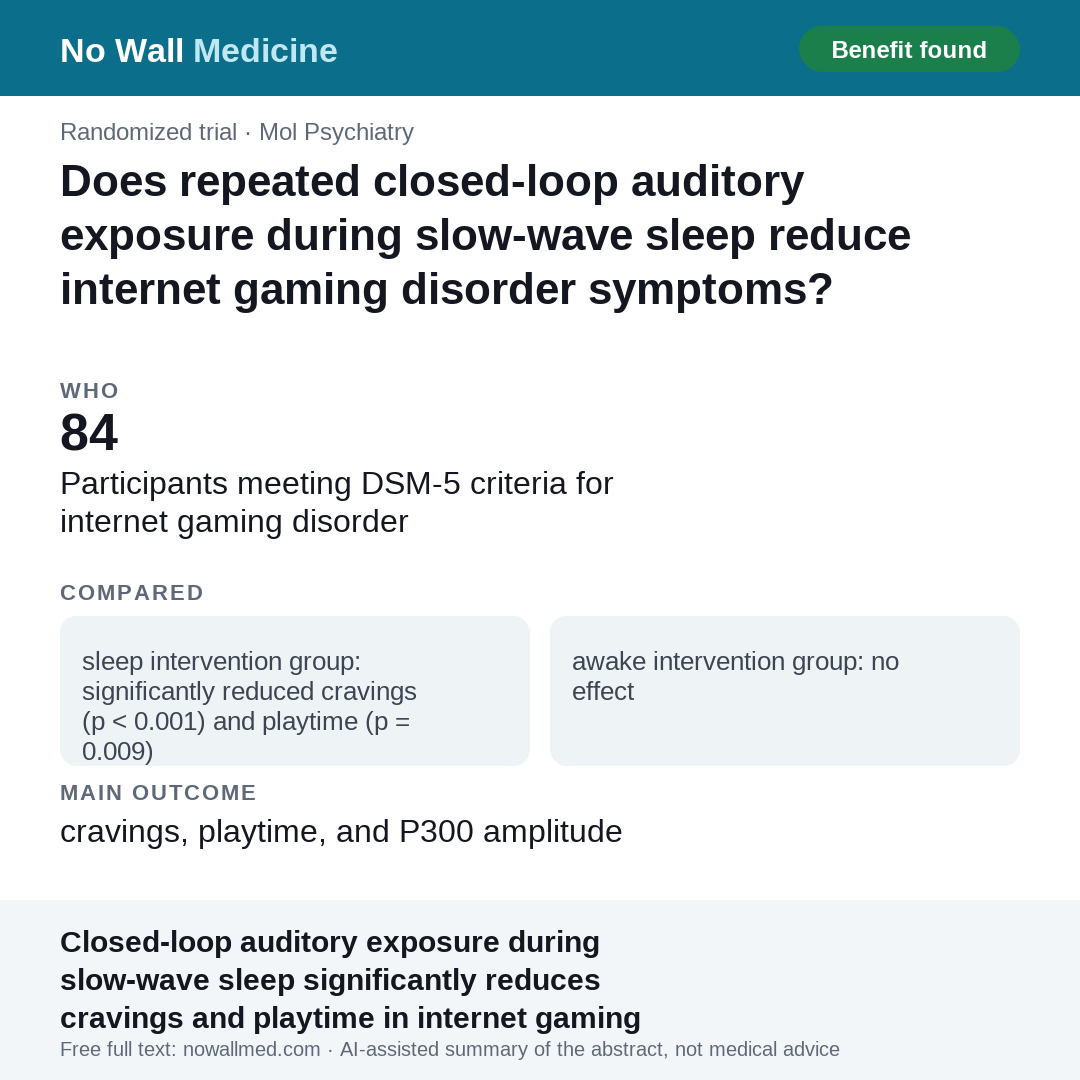
Does repeated closed-loop auditory exposure during slow-wave sleep reduce internet gaming disorder symptoms?
Who
84
Participants meeting DSM-5 criteria for internet gaming disorder
Compared
sleep intervention group: significantly reduced cravings (p < 0.001) and playtime (p = 0.009)
awake intervention group: no effect
Main outcome
cravings, playtime, and P300 amplitude
Bottom line: Closed-loop auditory exposure during slow-wave sleep significantly reduces cravings and playtime in internet gaming disorder.
Mol Psychiatry · 2025-05-27Download image
Clinical question: Does repeated closed-loop auditory exposure during slow-wave sleep reduce internet gaming disorder symptoms?
Why it matters: Internet gaming disorder lacks effective treatments, and researchers wanted to see if using sleep for memory modulation via cue exposure therapy could be more effective than awake therapy.
Key points
- Researchers studied 84 participants with internet gaming disorder who were randomly assigned to receive auditory cue exposure during sleep or while awake.
- The group receiving sound exposure during slow-wave sleep showed significant reductions in cravings and playtime at post-intervention and follow-up compared to the awake group.
- A linear increase in sound-elicited late spindle power, a type of brain wave activity, was positively correlated with reduced cravings (r = 0.54, p = 0.015).
Headline and key points written with AI from the paper’s abstract, with every number checked against it. Read the paper before relying on them.
Was this summary helpful?
Subject terms
Cite this article
Yang X, Song Y, Liu W, Huang Y, Jia T, Liu J. Efficacy and mechanisms of repeated closed-loop auditory exposure during slow-wave sleep for internet gaming disorder. Mol Psychiatry. 2025. doi:10.1038/s41380-025-02995-1
Spotted a mistake? Suggest a correction
Top studies every Monday
The week’s key trials and guidelines in your specialties, plus any topics you follow. By email, free.
Get the weekly digest