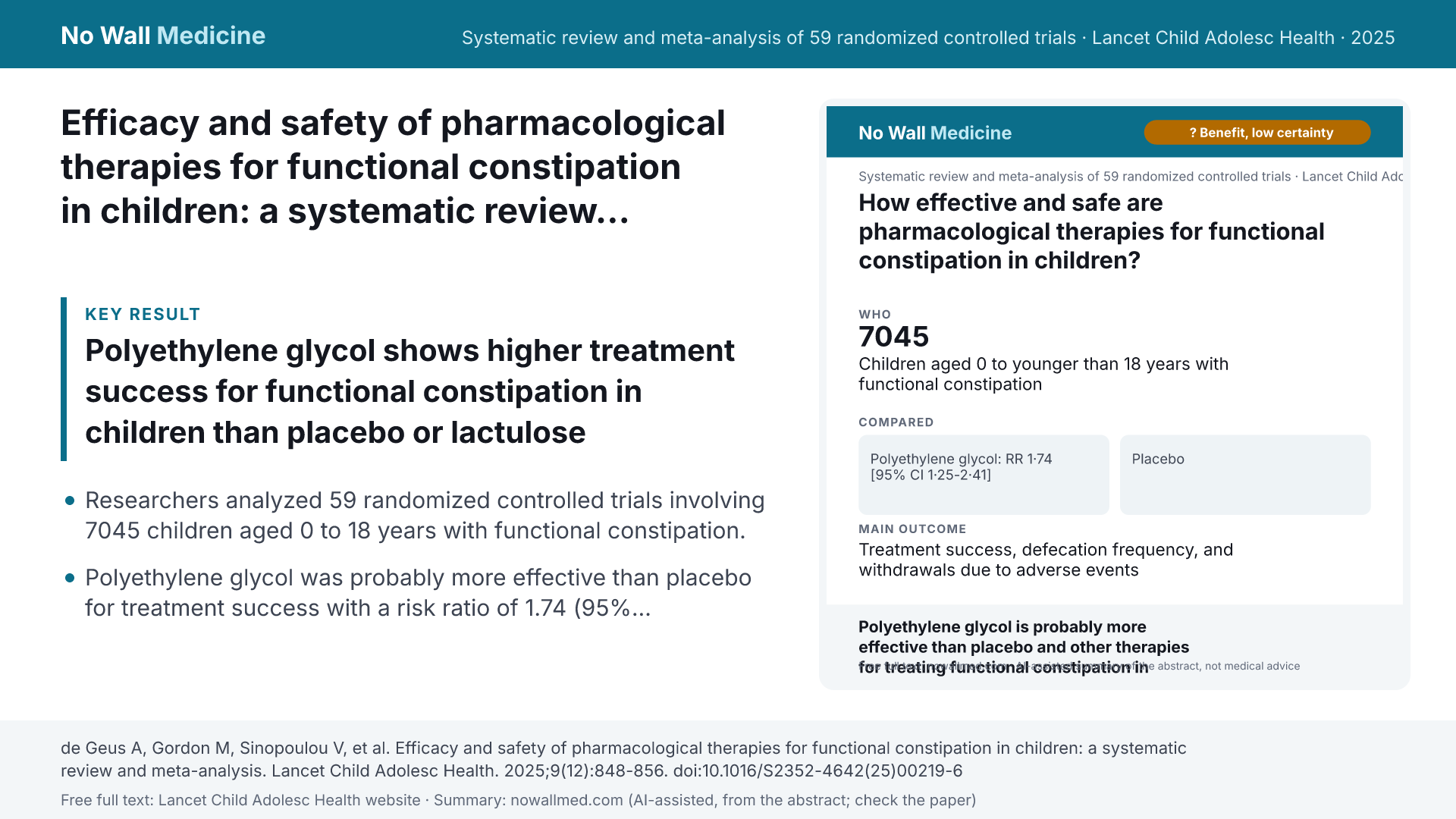
Polyethylene glycol shows higher treatment success for functional constipation in children than placebo or lactulose
Efficacy and safety of pharmacological therapies for functional constipation in children: a systematic review and meta-analysis
Systematic review and meta-analysis of 59 randomized controlled trialsBenefit, low certainty
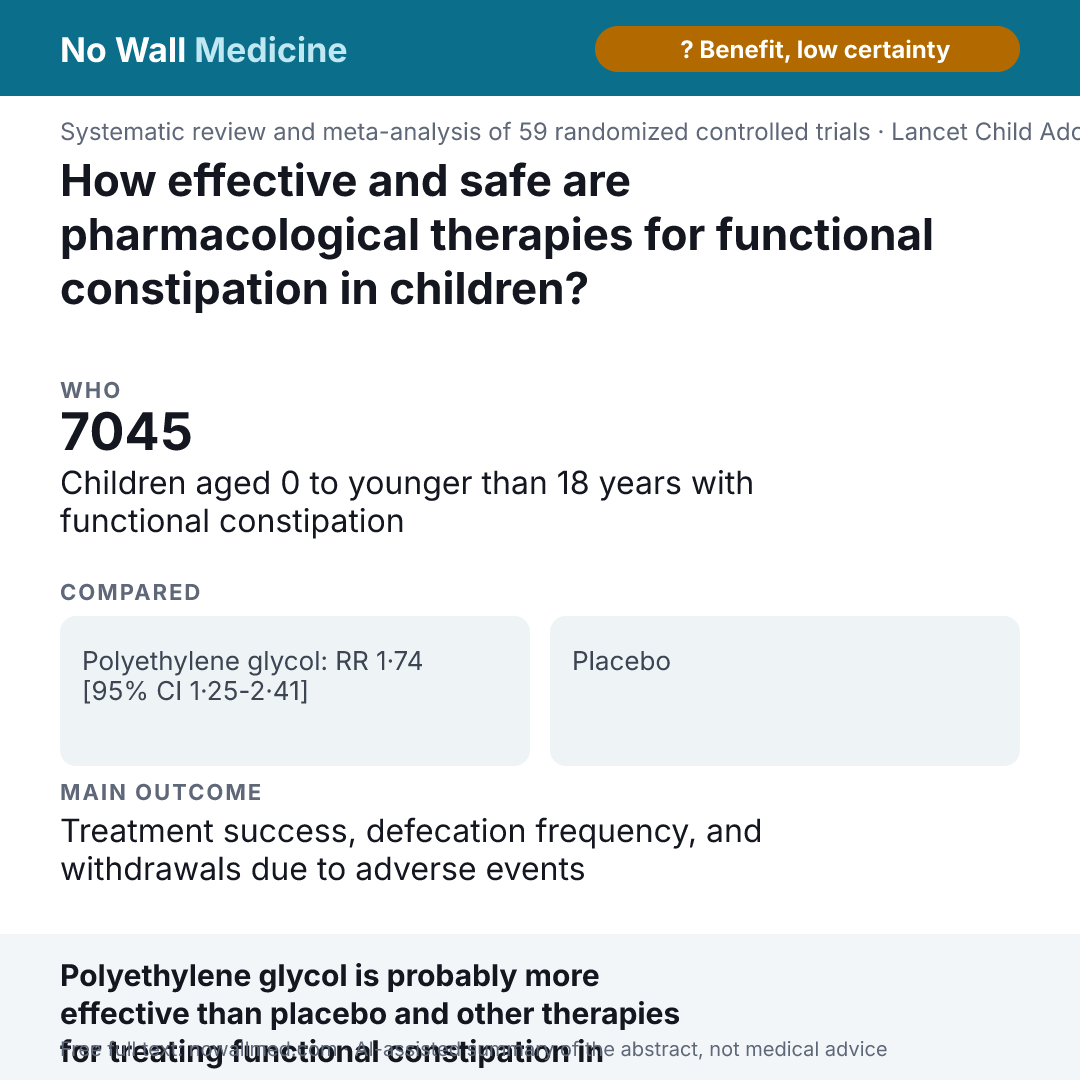
How effective and safe are pharmacological therapies for functional constipation in children?
Who
7045
Children aged 0 to younger than 18 years with functional constipation
Compared
Polyethylene glycol: RR 1·74 [95% CI 1·25-2·41]
Placebo
Main outcome
Treatment success, defecation frequency, and withdrawals due to adverse events
Result: RR 1·74 [95% CI 1·25-2·41]
Bottom line: Polyethylene glycol is probably more effective than placebo and other therapies for treating functional constipation in children.
Lancet Child Adolesc Health · 2025-10-13 · PROSPERO CRD42022368719
Why it matters: New therapies for functional constipation in children are being deployed, requiring an up-to-date assessment of the efficacy and safety of pharmacological interventions.
Headline and visual abstract written with AI from the paper’s abstract, with every number checked against it. Read the paper before relying on them.
Was this summary helpful?
Abstract
Background
There has been a substantial increase in studies on functional constipation in children as new therapies are deployed. We aimed to provide an up-to-date, methodologically robust systematic review and meta-analysis on the efficacy and safety of pharmacological therapies for functional constipation in children. Methods
In this systematic review and meta-analysis, we searched PubMed, Medline, Embase, and the Cochrane library from inception to Feb 5, 2025. We included randomised controlled trials that involved children aged 0 years to younger than 18 years with functional constipation treated with pharmacological interventions compared with placebo, no treatment, or other interventions and with at least a 2-week follow-up period. Studies were excluded if there was no definition of functional constipation, children with organic causes for constipation or previous bowel surgery were included, children with faecal incontinence without the presence of constipation were included, or the aim of treatment was faecal disimpaction rather than maintenance therapy. Pairs of authors independently extracted summary data from published reports and critiqued studies. We assessed risk of bias with the Cochrane tool. Meta-analyses estimated risk ratios (RRs) or mean differences, and 95% CIs. Certainty of evidence was established with GRADE. Our main outcomes were treatment success (as defined by study authors), defecation frequency, and withdrawals due to adverse events. This study was registered on PROSPERO (CRD42022368719). Findings
Our search identified 4595 articles, of which 59 randomised controlled trials were included, representing 7045 participants with functional constipation. Interventions included polyethylene glycol (n=36 studies), lactulose (n=18), magnesium oxide or magnesium hydroxide (n=7), picosulfate (n=1), liquid paraffin (n=4), prucalopride (n=1), lubiprostone (n=2), linaclotide (n=3), plecanatide (n=1), enemas (n=2), and domperidone (n=1). Meta-analyses for treatment success showed that polyethylene glycol was probably more effective than placebo (RR 1·74 [95% CI 1·25-2·41], moderate certainty of evidence) and may be more effective than lactulose (1·35 [1·11-1·64], low certainty of evidence). There might be no difference in treatment success for linaclotide compared with placebo (1·21 [0·69-2·13], low certainty of evidence), but linaclotide probably leads to higher defecation frequency per week (mean difference 1·10 [95% CI 0·40-1·80], moderate certainty of evidence). There is low to moderate certainty evidence that prucalopride is not more effective than placebo (RR 1·68 [95% CI 0·77 to 3·68]). Interpretation
Polyethylene glycol is probably more effective than placebo and key comparator therapies and should be considered the standard of first-line care. Future studies should consider polyethylene glycol as an index therapy, and clearly describe methods, patient characteristics, and previous therapeutics. Funding
None.
Abstract reproduced under the article’s CC BY licence.
Subject terms
Cite this article
de Geus A, Gordon M, Sinopoulou V, et al. Efficacy and safety of pharmacological therapies for functional constipation in children: a systematic review and meta-analysis. Lancet Child Adolesc Health. 2025;9(12):848-856. doi:10.1016/S2352-4642(25)00219-6
Spotted a mistake? Suggest a correction