Biofeedback and neurofeedback were associated with reduced depression symptoms in patients with major depressive disorder
Efficacy of bio- and neurofeedback for depression: a meta-analysis
Meta-analysisBenefit found
Are biofeedback and neurofeedback effective for treating depression?
Who
Patients with major depressive disorder or other depressive symptomatology
Compared
Bio- and neurofeedback
Control groups
Main outcome
Reduction in depressive symptomatology
Result: Hedges' g = 0.717 for major depressive disorder
Bottom line: Biofeedback and neurofeedback are associated with a reduction in self-reported depression.
Limitation: The field has a large room for improvement in terms of research quality.
Psychol Med · 2021-11-15Download image
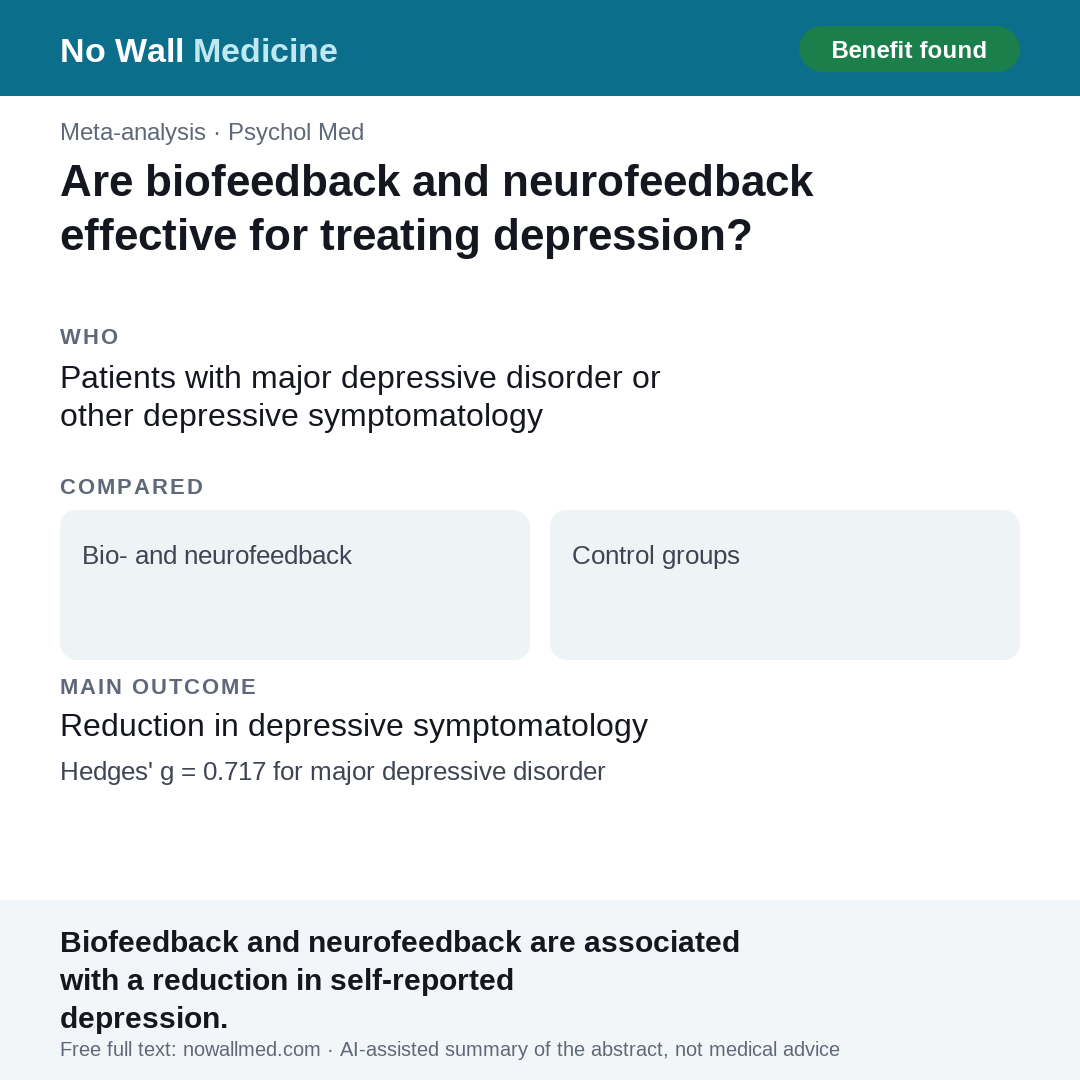
Clinical question: Are biofeedback and neurofeedback effective for treating depression?
Why it matters: The effectiveness of biofeedback and neurofeedback techniques on depressive symptoms has remained controversial.
Key points
- Researchers performed a meta-analysis of studies involving patients with major depressive disorder and those with depressive symptoms from other medical or mental conditions.
- In patients with major depressive disorder, within-group analysis showed an effect size of Hedges' g = 0.717 and between-group analysis showed Hedges' g = 1.050.
- For the second group of studies, a small but significant effect was found between groups with Hedges' g = 0.303 in favor of biofeedback and neurofeedback.
Limitation the authors note: The field has a large room for improvement in terms of research quality.
Headline and key points written with AI from the paper’s abstract, with every number checked against it. Read the paper before relying on them.
Was this summary helpful?
Subject terms
Cite this article
Fernández-Alvarez J, Grassi M, Colombo D, Botella C, Cipresso P, Perna G. Efficacy of bio- and neurofeedback for depression: a meta-analysis. Psychol Med. 2021. doi:10.1017/S0033291721004396
Spotted a mistake? Suggest a correction
Top studies every Monday
The week’s key trials and guidelines in your specialties, plus any topics you follow. By email, free.
Get the weekly digest