Neurofeedback and self-guided psychological strategies showed similar reductions in depression symptoms in a pilot trial
Self-blame in major depression: a randomised pilot trial comparing fMRI neurofeedback with self-guided psychological strategies
Single-blind randomized controlled pilot trialNo clear difference
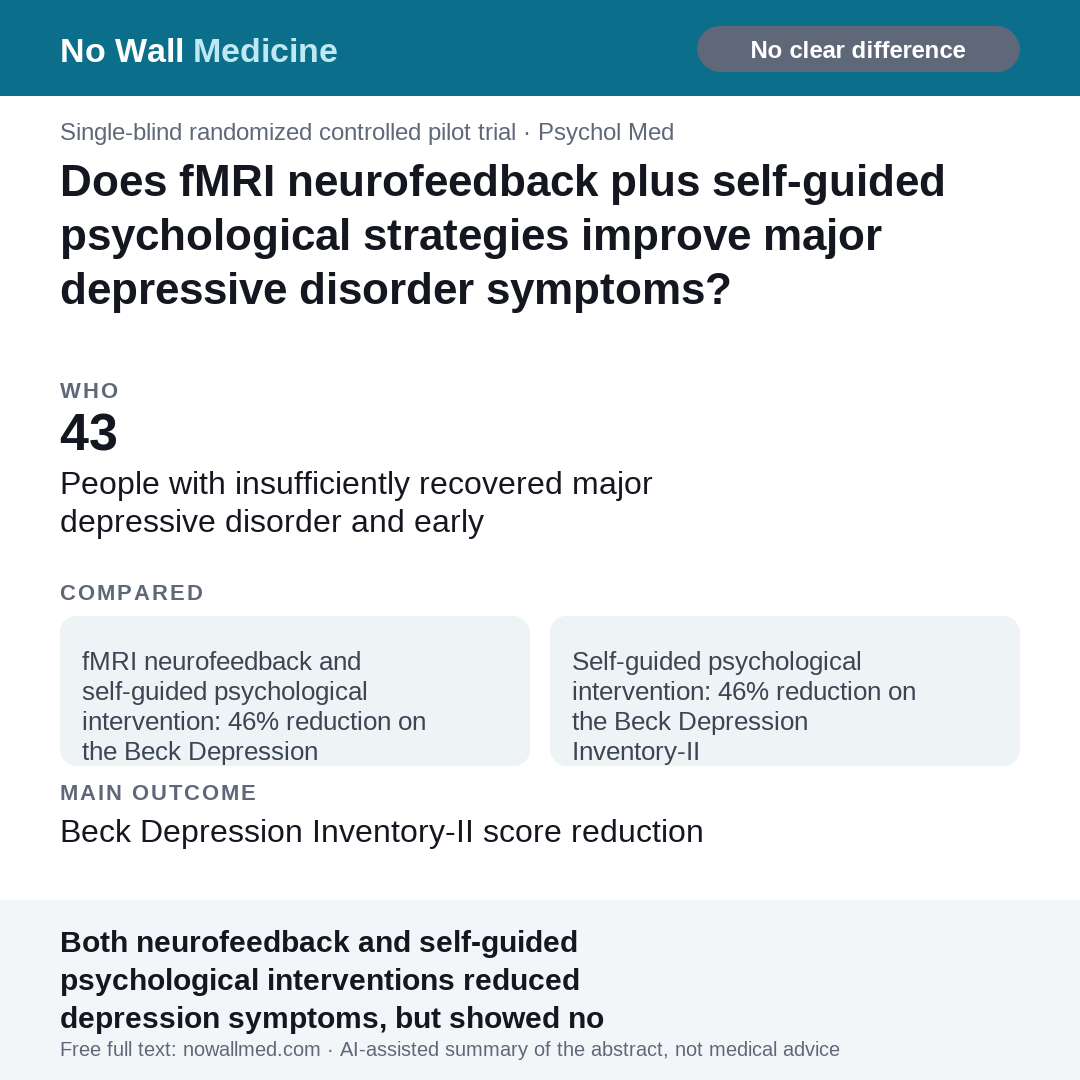
Does fMRI neurofeedback plus self-guided psychological strategies improve major depressive disorder symptoms?
Who
43
People with insufficiently recovered major depressive disorder and early treatment-resistance
Compared
fMRI neurofeedback and self-guided psychological intervention: 46% reduction on the Beck Depression Inventory-II
Self-guided psychological intervention: 46% reduction on the Beck Depression Inventory-II
Main outcome
Beck Depression Inventory-II score reduction
Bottom line: Both neurofeedback and self-guided psychological interventions reduced depression symptoms, but showed no significant difference between groups.
Limitation: Further confirmatory studies are needed and comparison against treatment-as-usual is required.
Psychol Med · 2021-12-02Download image
Clinical question: Does fMRI neurofeedback plus self-guided psychological strategies improve major depressive disorder symptoms?
Why it matters: It was unknown if functional magnetic resonance imaging (fMRI) neurofeedback could be used to target self-blaming emotions in people with symptomatic major depressive disorder.
Key points
- The study involved 43 participants with major depressive disorder, 35 of whom completed a trial comparing functional magnetic resonance imaging (fMRI) neurofeedback with self-guided psychological strategies.
- Both interventions resulted in a 46% reduction on the Beck Depression Inventory-II, which is a tool used to measure the severity of depression, with no significant differences between groups.
- Patients without DSM-5-defined anxious distress showed a superior response to neurofeedback compared with the psychological intervention, while the opposite pattern was seen in patients with anxious depression.
Headline and key points written with AI from the paper’s abstract, with every number checked against it. Read the paper before relying on them.
Was this summary helpful?
Subject terms
Cite this article
Jaeckle T, Williams SCR, Barker GJ, Basilio R, Carr E, Goldsmith K. Self-blame in major depression: a randomised pilot trial comparing fMRI neurofeedback with self-guided psychological strategies. Psychol Med. 2021. doi:10.1017/S0033291721004797
Spotted a mistake? Suggest a correction
Top studies every Monday
The week’s key trials and guidelines in your specialties, plus any topics you follow. By email, free.
Get the weekly digest