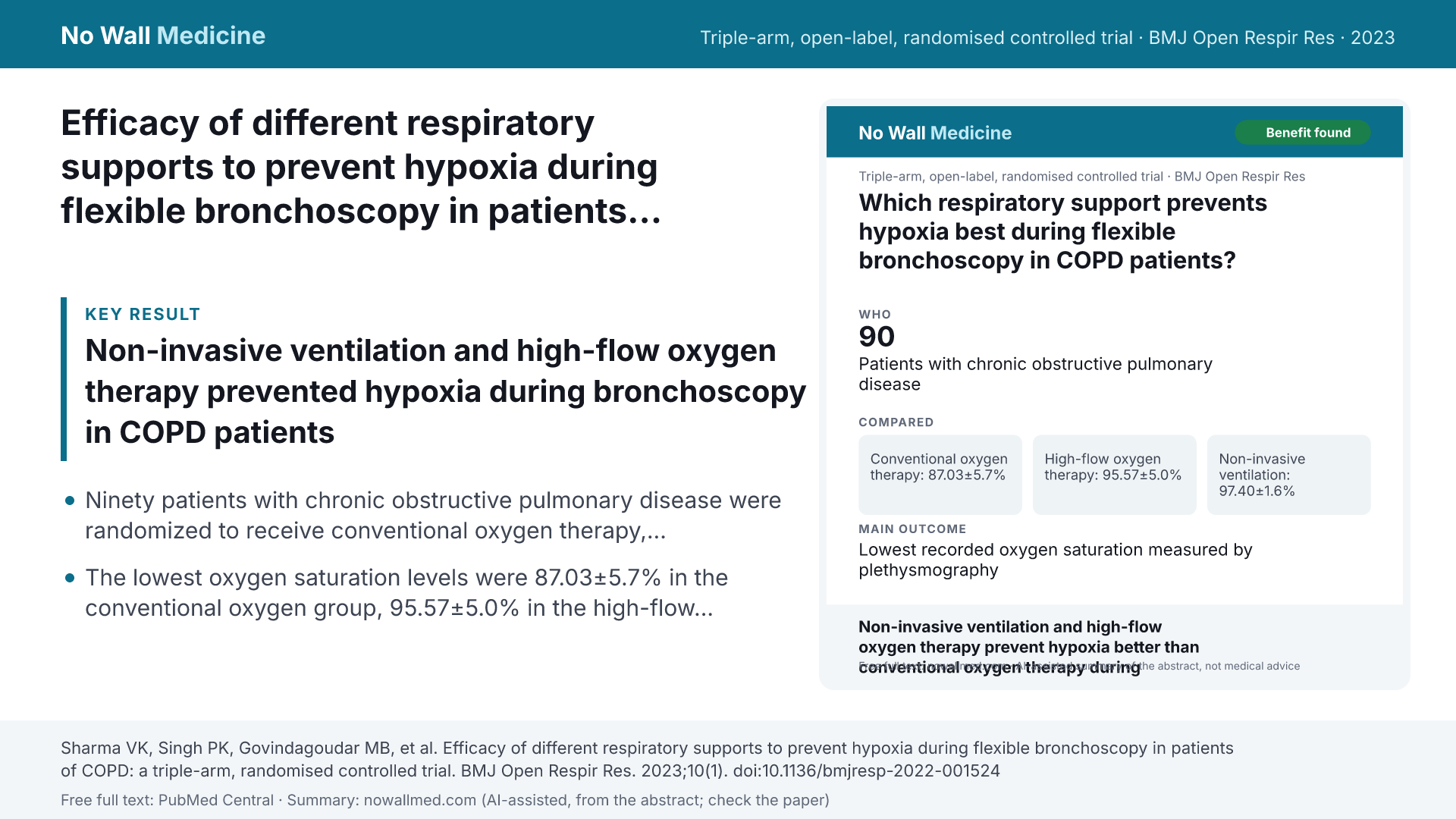
Non-invasive ventilation and high-flow oxygen therapy prevented hypoxia during bronchoscopy in COPD patients
Efficacy of different respiratory supports to prevent hypoxia during flexible bronchoscopy in patients of COPD: a triple-arm, randomised controlled trial
Triple-arm, open-label, randomised controlled trialBenefit found
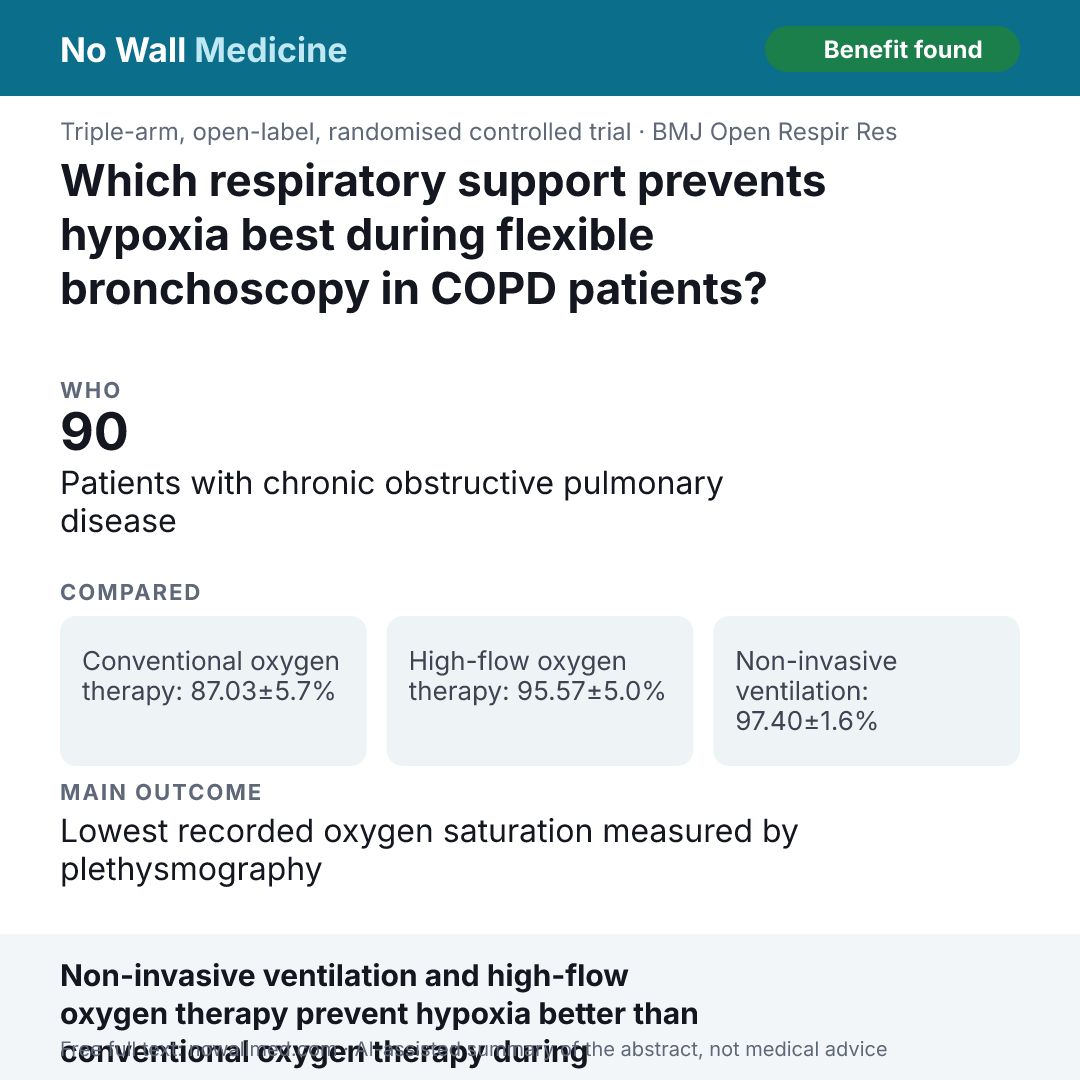
Which respiratory support prevents hypoxia best during flexible bronchoscopy in COPD patients?
Who
90
Patients with chronic obstructive pulmonary disease
Compared
Conventional oxygen therapy: 87.03±5.7%
High-flow oxygen therapy: 95.57±5.0%
Non-invasive ventilation: 97.40±1.6%
Main outcome
Lowest recorded oxygen saturation measured by plethysmography
Bottom line: Non-invasive ventilation and high-flow oxygen therapy prevent hypoxia better than conventional oxygen therapy during bronchoscopy.
BMJ Open Respir Res · 2023-11-07
Headline and visual abstract written with AI from the paper’s abstract, with every number checked against it. Read the paper before relying on them.
Was this summary helpful?
Abstract
Background
Patients with chronic-obstructive-pulmonary-disease (COPD) undergo bronchoscopy for various reasons, and are at relatively higher risk of complications. This study evaluated the efficacy of non-invasive ventilation (NIV) and high-flow-oxygen-therapy (HFOT) compared with conventional-oxygen-therapy (COT) in patients with COPD undergoing bronchoscopy, to prevent hypoxia. Methods
It was a triple-arm, open-label, randomised controlled trial. Ninety patients with COPD were randomly assigned into three intervention arms in 1:1:1 ratio. The incidence of hypoxia, lowest recorded oxygen saturation measured by plethysmography (SpO2), ECG, patient vitals and comfort levels were assessed. Results
Mean age of the study population was 61.71±7.5 years. Out of 90 cases enrolled, 51, 34 and 5 were moderate, severe and very-severe COPD, respectively, as per GOLD (Global Initiative for Chronic Obstructive Lung Disease) classification. Rest of the baseline characteristics were similar. SpO2 during flexible bronchoscopy (FB) was lowest in COT group (COT: 87.03±5.7% vs HFOT: 95.57±5.0% vs NIV: 97.40±1.6%, p<0.001). Secondary objectives were similar except respiratory-rate (breaths-per-minute) which was highest in COT group (COT: 20.23±3.1 vs HFOT: 18.57±4.1 vs NIV: 16.80±1.9, p<0.001). Whereas post FB partial of oxygen in arterial blood was highest in NIV group (NIV: 84.27±21.6 mm Hg vs HFOT: 69.03±13.6 mm Hg vs COT: 69.30±11.9 mm Hg, p<0.001). Post FB partial pressure of carbon dioxide in arterial blood was similar in the three arms. Operator's ease-of-performing-procedure was least in the NIV group as assessed with Visual Analogue Scale (p<0.01). A higher number of NIV group participants reported nasal pain as compared with the other two arms (p<0.01). Conclusion
NIV and HFOT are superior to COT in preventing hypoxia during bronchoscopy, but NIV is associated with poor patient-tolerance and inferior operator's ease of doing procedure. Trial registration number
CTRI/2021/03/032190.
Abstract reproduced under the article’s CC BY NC licence.
Subject terms
Cite this article
Sharma VK, Singh PK, Govindagoudar MB, et al. Efficacy of different respiratory supports to prevent hypoxia during flexible bronchoscopy in patients of COPD: a triple-arm, randomised controlled trial. BMJ Open Respir Res. 2023;10(1). doi:10.1136/bmjresp-2022-001524
Spotted a mistake? Suggest a correction