Efficacy of non-invasive brain stimulation interventions on cognitive impairment: an umbrella review of meta-analyses of randomized controlled trials
Umbrella review of meta-analysesBenefit found
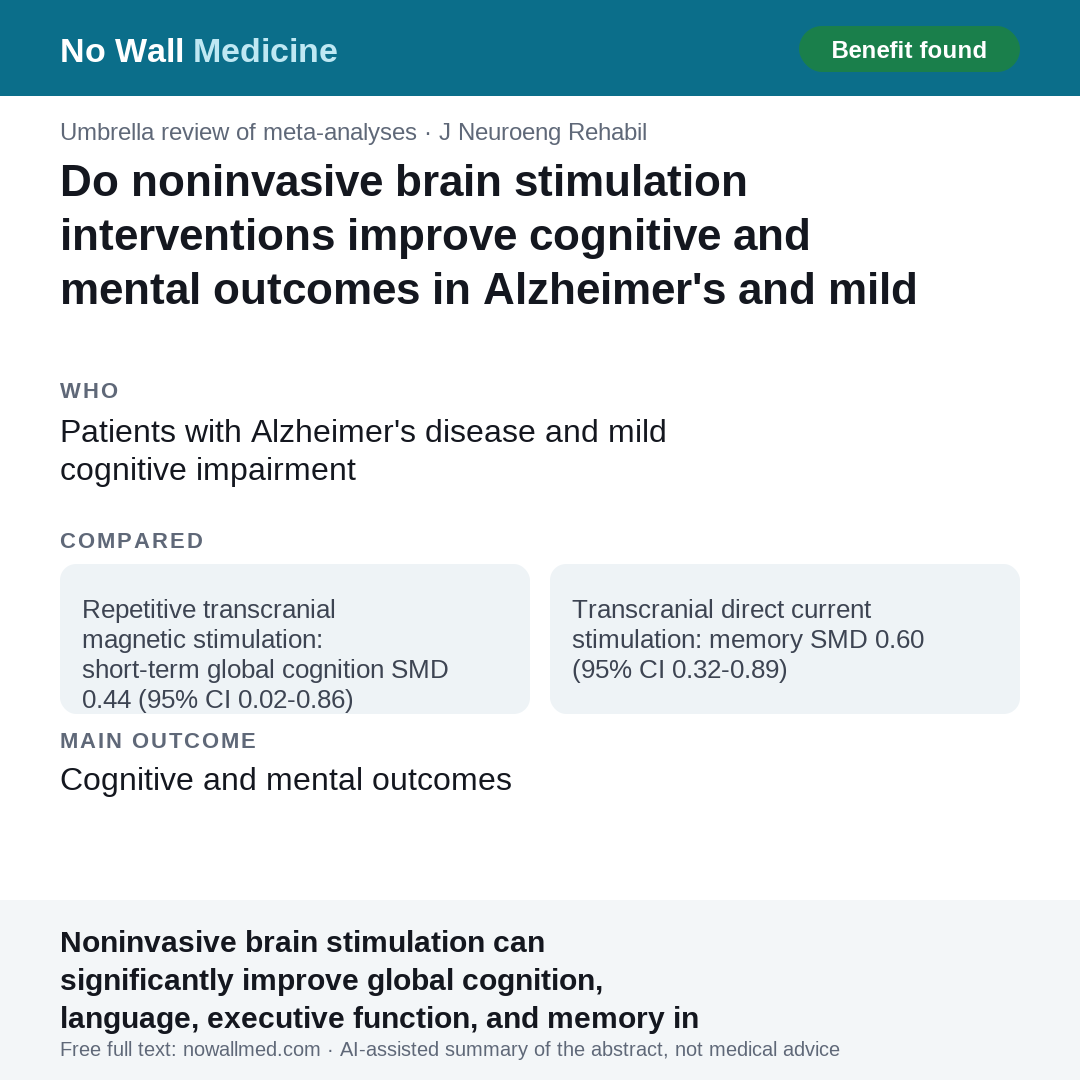
Do noninvasive brain stimulation interventions improve cognitive and mental outcomes in Alzheimer's and mild cognitive impairment?
Who
Patients with Alzheimer's disease and mild cognitive impairment
Compared
Repetitive transcranial magnetic stimulation: short-term global cognition SMD 0.44 (95% CI 0.02-0.86)
Transcranial direct current stimulation: memory SMD 0.60 (95% CI 0.32-0.89)
Main outcome
Cognitive and mental outcomes
Bottom line: Noninvasive brain stimulation can significantly improve global cognition, language, executive function, and memory in these patients.
Limitation: Results should be interpreted cautiously due to study heterogeneity and methodological limitations.
J Neuroeng Rehabil · 2025-02-05Download image
Clinical question: Do noninvasive brain stimulation interventions improve cognitive and mental outcomes in Alzheimer's and mild cognitive impairment?
Abstract
Background
The impact of noninvasive brain stimulation (NIBS) on cognitive and mental outcomes in Alzheimer's disease (AD) and mild cognitive impairment (MCI) remains under debate due to contradictory findings from systematic reviews and meta-analyses (SRMAs). To synthesize evidence from SRMAs assessing the effectiveness of NIBS techniques on cognitive and mental outcomes in AD and MCI populations. By comparing our findings to recent reviews and clinical guidelines, we highlight how this study addresses current limitations in the literature, provides a more holistic perspective on NIBS interventions, and guides future research and clinical practice. Methods
We searched four databases from inception to May 15, 2024, reviewing SRMAs that analyzed the effects of NIBS. Effect sizes, 95% confidence intervals (CIs), and prediction intervals were computed for each meta-analysis. The methodological quality of the SRMAs was evaluated using the Measurement Tool to Assess Systematic Reviews 2, and the quality of evidence was assessed through the Grading of Recommendations, Assessment, Development, and Evaluation criteria. Findings
Ten SRMAs detailing 22 associations were analyzed, focusing on two NIBS techniques across 12 unique outcomes. Significant improvements were observed in global cognition, language, executive function, and memory. Repetitive transcranial magnetic stimulation (rTMS) significantly enhanced short-term global cognition (standardized mean difference [SMD], 0.44; 95% CI 0.02-0.86), language (SMD, 1.64; 95% CI 1.22-2.06), executive function (SMD, 1.64; 95% CI 0.18-0.83), and long-term global cognition (SMD, 0.29; 95% CI 0.07-0.50). Transcranial direct current stimulation (tDCS) was effective in improving memory (SMD, 0.60; 95% CI 0.32-0.89) and executive function (SMD, 0.39; 95% CI 0.08-0.71). NIBS interventions showed no significant correlation with neuropsychiatric symptoms but demonstrated good tolerability in terms of safety and acceptability. Interpretation
This umbrella review indicates that NIBS techniques, particularly rTMS and tDCS, can significantly improve cognitive functions such as global cognition, language, executive functions, and memory in patients with AD and MCI. Despite potential benefits, results should be interpreted cautiously due to study heterogeneity and methodological limitations. Future studies should investigate their long-term effects and applicability across dementia types.
Subject terms
Cite this article
Wu M, Song W, Wang X, Teng L, Li J, Zhang J. Efficacy of non-invasive brain stimulation interventions on cognitive impairment: an umbrella review of meta-analyses of randomized controlled trials. J Neuroeng Rehabil. 2025. doi:10.1186/s12984-025-01566-3
Spotted a mistake? Suggest a correction
Top studies every Monday
The week’s key trials and guidelines in your specialties, plus any topics you follow. By email, free.
Get the weekly digest