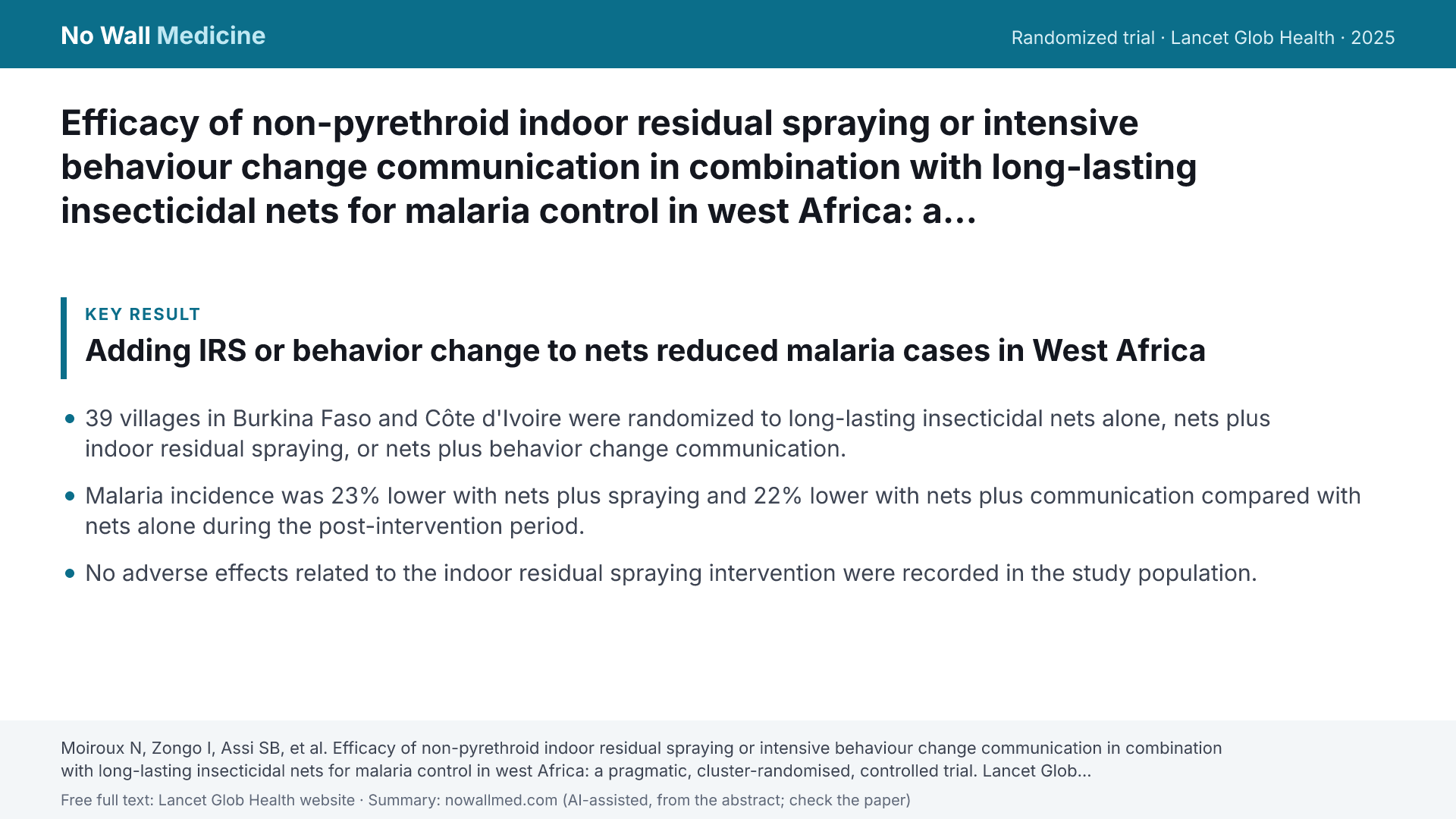
Adding IRS or behavior change to nets reduced malaria cases in West Africa
Efficacy of non-pyrethroid indoor residual spraying or intensive behaviour change communication in combination with long-lasting insecticidal nets for malaria control in west Africa: a pragmatic, cluster-randomised, controlled trial
Why it matters: Applies to rural West Africa; supports adding non-pyrethroid spraying or intensive communication to net distribution to reduce malaria cases.
Key points
- 39 villages in Burkina Faso and Côte d'Ivoire were randomized to long-lasting insecticidal nets alone, nets plus indoor residual spraying, or nets plus behavior change communication.
- Malaria incidence was 23% lower with nets plus spraying and 22% lower with nets plus communication compared with nets alone during the post-intervention period.
- No adverse effects related to the indoor residual spraying intervention were recorded in the study population.
Limitation the authors note: The authors state that the effectiveness of the behavior change communication intervention requires confirmation through additional studies.
Headline and key points written with AI from the paper’s abstract, with every number checked against it. Read the paper before relying on them.
Was this summary helpful?
Abstract
Background
Since 2015, progress in the control of malaria has stalled owing to multiple factors, including the probable reduced efficacy of long-lasting insecticidal nets (LLINs) caused by insecticide resistance and plateauing LLIN use rates. This study aimed to assess the additional effect of non-pyrethroid indoor residual spraying (IRS) and intensive behaviour change communication (BCC) when combined with LLINs on malaria in rural west Africa. Methods
This pragmatic, parallel-group, cluster-randomised, controlled trial took place in community settings in Burkina Faso and Côte d'Ivoire. Villages (clusters) with an average population of 300 inhabitants, a minimum distance between villages of 2 km, and year-round accessibility by a four-wheel drive vehicle were eligible for inclusion. A simple randomisation approach with a computer-generated random number sequence was used to assign 39 villages with a total population of 10 750 inhabitants to three groups: LLIN alone (16 villages; the control group), LLIN plus IRS (11 villages), and LLIN plus BCC (12 villages). Field teams that collected epidemiological data and laboratory staff were masked to intervention allocation; it was not possible to mask participants, field teams that implemented the interventions, or study investigators to intervention allocation. The IRS intervention consisted of pirimiphos-methyl treatment of the dwellings and the BCC intervention focused on promoting LLIN use, environmental sanitation, and early health-seeking behaviour through home visits, interpersonal talks, and group talks. The primary outcome was malaria incidence rate in the whole population as measured by passive case detection at health centres. Data were collected for 10 months before (the pre-intervention period) and 10 months after (the post-intervention period) randomisation. All outcome data were analysed by intention to treat and using constrained baseline analyses. The trial is registered with ClinicalTrials.gov, NCT03074435, and is completed. Findings
Between November, 2016, and August, 2018, 215 000 theoretical person-months of follow-up resulted in 3612 malaria cases recorded by passive case detection during both pre-intervention and post-intervention periods. During the post-intervention period, passive case detection showed a 23% reduction in malaria incidence rate (rate ratio 0·77 [95% CI 0·64-0·93], p=0·0073) in the LLIN plus IRS group and a 22% reduction (0·78 [0·63-0·96], p=0·020) in the LLIN plus BCC group compared with the LLIN-alone (control) group. No IRS-related adverse effects were recorded. Interpretation
Results show that the addition of non-pyrethroid IRS or intensive BCC to LLINs can effectively reduce the number of malaria cases. The effect of IRS observed in our trial was intermediate compared with that reported in previous trials conducted in Africa. Notably, this study provides the first trial-based evidence supporting the effectiveness of an intensive BCC intervention, which is a promising result but requires confirmation through additional studies. Funding
Initiative 5%, Expertise France. Translation
For the French translation of the abstract see Supplementary Materials section.
Abstract reproduced under the article’s CC BY licence.
Subject terms
Headline, design, result, key points, caveat and citation as plain text.
Cite this article
Moiroux N, Zongo I, Assi SB, et al. Efficacy of non-pyrethroid indoor residual spraying or intensive behaviour change communication in combination with long-lasting insecticidal nets for malaria control in west Africa: a pragmatic, cluster-randomised, controlled trial. Lancet Glob Health. 2025;13(9):e1605-e1616. doi:10.1016/S2214-109X(25)00216-5
Spotted a mistake? Suggest a correction