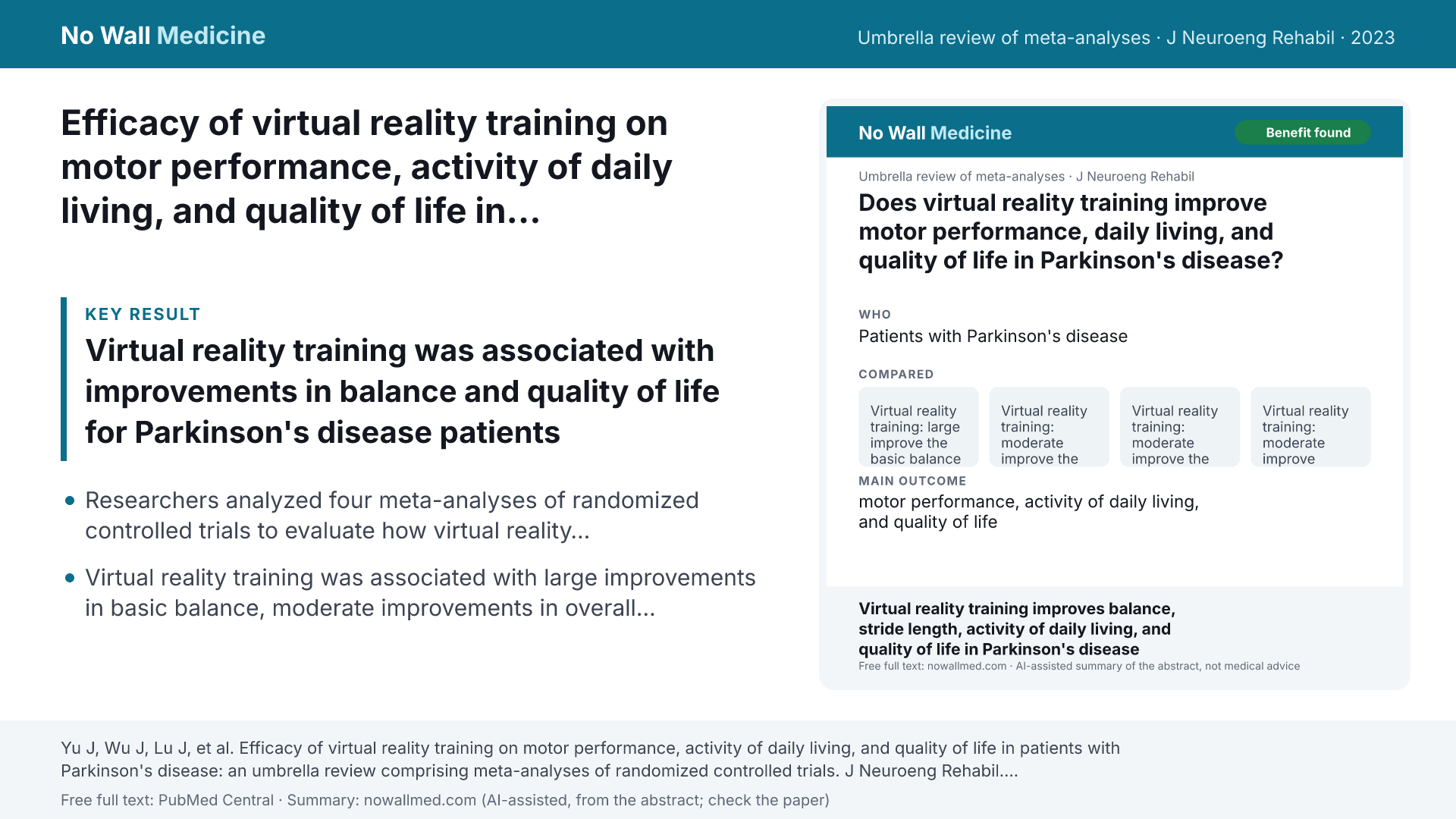
Virtual reality training was associated with improvements in balance and quality of life for Parkinson's disease patients
Efficacy of virtual reality training on motor performance, activity of daily living, and quality of life in patients with Parkinson's disease: an umbrella review comprising meta-analyses of randomized controlled trials
Umbrella review of meta-analysesBenefit found
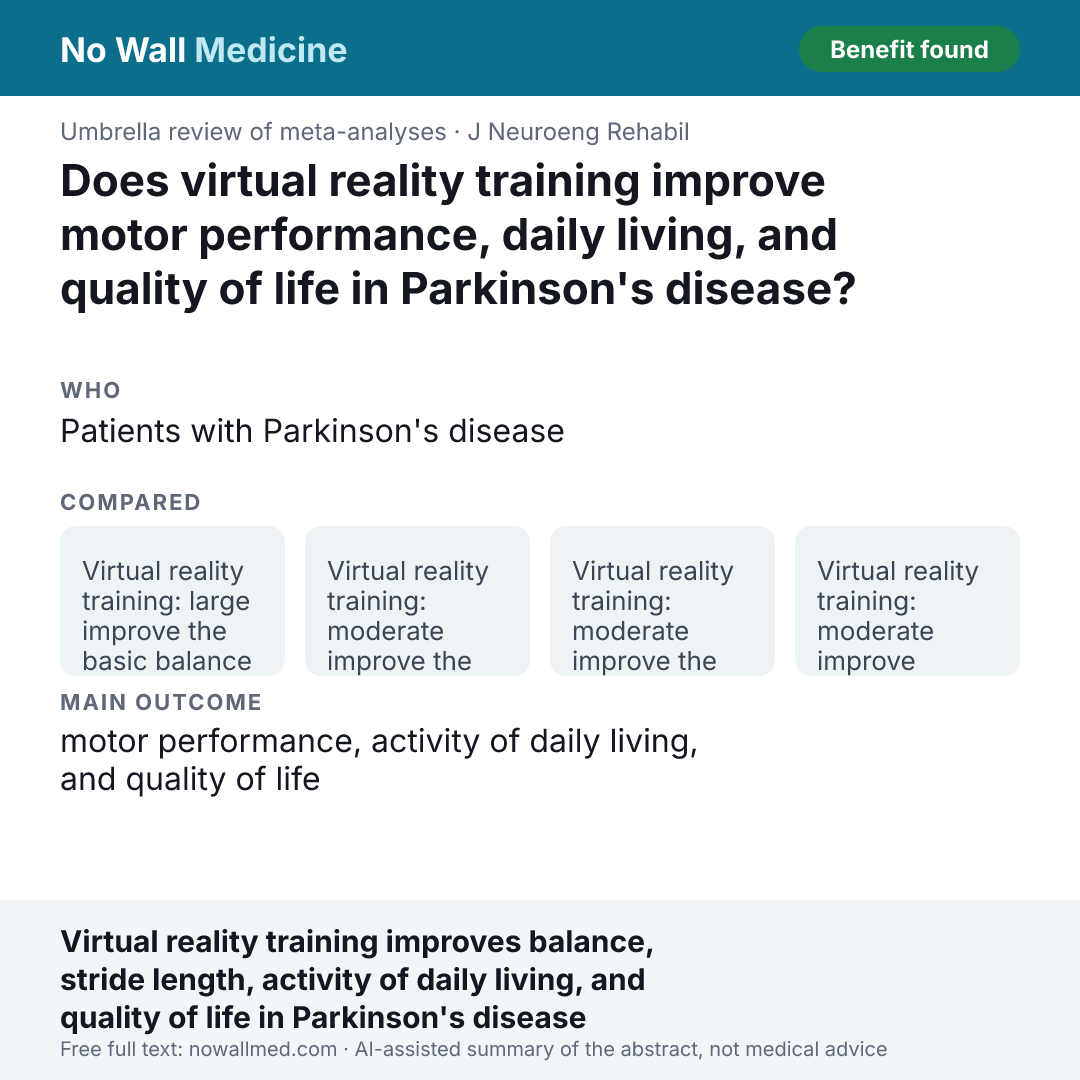
Does virtual reality training improve motor performance, daily living, and quality of life in Parkinson's disease?
Who
Patients with Parkinson's disease
Compared
Virtual reality training: large improve the basic balance ability
Virtual reality training: moderate improve the overall balance capacity
Virtual reality training: moderate improve the stride length
Virtual reality training: moderate improve activity of daily living and quality of life
Main outcome
motor performance, activity of daily living, and quality of life
Bottom line: Virtual reality training improves balance, stride length, activity of daily living, and quality of life in Parkinson's disease patients.
Limitation: The evidence presented was of moderate-to-very low quality.
J Neuroeng Rehabil · 2023-09-30 · Save PNG
Clinical question: Does virtual reality training improve motor performance, daily living, and quality of life in Parkinson's disease?
Why it matters: The strength, quality, and reproducibility of existing evidence regarding the efficacy of virtual reality training for Parkinson's disease outcomes had not been thoroughly evaluated.
Key points
- Researchers analyzed four meta-analyses of randomized controlled trials to evaluate how virtual reality training affects motor performance, daily activities, and quality of life in people with Parkinson's disease.
- Virtual reality training was associated with large improvements in basic balance, moderate improvements in overall balance, stride length, activities of daily living, and quality of life.
- No statistically clear evidence was found regarding the effects of virtual reality training on walking speed, motor function, or gait function.
Limitation the authors note: The analyzed meta-analyses showed low-to-moderate methodological quality and presented evidence of moderate-to-very low quality.
Headline and key points written with AI from the paper’s abstract, with every number checked against it. Read the paper before relying on them.
Was this summary helpful?
Subject terms
Headline, design, result, key points, caveat and citation as plain text.
Cite this article
Yu J, Wu J, Lu J, et al. Efficacy of virtual reality training on motor performance, activity of daily living, and quality of life in patients with Parkinson's disease: an umbrella review comprising meta-analyses of randomized controlled trials. J Neuroeng Rehabil. 2023;20(1):133. doi:10.1186/s12984-023-01256-y
Spotted a mistake? Suggest a correction