Machine learning models show high accuracy for screening obstructive sleep apnea in adults
Enabling Early Obstructive Sleep Apnea Diagnosis With Machine Learning: Systematic Review
Systematic reviewUnclear result
Can machine learning diagnose sleep apnea?
Who
63
adult patients with suspected obstructive sleep apnea
Compared
0.98logistic regression (0.96-0.99)
other models
Main outcome
area under receiver operating curve
Bottom line: Machine learning shows promise for sleep apnea diagnosis
Limitation: lacked external validation results
J Med Internet Res · 2022-09-30Download image
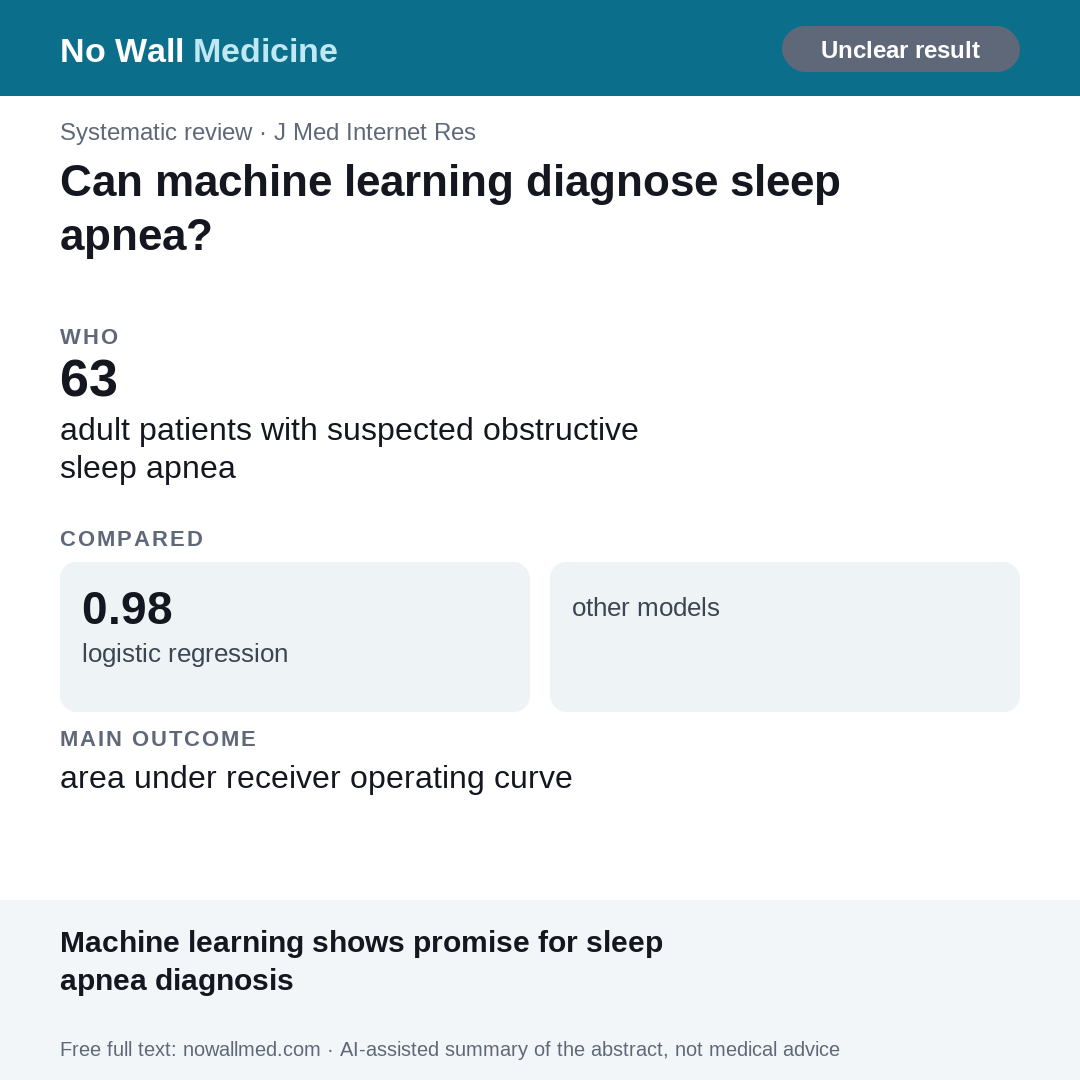
Clinical question: Can machine learning diagnose sleep apnea?
Why it matters: It is unknown how well various machine learning approaches for screening obstructive sleep apnea perform when compared to the gold standard of polysomnography.
Key points
- Researchers analyzed 63 studies from 5479 articles to evaluate machine learning techniques for screening obstructive sleep apnea, a condition where breathing repeatedly stops and starts during sleep.
- The highest area under the receiver operating characteristic curve, a measure of how well a test distinguishes between groups, was 0.98 (0.96-0.99) using logistic regression.
- Predictors used in the most accurate model included age, waist circumference, Epworth Somnolence Scale score, and oxygen saturation levels.
Limitation the authors note: The included studies lacked external validation results in large cohorts and a standard definition for obstructive sleep apnea criteria.
Headline and key points written with AI from the paper’s abstract, with every number checked against it. Read the paper before relying on them.
Was this summary helpful?
Subject terms
Cite this article
Ferreira-Santos D, Amorim P, Silva Martins T, Monteiro-Soares M, Pereira Rodrigues P. Enabling Early Obstructive Sleep Apnea Diagnosis With Machine Learning: Systematic Review. J Med Internet Res. 2022. doi:10.2196/39452
Spotted a mistake? Suggest a correction
Top studies every Monday
The week’s key trials and guidelines in your specialties, plus any topics you follow. By email, free.
Get the weekly digest