Machine listening using audio recordings shows high accuracy for diagnosing obstructive sleep apnea
Machine Listening for OSA Diagnosis: A Bayesian Meta-Analysis
Bayesian bivariate meta-analysisBenefit found
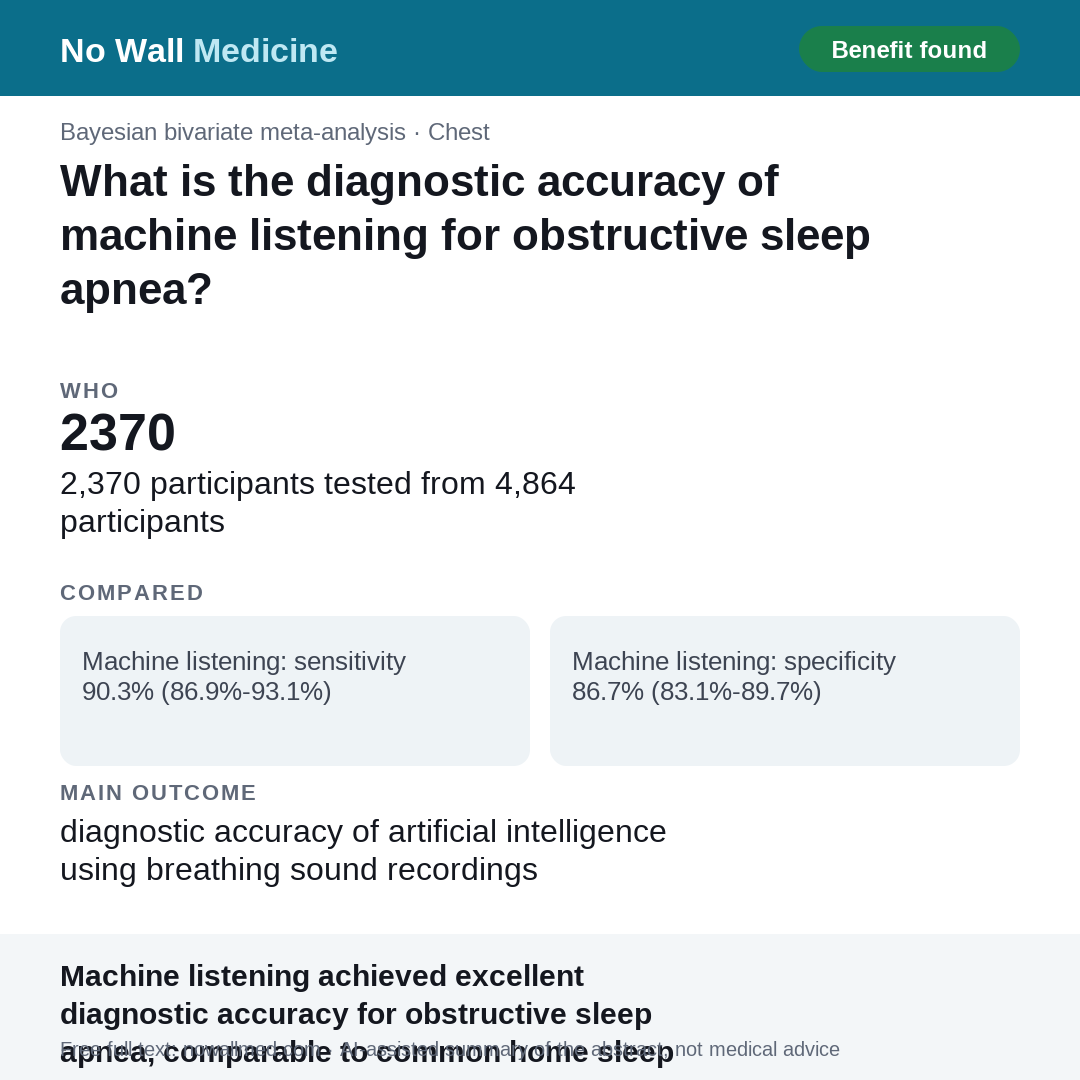
What is the diagnostic accuracy of machine listening for obstructive sleep apnea?
Who
2370
2,370 participants tested from 4,864 participants
Compared
Machine listening: sensitivity 90.3% (86.9%-93.1%)
Machine listening: specificity 86.7% (83.1%-89.7%)
Main outcome
diagnostic accuracy of artificial intelligence using breathing sound recordings
Result: diagnostic odds ratio 60.8 (39.4-99.9)
Bottom line: Machine listening achieved excellent diagnostic accuracy for obstructive sleep apnea, comparable to common home sleep tests.
Chest · 2025-04-11Download image
Clinical question: What is the diagnostic accuracy of machine listening for obstructive sleep apnea?
Why it matters: The overnight polysomnogram requires specialized equipment and skilled technicians, which acts as a barrier for the 90% of patients with obstructive sleep apnea who remain undiagnosed.
Key points
- Researchers analyzed 16 studies involving 4,864 trained and 2,370 tested participants to evaluate artificial intelligence using breathing sounds for obstructive sleep apnea diagnosis.
- The pooled sensitivity was 90.3% (95% credible interval 86.9%-93.1%) and the pooled specificity was 86.7% (83.1%-89.7%).
- Higher audio sampling frequencies and non-contact microphones were associated with increased sensitivity in the meta-regression analysis.
Headline and key points written with AI from the paper’s abstract, with every number checked against it. Read the paper before relying on them.
Was this summary helpful?
Subject terms
Cite this article
Tan BKJ, Gao EY, Tan NKW, Yeo BSY, Tan CJ, Ng ACW. Machine Listening for OSA Diagnosis: A Bayesian Meta-Analysis. Chest. 2025. doi:10.1016/j.chest.2025.04.006
Spotted a mistake? Suggest a correction
Top studies every Monday
The week’s key trials and guidelines in your specialties, plus any topics you follow. By email, free.
Get the weekly digest