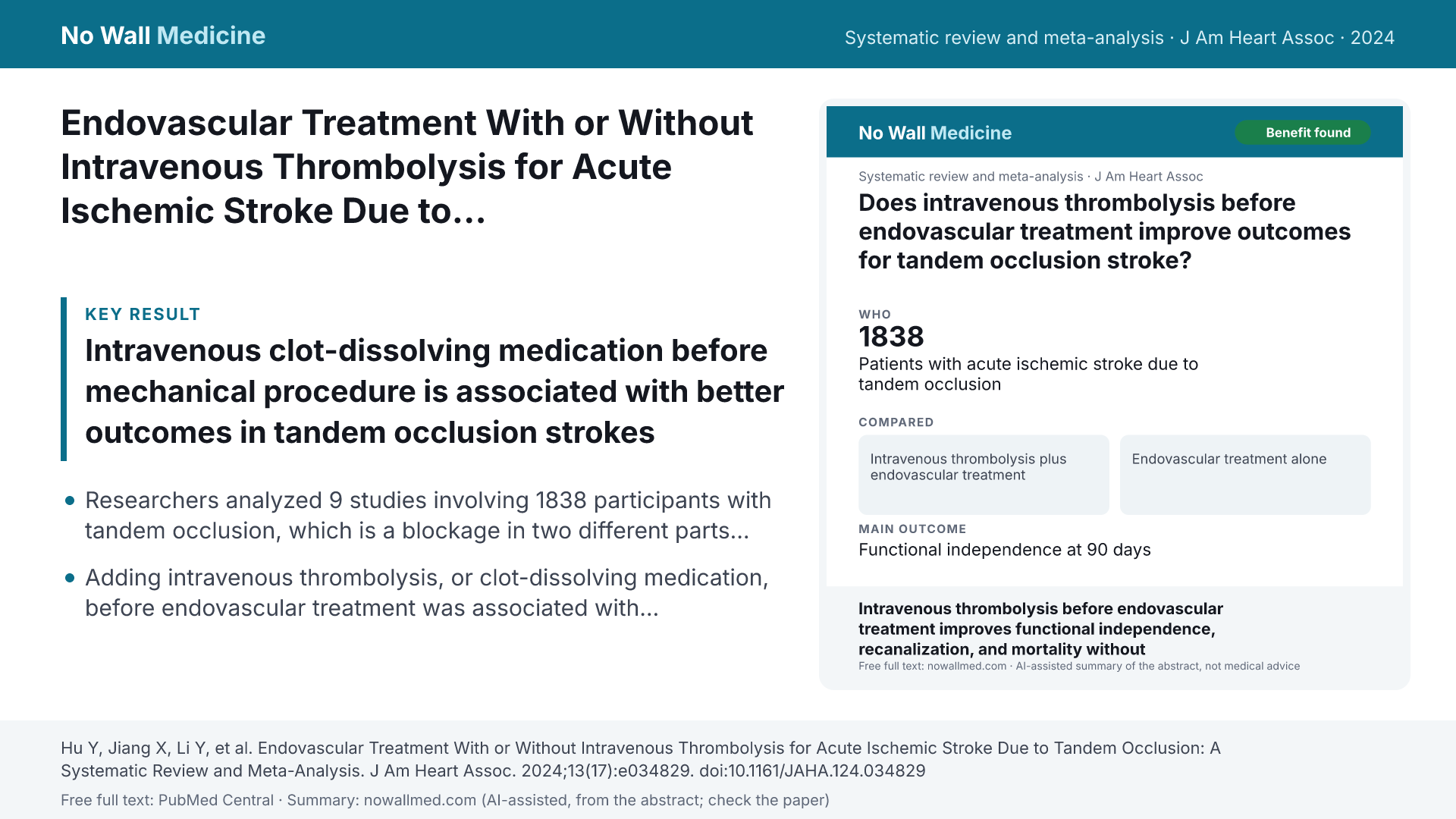
Intravenous clot-dissolving medication before mechanical procedure is associated with better outcomes in tandem occlusion strokes
Endovascular Treatment With or Without Intravenous Thrombolysis for Acute Ischemic Stroke Due to Tandem Occlusion: A Systematic Review and Meta-Analysis
Systematic review and meta-analysisBenefit found
Does intravenous thrombolysis before endovascular treatment improve outcomes for tandem occlusion stroke?
Who
1838
Patients with acute ischemic stroke due to tandem occlusion
Compared
Intravenous thrombolysis plus endovascular treatment
Endovascular treatment alone
Main outcome
Functional independence at 90 days
Result: odds ratio 1.39 (95% CI 1.14-1.69)
Bottom line: Intravenous thrombolysis before endovascular treatment improves functional independence, recanalization, and mortality without increasing symptomatic intracerebral hemorrhage.
J Am Heart Assoc · 2024-08-29 · Save PNG
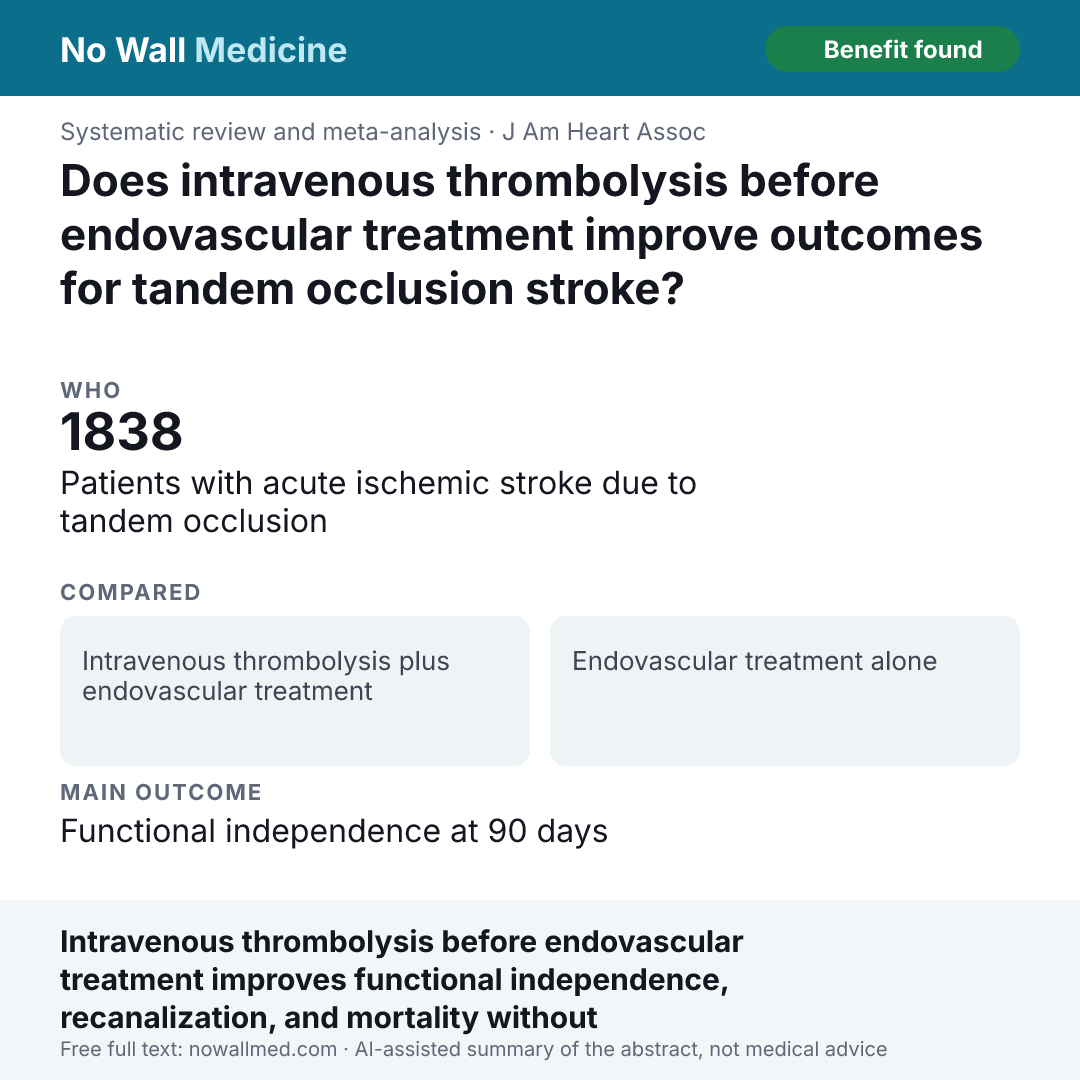
Clinical question: Does intravenous thrombolysis before endovascular treatment improve outcomes for tandem occlusion stroke?
Why it matters: The efficacy and safety of using intravenous clot-dissolving medication before mechanical endovascular treatment for patients with tandem occlusion remain debatable.
Key points
- Researchers analyzed 9 studies involving 1838 participants with tandem occlusion, which is a blockage in two different parts of the blood vessels in the brain.
- Adding intravenous thrombolysis, or clot-dissolving medication, before endovascular treatment was associated with higher functional independence at 90 days (OR, 1.39 [95% CI, 1.14-1.69]) and successful vessel reopening (OR, 1.45 [95% CI, 1.11-1.89]).
- The combination therapy was also associated with lower mortality (OR, 0.68 [95% CI, 0.50-0.93]) and no significant difference in symptomatic intracerebral hemorrhage (OR, 1.16 [95% CI, 0.79-1.70]).
Headline and key points written with AI from the paper’s abstract, with every number checked against it. Read the paper before relying on them.
Was this summary helpful?
Subject terms
Headline, design, result, key points, caveat and citation as plain text.
Cite this article
Hu Y, Jiang X, Li Y, et al. Endovascular Treatment With or Without Intravenous Thrombolysis for Acute Ischemic Stroke Due to Tandem Occlusion: A Systematic Review and Meta-Analysis. J Am Heart Assoc. 2024;13(17):e034829. doi:10.1161/JAHA.124.034829
Spotted a mistake? Suggest a correction