Brain stimulation improved manual rendezvous and docking skill acquisition in astronaut training
Enhancing astronaut training: effects of transcranial direct current stimulation on manual rendezvous and docking skill acquisition
Double-blind, randomized, placebo-controlled trialBenefit found
Does transcranial direct current stimulation enhance manual rendezvous and docking skill acquisition?
Who
26
26 participants
Compared
transcranial direct current stimulation group: 11% average performance improvement over sham group
sham group
Main outcome
manual rendezvous and docking skill acquisition and retention
Bottom line: Bilateral motor cortex transcranial direct current stimulation enhances manual rendezvous and docking skill acquisition and retention.
J Neuroeng Rehabil · 2025-10-27Download image
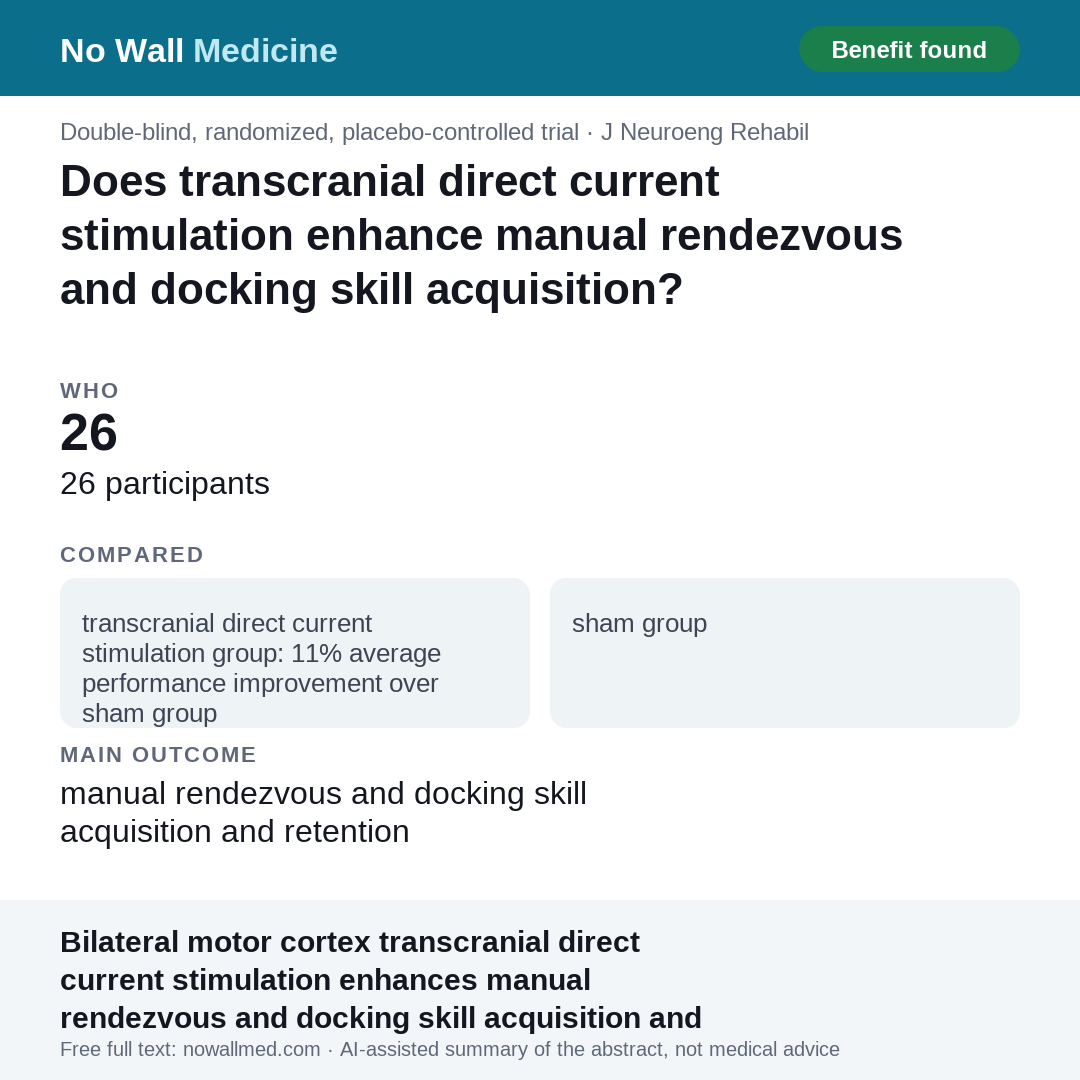
Clinical question: Does transcranial direct current stimulation enhance manual rendezvous and docking skill acquisition?
Why it matters: Spaceflight missions involve high complexity and operational risks, requiring astronauts to achieve exceptional proficiency through training.
Key points
- Researchers studied 26 participants divided into a transcranial direct current stimulation group of 14 and a sham group of 12 during manual rendezvous and docking training.
- The stimulation group showed an average performance improvement of 11% over the sham group and higher scores during retention tests three weeks after training.
- Brain activity analysis showed distinct theta band patterns in the right primary motor cortex region that correlated with enhanced skill learning.
Headline and key points written with AI from the paper’s abstract, with every number checked against it. Read the paper before relying on them.
Was this summary helpful?
Subject terms
Cite this article
Feng J, Huang W, Wang M, Shi Y, Jiao X, Wang Y. Enhancing astronaut training: effects of transcranial direct current stimulation on manual rendezvous and docking skill acquisition. J Neuroeng Rehabil. 2025. doi:10.1186/s12984-025-01737-2
Spotted a mistake? Suggest a correction
Top studies every Monday
The week’s key trials and guidelines in your specialties, plus any topics you follow. By email, free.
Get the weekly digest