Implantable cardioverter-defibrillators reduce sudden cardiovascular death regardless of baseline kidney function in heart failure patients
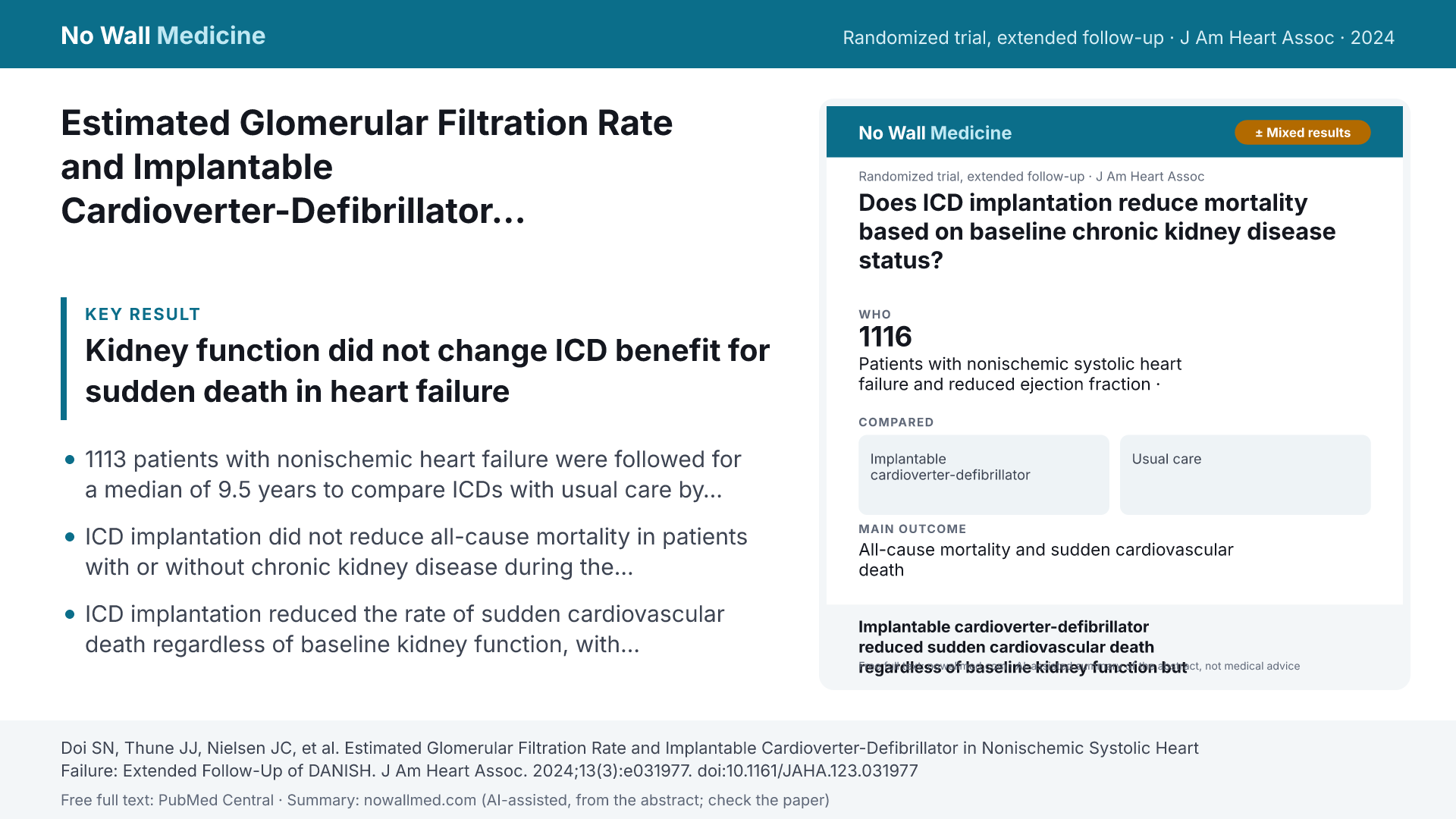
Estimated Glomerular Filtration Rate and Implantable Cardioverter-Defibrillator in Nonischemic Systolic Heart Failure: Extended Follow-Up of DANISH
Randomized trial, extended follow-upMixed results
Does ICD implantation reduce mortality based on baseline chronic kidney disease status?
Who
1116
Patients with nonischemic systolic heart failure and reduced ejection fraction · Denmark
Compared
Implantable cardioverter-defibrillator
Usual care
Main outcome
All-cause mortality and sudden cardiovascular death
Result: no CKD, HR 0.82 (95% CI 0.64-1.04); CKD, HR 1.02 (95% CI 0.75-1.38)
Bottom line: Implantable cardioverter-defibrillator reduced sudden cardiovascular death regardless of baseline kidney function but did not reduce all-cause mortality.
J Am Heart Assoc · 2024-01-31Download image
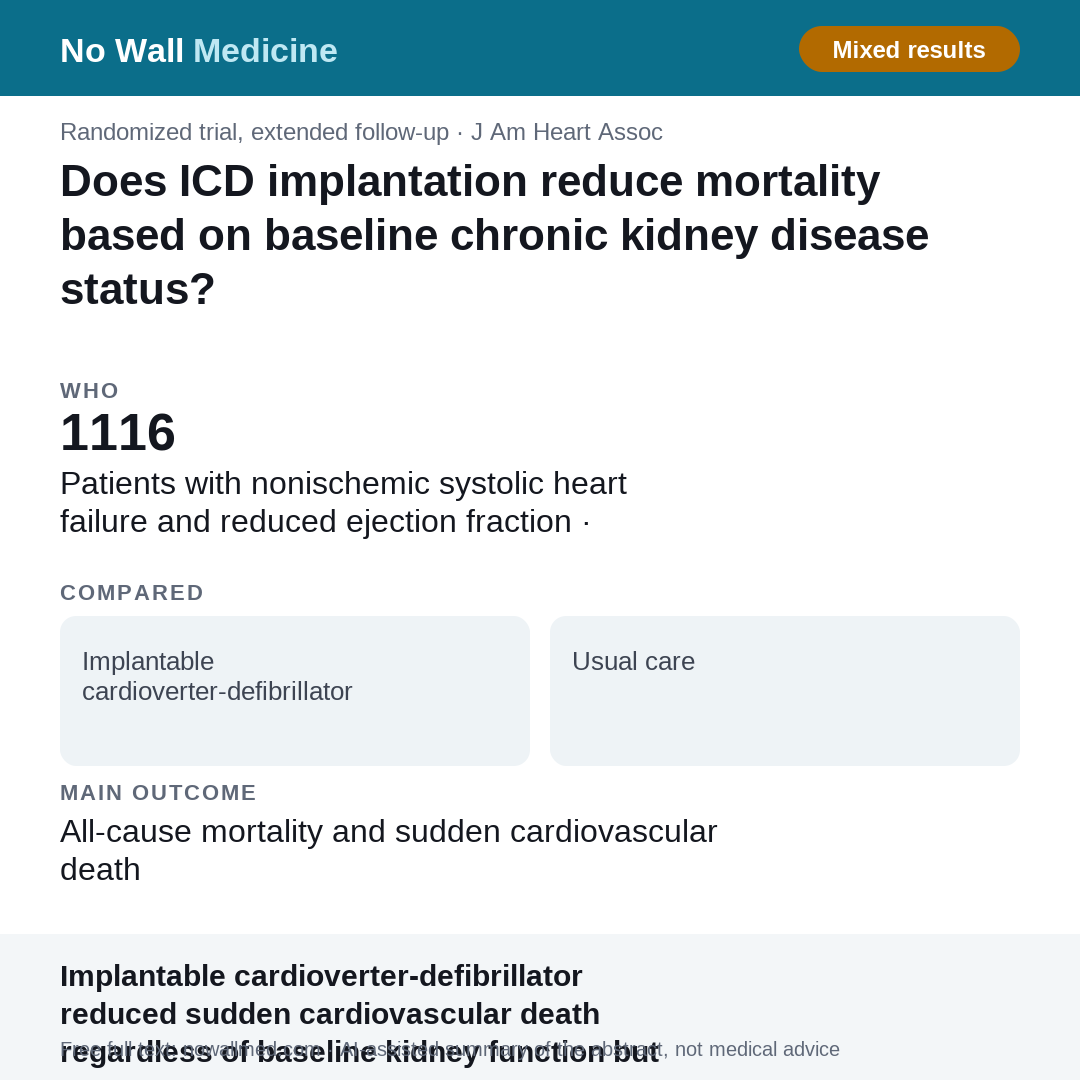
Clinical question: Does ICD implantation reduce mortality based on baseline chronic kidney disease status?
Why it matters: It was unknown if chronic kidney disease, which increases the risk of death from non-arrhythmic causes, affects the effectiveness of implantable cardioverter-defibrillators.
Key points
- Researchers followed 1116 patients with nonischemic heart failure and reduced ejection fraction, comparing implantable cardioverter-defibrillators to usual care over a median of 9.5 years.
- Implantable cardioverter-defibrillator implantation was associated with a lower rate of sudden cardiovascular death for patients with and without chronic kidney disease.
- The device did not reduce the rate of all-cause mortality or cardiovascular death, regardless of whether patients had chronic kidney disease.
Headline and key points written with AI from the paper’s abstract, with every number checked against it. Read the paper before relying on them.
Was this summary helpful?
Subject terms
Cite this article
Doi SN, Thune JJ, Nielsen JC, Haarbo J, Videbæk L, Yafasova A. Estimated Glomerular Filtration Rate and Implantable Cardioverter-Defibrillator in Nonischemic Systolic Heart Failure: Extended Follow-Up of DANISH. J Am Heart Assoc. 2024. doi:10.1161/JAHA.123.031977
Spotted a mistake? Suggest a correction