Risk modeling identifies specific patient subgroups that benefit from epidural steroid injections for spinal stenosis
Estimating individualized treatment effects using a risk-modeling approach: an application to epidural steroid injections for lumbar spinal stenosis
Risk-modeling approach applied to a randomized controlled trialBenefit found
Can risk-modeling identify subgroups with individualized treatment effects for epidural steroid injections?
Who
3259
Patients with lumbar spinal stenosis
Compared
Highest predicted risk quartiles: -3.7 and -3.3 Roland-Morris Disability Questionnaire points
Lowest predicted risk quartiles: no effect
Main outcome
Roland-Morris Disability Questionnaire scores at 3-week follow-up
Result: P = 0.03
Bottom line: Risk-modeling identified subgroups of patients with lumbar spinal stenosis who benefit clinically from epidural steroid injections.
Pain · 2022-08-26Download image
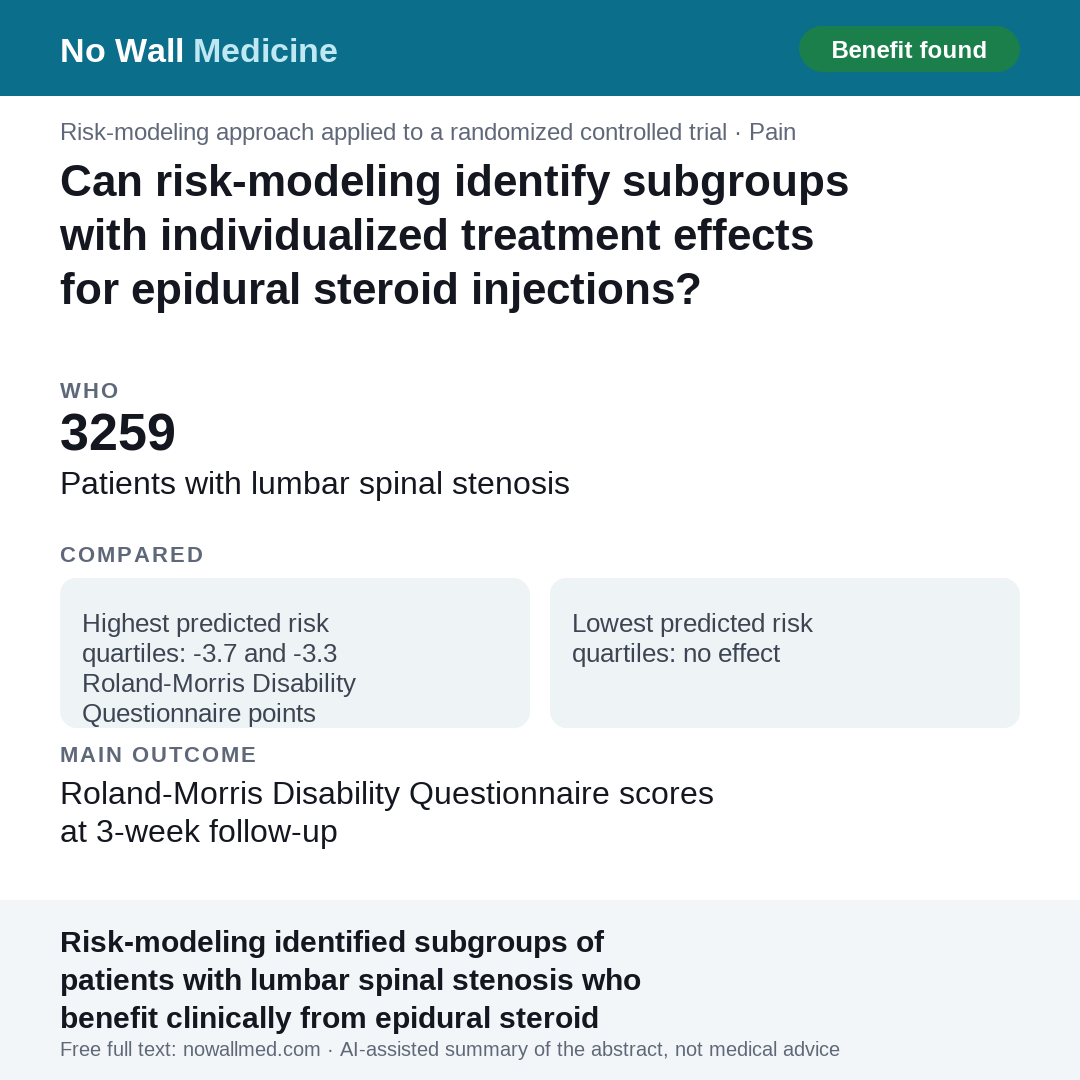
Clinical question: Can risk-modeling identify subgroups with individualized treatment effects for epidural steroid injections?
Why it matters: Conventional methods for identifying which patients benefit most from specific treatments are often underpowered and prone to false-positive results.
Key points
- Researchers used a risk-modeling approach on a cohort of 3259 patients to predict back-related functional limitations using the Roland-Morris Disability Questionnaire.
- The model showed statistically significant modification of the treatment effect (P = 0.03) based on predicted risk quartiles.
- Clinically relevant effects were seen in the two highest risk quartiles with point estimates of -3.7 and -3.3 Roland-Morris Disability Questionnaire points.
Headline and key points written with AI from the paper’s abstract, with every number checked against it. Read the paper before relying on them.
Was this summary helpful?
Subject terms
Cite this article
Liu P, Wu Y, Xiao Z, Gold LS, Heagerty PJ, Annaswamy T. Estimating individualized treatment effects using a risk-modeling approach: an application to epidural steroid injections for lumbar spinal stenosis. Pain. 2022. doi:10.1097/j.pain.0000000000002768
Spotted a mistake? Suggest a correction
Top studies every Monday
The week’s key trials and guidelines in your specialties, plus any topics you follow. By email, free.
Get the weekly digest