Minimal residual disease negativity was associated with better survival outcomes in multiple myeloma patients
Evaluating Minimal Residual Disease Negativity as a Surrogate Endpoint for Treatment Efficacy in Multiple Myeloma: A Meta-Analysis of Randomized Controlled Trials
Meta-analysis of randomized controlled trialsBenefit found
Is minimal residual disease negativity a surrogate endpoint for treatment efficacy in multiple myeloma?
Who
15304
Patients with multiple myeloma
Compared
Minimal residual disease negativity
Survival outcomes
Main outcome
Progression free survival and overall survival
Result: beta progression free survival = -0.20, p < 0.001, beta overall survival = -0.12, p = 0.023
Bottom line: Minimal residual disease negativity is a surrogate for survival in multiple myeloma.
Am J Hematol · 2025-01-09Download image
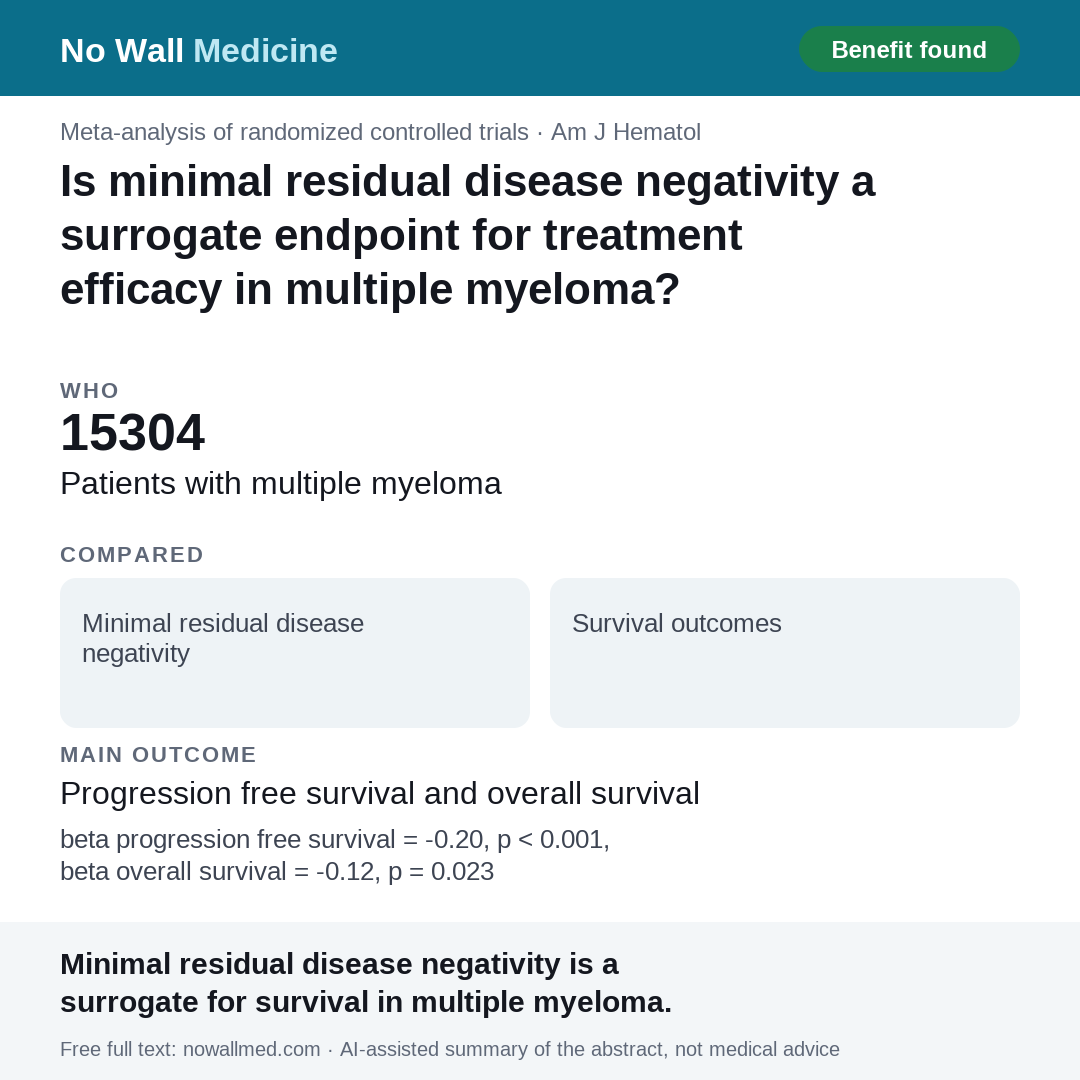
Clinical question: Is minimal residual disease negativity a surrogate endpoint for treatment efficacy in multiple myeloma?
Why it matters: It was unknown if minimal residual disease negativity could serve as a reliable substitute for measuring survival outcomes in multiple myeloma clinical trials.
Key points
- Researchers analyzed 15,304 patients with multiple myeloma from randomized controlled trials to examine the link between minimal residual disease negativity and survival.
- Minimal residual disease negativity, which means no detectable cancer cells remain, was associated with improved progression-free survival (β_PFS = -0.20, p < 0.001) and overall survival (β_OS = -0.12, p = 0.023).
- The association remained significant for newly diagnosed patients (β_PFS = -0.35, p < 0.001) but was not significant for relapsed or refractory patients (β_PFS = -0.06, p = 0.635).
Headline and key points written with AI from the paper’s abstract, with every number checked against it. Read the paper before relying on them.
Topics
Cite this article
Ntanasis-Stathopoulos I, Filippatos C, Ntanasis-Stathopoulos A, Malandrakis P, Kastritis E, Tsitsilonis OE. Evaluating Minimal Residual Disease Negativity as a Surrogate Endpoint for Treatment Efficacy in Multiple Myeloma: A Meta-Analysis of Randomized Controlled Trials. Am J Hematol. 2025. doi:10.1002/ajh.27582
Spotted a mistake? Suggest a correction
Top studies every Monday
The week’s key trials and guidelines in your specialties, by email. Free.
Get the weekly digest