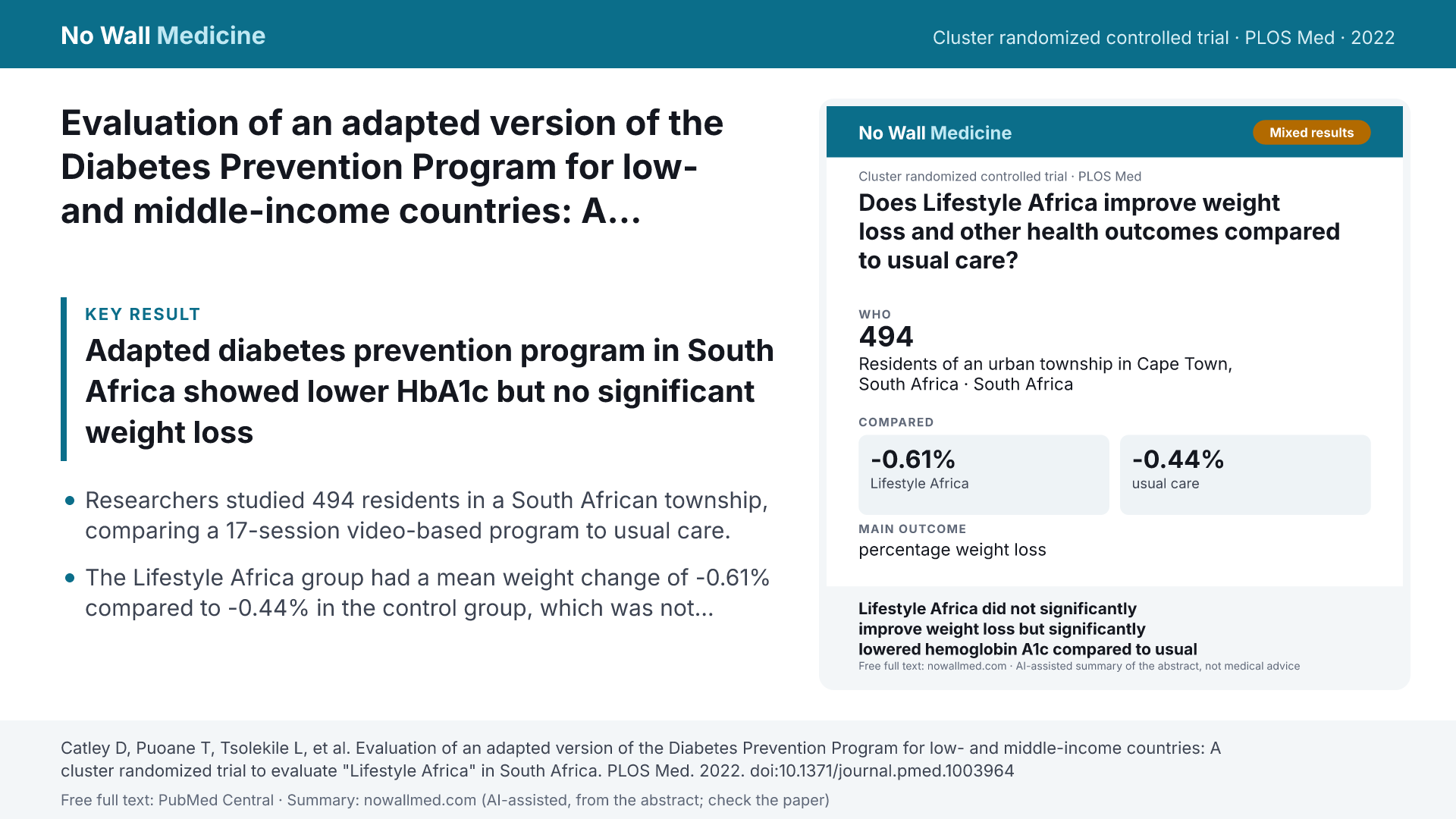
Adapted diabetes prevention program in South Africa showed lower HbA1c but no significant weight loss
Evaluation of an adapted version of the Diabetes Prevention Program for low- and middle-income countries: A cluster randomized trial to evaluate "Lifestyle Africa" in South Africa
Cluster randomized controlled trialMixed results
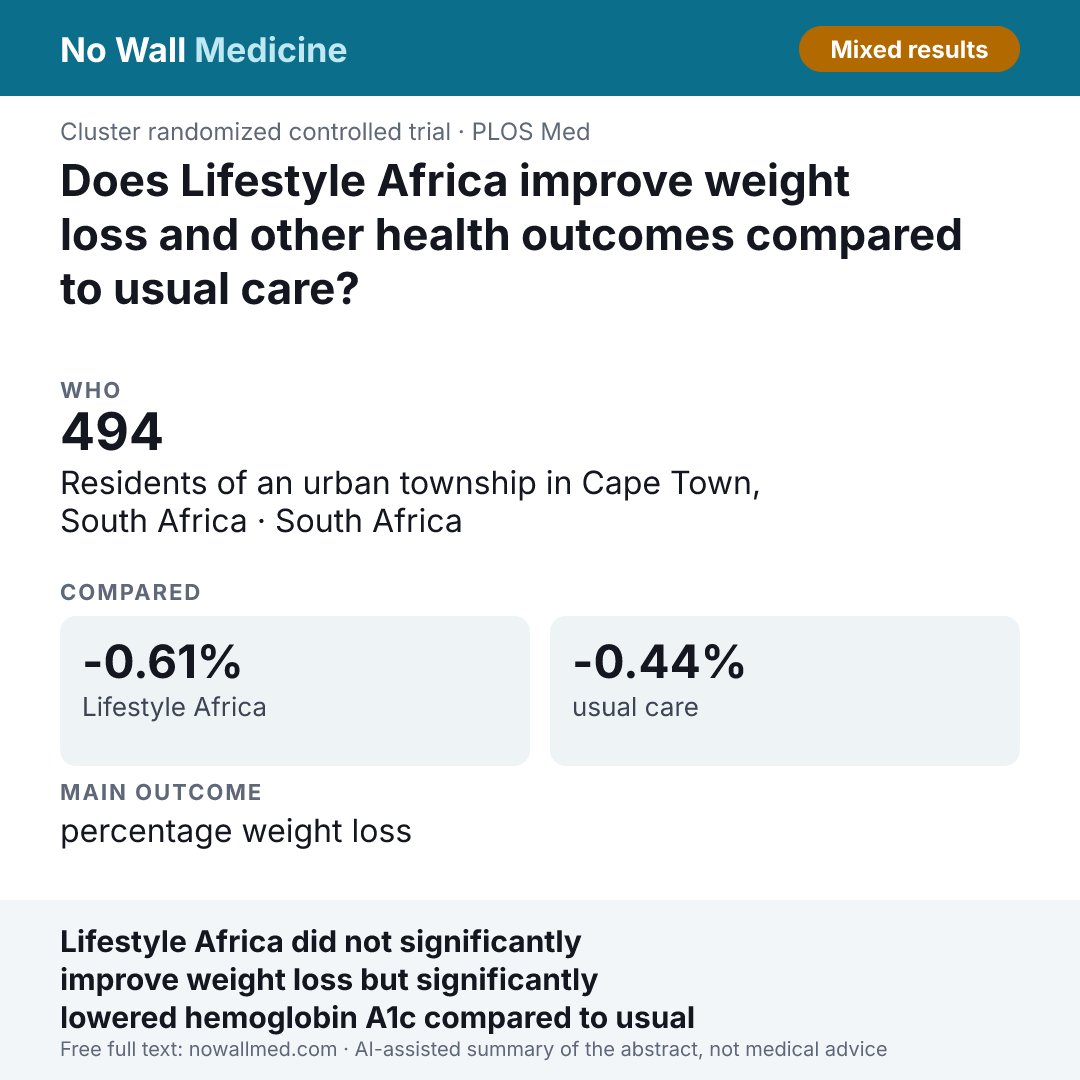
Does Lifestyle Africa improve weight loss and other health outcomes compared to usual care?
Who
494
Residents of an urban township in Cape Town, South Africa · South Africa
Compared
-0.61%Lifestyle Africa (95% CI = -1.22, -0.01)
-0.44%usual care (95% CI = -1.06, 0.18)
Main outcome
percentage weight loss
Result: group difference = -0.17%; 95% CI = -1.04, 0.71
Bottom line: Lifestyle Africa did not significantly improve weight loss but significantly lowered hemoglobin A1c compared to usual care.
Limitation: lack of a rigorous dietary intake measure and high representation of older women
PLOS Med · 2022-04-15 · Save PNG
Clinical question: Does Lifestyle Africa improve weight loss and other health outcomes compared to usual care?
Why it matters: Lifestyle interventions developed in high-income countries may require cultural tailoring and adaptation for use in low- and middle-income countries.
Key points
- Researchers studied 494 residents in a South African township, comparing a 17-session video-based program to usual care.
- The Lifestyle Africa group had a mean weight change of -0.61% compared to -0.44% in the control group, which was not a significant difference.
- Hemoglobin A1c, a measure of long-term blood sugar, was significantly lower in the Lifestyle Africa group compared to usual care.
Limitation the authors note: The study lacked a rigorous dietary intake measure and had a high representation of older women.
Headline and key points written with AI from the paper’s abstract, with every number checked against it. Read the paper before relying on them.
Was this summary helpful?
Subject terms
Headline, design, result, key points, caveat and citation as plain text.
Cite this article
Catley D, Puoane T, Tsolekile L, et al. Evaluation of an adapted version of the Diabetes Prevention Program for low- and middle-income countries: A cluster randomized trial to evaluate "Lifestyle Africa" in South Africa. PLOS Med. 2022. doi:10.1371/journal.pmed.1003964
Spotted a mistake? Suggest a correction