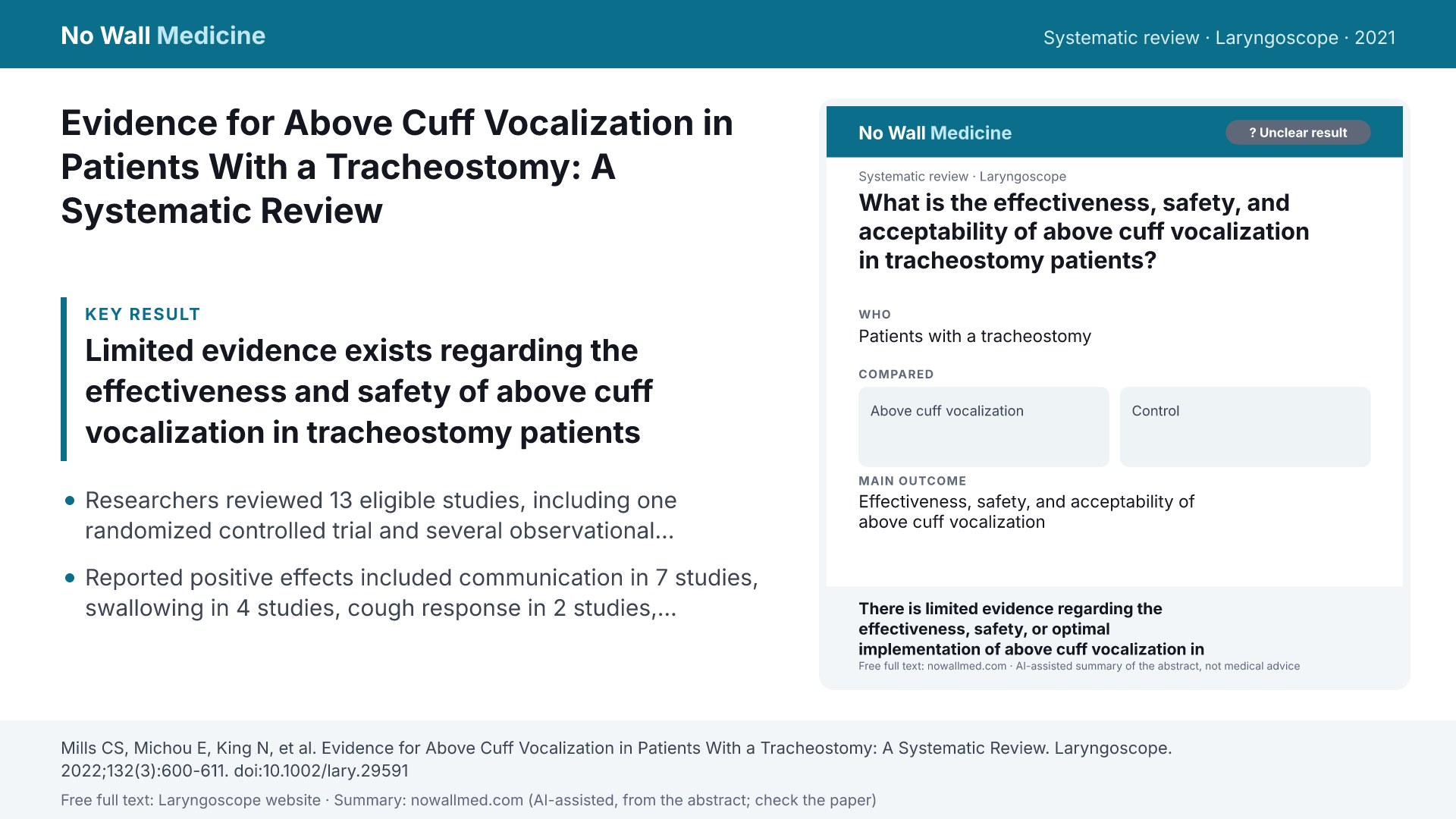
Limited evidence exists regarding the effectiveness and safety of above cuff vocalization in tracheostomy patients
Evidence for Above Cuff Vocalization in Patients With a Tracheostomy: A Systematic Review
Systematic reviewUnclear result
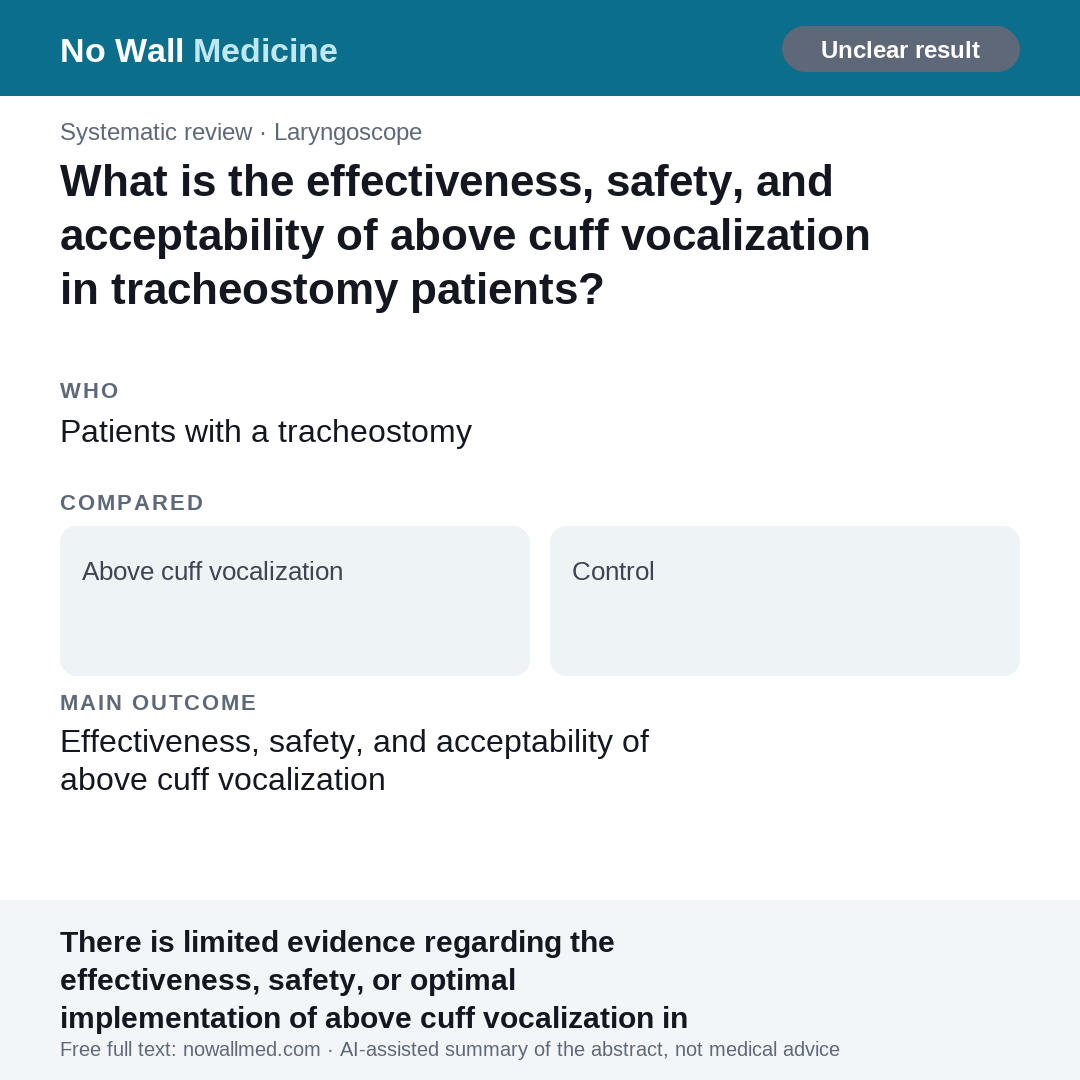
What is the effectiveness, safety, and acceptability of above cuff vocalization in tracheostomy patients?
Who
Patients with a tracheostomy
Compared
Above cuff vocalization
Control
Main outcome
Effectiveness, safety, and acceptability of above cuff vocalization
Bottom line: There is limited evidence regarding the effectiveness, safety, or optimal implementation of above cuff vocalization in tracheostomy patients.
Limitation: Low study quality, high risk of bias, and high heterogeneity in study design and outcome measures.
Laryngoscope · 2021-05-01Download image
Clinical question: What is the effectiveness, safety, and acceptability of above cuff vocalization in tracheostomy patients?
Why it matters: The effectiveness, safety, acceptability, and optimal implementation of above cuff vocalization in patients with a tracheostomy are currently unknown.
Key points
- Researchers reviewed 13 eligible studies, including one randomized controlled trial and several observational studies, to evaluate above cuff vocalization, which is speaking while a breathing tube cuff is deflated.
- Reported positive effects included communication in 7 studies, swallowing in 4 studies, cough response in 2 studies, and quality-of-life in 2 studies, though objective measures were used inconsistently.
- Nine studies reported adverse events or complications, and four studies noted the importance of involving an experienced speech and language therapist.
Limitation the authors note: The study quality was low, most studies had a high risk of bias, and there was a high level of heterogeneity in study design and outcome measures.
Headline and key points written with AI from the paper’s abstract, with every number checked against it. Read the paper before relying on them.
Was this summary helpful?
Subject terms
Headline, design, result, key points, caveat and citation as plain text.
Cite this article
Mills CS, Michou E, King N, et al. Evidence for Above Cuff Vocalization in Patients With a Tracheostomy: A Systematic Review. Laryngoscope. 2021. doi:10.1002/lary.29591
Spotted a mistake? Suggest a correction