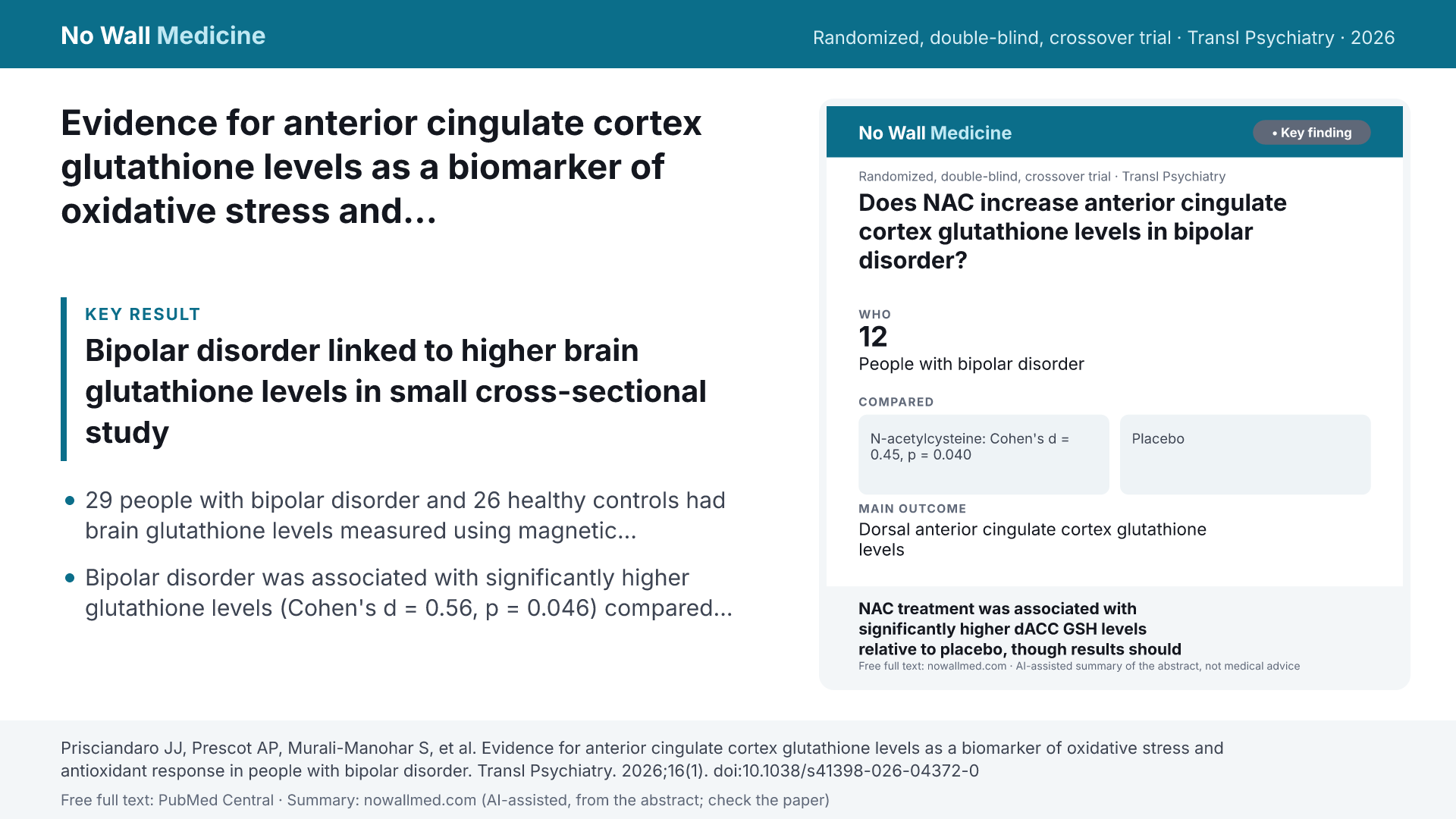
Bipolar disorder linked to higher brain glutathione levels in small cross-sectional study
Evidence for anterior cingulate cortex glutathione levels as a biomarker of oxidative stress and antioxidant response in people with bipolar disorder
Randomized, double-blind, crossover trialKey finding
Does NAC increase anterior cingulate cortex glutathione levels in bipolar disorder?
Who
12
People with bipolar disorder
Compared
N-acetylcysteine: Cohen's d = 0.45, p = 0.040
Placebo
Main outcome
Dorsal anterior cingulate cortex glutathione levels
Result: Cohen's d = 0.45, p = 0.040
Bottom line: NAC treatment was associated with significantly higher dACC GSH levels relative to placebo, though results should be interpreted with caution.
Limitation: Small sample sizes
Transl Psychiatry · 2026-09-03 · Save PNG
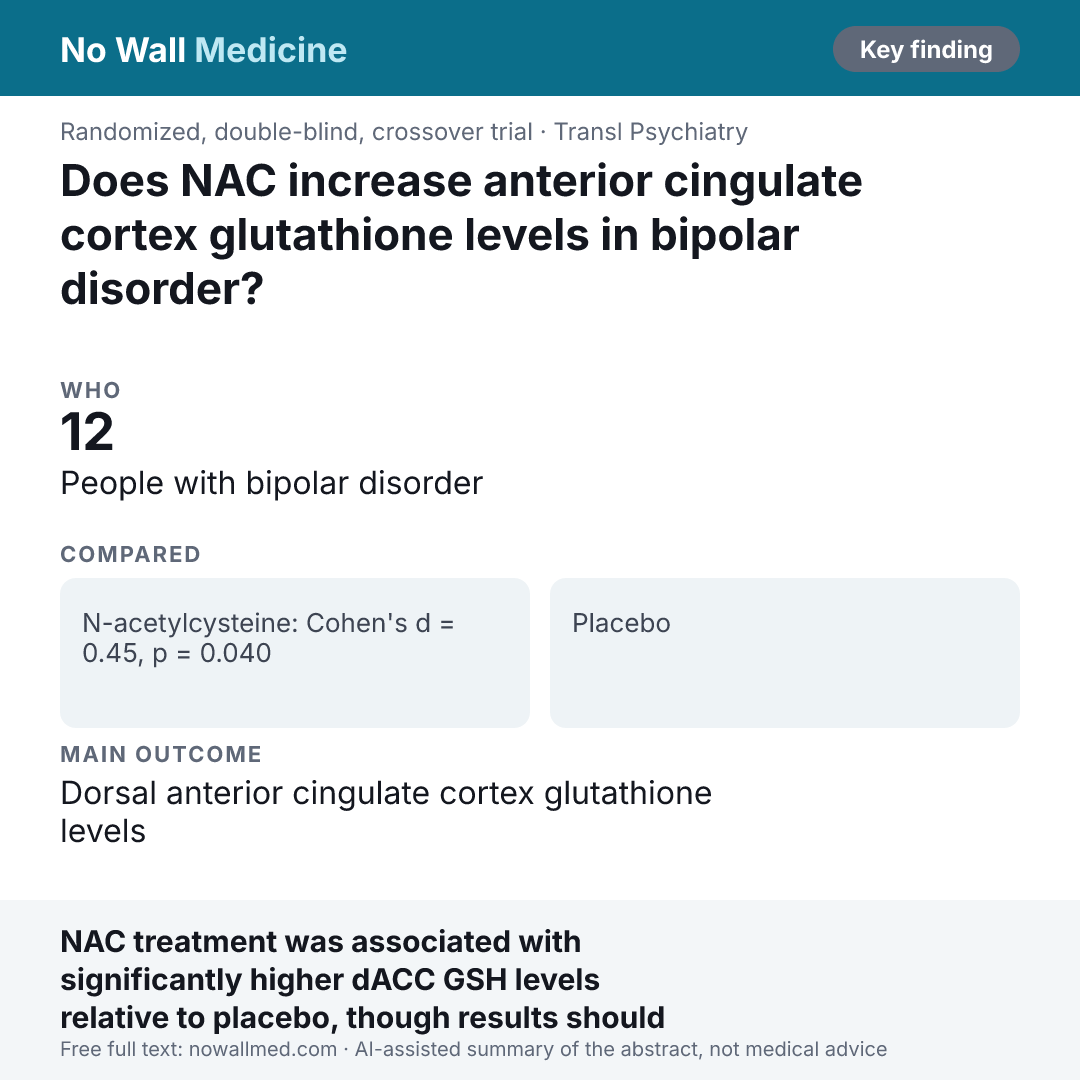
Clinical question: Does NAC increase anterior cingulate cortex glutathione levels in bipolar disorder?
Why it matters: Applies to people with bipolar disorder; suggests anterior cingulate cortex glutathione may be a biomarker for oxidative stress and antioxidant response.
Key points
- 29 people with bipolar disorder and 26 healthy controls had brain glutathione levels measured using magnetic resonance spectroscopy.
- Bipolar disorder was associated with significantly higher glutathione levels (Cohen's d = 0.56, p = 0.046) compared to healthy controls.
- In a pilot trial of 12 people, NAC treatment was associated with higher glutathione levels than placebo (Cohen's d = 0.45, p = 0.040).
Limitation the authors note: The authors state the results should be interpreted with caution given the small sample sizes.
Headline and key points written with AI from the paper’s abstract, with every number checked against it. Read the paper before relying on them.
Was this summary helpful?
Subject terms
Headline, design, result, key points, caveat and citation as plain text.
Cite this article
Prisciandaro JJ, Prescot AP, Murali-Manohar S, et al. Evidence for anterior cingulate cortex glutathione levels as a biomarker of oxidative stress and antioxidant response in people with bipolar disorder. Transl Psychiatry. 2026;16(1). doi:10.1038/s41398-026-04372-0
Spotted a mistake? Suggest a correction